Beyond Succession: Building Family Businesses That Endure with Lisë Stewart
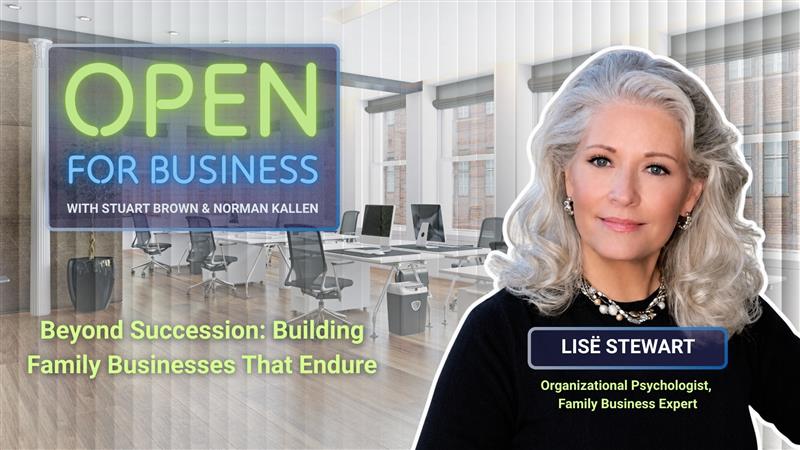
In this episode of Open For Business, hosts Stuart Brown and Norman Kallen talk with organizational psychologist, entrepreneur and family business advisor Lisë Stewart about why succession planning involves far more than choosing the next leader. Drawing on nearly four decades of experience, Lisë explores how communication, governance, leadership development and family dynamics can shape the long-term success of a family business.
Through real-world case studies, she discusses how business owners can prepare the next generation, navigate difficult family conversations and determine the right path forward, whether that means family leadership, professional management, an ESOP or a sale. The conversation offers practical guidance for owners looking to protect both the business and family relationships across generations.
[Stuart] (0:05 - 0:16)
Welcome back to the Open for Business podcast. I'm Stuart Brown, and as always, I'm joined by my co-host Norman Callan. Norm, how you doing?
I'm good, Stuart. How are you today? I'm doing well.
Doing well.
[Norman] (0:17 - 0:44)
Well, what's going on? Today, Stuart, one of the biggest issues facing our clients, particularly family-owned businesses, is how to transition a company successfully from one generation to the next, and how to deal with the family different variations and personalities. Succession is a leadership issue, but it's also a governance issue and a human issue.
It's a really difficult situation, and it's difficult to have conversations, and the person today is going to address those issues. And how do you deal with them?
[Stuart] (0:44 - 1:28)
You're absolutely right. I'm sure that everybody listening today who is in a family business is constantly thinking about, okay, what's next? And our guest today, who's named Lisa Stewart, and we're very excited to have Lisa, is truly an expert.
She's a professional facilitator, a coach, and a consultant with significant experience in organizational psychology, strategic planning, training, human performance management. You name it. She's done it.
And Lisa has had a very successful career over a long period of time, and we're very happy that she's back because she was sailing in the Caribbean for a long period of time. But apparently she's back on land. Lisa, we're delighted to have you with us.
[Lisë] (1:28 - 1:44)
Thank you. I am so happy to be here, and I actually have to say I'm really happy to be back on land. I've got my land legs back, and I'm really in wing all the variety of work, a variety of work that you can't actually do from about surprise, surprise, surprise.
So thank you for having me.
[Norman] (1:44 - 1:53)
Lisa, why don't you give us a quick background on what you do, what you've done. And by the way, coming back to the United States, tell us a little about your trip and why and how and what happened.
[Lisë] (1:54 - 4:26)
So going out on the boat was sort of the big adventure where I was going to wind down and stop doing so much work. But I love it. And it's really hard to walk away.
So I managed to keep my work alive and going sort of at a slow pace while I was sailing about in the Caribbean. I think a lot of people don't realize that there are thousands of islands in the Caribbean. I think it's something like 7,000 islands.
And we only hit 200 of them. Someday we got to go back and hit the rest of them. But what I found was I really did enjoy keeping my hand and feet, I guess, in the work world and continuing to sit on family business boards and trying to help as I could from far away.
So it's really nice to come back and actually see people in person. I'm so used to spending time with clients and various people talking via video. And really, the face-to-face world has become so important in this work.
I am excited. In terms of background, I'm an organizational psychologist by training. I've always been interested in psychology.
I actually got started in a sort of a funny way. I started out in customer service training. I lived in New Zealand for almost 18 years.
And while I was in New Zealand, the New Zealand tourism board was trying to introduce a customer service training program to all these different businesses that serve tourists. Because some big, I think it was connast or somebody, rated New Zealand in the early 1980s as having the worst customer service of any tourist destination in the world. And they were trying to change the reputation as a country.
And I was hired to do a lot of this customer service training. But you know what is interesting? Most of the companies that needed this training and asked me to come and do it were small mom and pop family-owned businesses.
And what I discovered is the route to their customer service training came from a lack of organizational culture, which in many cases came from a lack of communication within the business itself. And I discovered the problems really weren't so much about training people about customer service. It was about helping those businesses to figure out who they wanted to be, what kind of a reputation they wanted to build, and how do they put systems and processes in place in order to be able to get there.
And in family businesses, it was so unique. It just spoke to me. I really enjoyed it.
And I've focused on that now for, I hate to say it's been almost 40 years in doing this work.
[Stuart] (4:26 - 4:55)
Wow. That's terrific. You had mentioned a moment ago, and I find this really interesting, and I believe a lot of people will as well, that it's difficult to do effectively remotely.
You believe the interpersonal connection is necessary in order to deliver the best product. So are you more inclined when you're working with your clients to have face-to-face in-person meetings as opposed to what we all do today over Zoom or Teams or what have you?
[Lisë] (4:56 - 6:01)
Actually, I do a combination of both because I want the face-to-face for the interpersonal contact that I get, but I also want to make sure that the services that I and my team offer that they're really cost effective as well. And travel these days is very expensive. So what we really try to do is to make sure that in those initial meetings as we get to know each other and to build trust that those are face-to-face, that we're right there and in the room.
In any circumstances where perhaps there's a lot of conflict, maybe that's the key reason that we're there and trying to help the family. And in that case, again, being there in the room to be able to sort of read what's happening, to pick up on those meta messages and so on. It's so much easier when you can look people right in the eye.
For the rest of the work, if we're working on, say, some strategy or a family charter or other things where we're producing some documents together, some of that can be done quite successfully, virtually. Again, it is always that balance between being cost effective and having that personal connection with people.
[Norman] (6:02 - 6:24)
You know, we noticed too, you know, Stuart and I are both M&A lawyers. And we always got together, the prospective buyer always walked the premises, got to feel for it. And that went away after COVID for the most part.
But you learn a lot on an in-person meeting. Body language to me, as I find it, in the discussion, negotiations. And I'm certain a family setting is really essential to see.
There's a lot you can pick up from that.
[Stuart] (6:25 - 6:36)
We'll agree with you all hardly. One other thing you said, and I'm just shocked to hear this, quite frankly, that you find dysfunctional families. I thought all family businesses worked very well.
I don't understand that at all. We never encounter that.
[Lisë] (6:36 - 6:37)
Just like all families.
[Stuart] (6:38 - 6:39)
Yes, that's exactly right.
[Lisë] (6:39 - 7:32)
The question is, have you ever met a truly functional family? That's the trick. It's really significant.
Families are complex. I think that to be able to work successfully, you have to really be comfortable with and truly celebrate that complexity. All those different personalities of styles, those dreams, the visions, the differences in their perspectives.
Some people are comfortable with risk. Some people are not comfortable with risk. Some people have a philosophy of money that moves one way.
Some people have a philosophy of money that moves a completely different direction. I think that really effective consultants in this arena are comfortable with ambiguity. They're comfortable with conflict, and they're comfortable with the complexity that they're met with all the time.
So you're right. It's dysfunctional. It's really the norm.
[Norman] (7:32 - 7:33)
One size doesn't fit all.
[Lisë] (7:34 - 7:35)
That's right. Absolutely.
[Stuart] (7:36 - 7:53)
So when you are engaged by a client and you have that initial meeting, I'm curious, how do you get people to open up and really explain what the issues are? Because I would imagine that most people are relatively close to the vest when it comes to these types of issues.
[Lisë] (7:53 - 9:07)
They are. In fact, a term that I really like to use, I train a lot of advisors these days. The term that I share is authentic curiosity.
That I walk into any room in any situation, not to sell a service, not to figure it out, not to try to fix anybody, but true with just real curiosity. What's going on for you? How does it feel?
What's it look like? I think with compassion and empathy. I'm in there to pay attention to what's really happening for people.
And once you do that and you can reflect back to people what you see when you think is happening, I think that people are so appreciative that you took the time to listen and you weren't just there to one, prove how good you are, two, prove how smart you are, three, demonstrate how dumb they are, and four, that you've got to actually fix them when maybe they don't feel like they need fixing, they just need support. So I think that this whole concept of being authentically curious, being kind, compassionate, and asking really powerful questions helps to build trust very quickly.
[Norman] (9:08 - 9:27)
When you meet with family members of a business in the family psychology setting, it's often we meet as a group collectively, and then we meet individuals because sometimes and maybe oftentimes people are at least initially uncomfortable being open with their ideas or feelings in front of other people. Is that the same process you generally follow as well?
[Lisë] (9:28 - 11:21)
Yes, absolutely. Do exactly the same thing. Meeting together in the larger group gives me an opportunity to read the room, see how people are reacting, as you said earlier, try to read that body language, who's holding back, who's leaning into the opportunity, who's sharing a lot, who's not saying very much.
So it gives me a really good idea of sort of the larger family or the larger organizational dynamics, which are very important. And then when I meet individually, it gives me a chance to ask questions that are more pointed that are potentially emotionally charged, although I'm very careful. In psychology, we sometimes talk about the difference between shallow entry and deep entry into a conversation.
So shallow entry means that we start out very gently. We don't go right into, so tell me, what's keeping you up at night or doesn't look like your son is really the right person to take over the business. What do you think about that?
We're more likely to ask questions such as, tell me, you've built a really successful business here. What are you most proud of? What was the most exciting thing for you over the last 10 years that you or your business or your family did?
Those kinds of things to help people to get in touch with all of the positive and wonderful things that they've done. Then we might explore, again, gently, this is still on that shallow end of questioning of those things that you're really proud of. What do you want to carry forward into the future?
And what might be some of the barriers that exist today that would make it more difficult to be able to do that? And when we start asking those questions and they're starting to divulge more information, that gives us permission to go a little bit deeper. So we never start out at that really deep, invasive questions that would be unkind and it really wouldn't get us to where we want to go.
People tend to shut down. So we work at the shallow end of the pool first.
[Norman] (11:21 - 11:35)
So you started a business, a very successful business. You were a real entrepreneur. How did doing that or did it impact on how you looked at your potential clients?
Was that important for you because you have some experience in doing that? Did it matter?
[Lisë] (11:36 - 13:48)
So I should clarify, I've started nine businesses. I have a long history of starting businesses, building them up. Some of them I closed down because it was fail fast, fail cheap.
This isn't going to work. Others were more of a stop gap measure. And then I built a couple that were very successful.
So one galleared group was the largest provider of family business services in the United States for a very long time. And I finally sold that business in 2017. We were a national firm and I sold it to a multinational company, which was delightful.
It has really informed what I've done. What I know is that failure is not failure. Closing something down or deciding it doesn't work or stepping back, as I said, failing fast, failing cheap, moving away from an idea.
It's a learning experience. And I really celebrate those business owners and those entrepreneurs that have a long list of learning experiences on their resume. Good on you.
And it takes a while to get to the point where you really do know and understand, one, what you're good at, two, how you can apply that knowledge and experience, and three, the kinds of people you need to surround yourself with in order to be successful, whether those people happen to be employees, team members, partners, other key stakeholders, mentors, or even investors. Who's it going to take to be able to help you to grow your business? So I think what it did is it expanded my ideas about what does it really mean to be a business person?
And because my ideas were expansive, and I had more patience and understanding and empathy for business owners, I think it just made me a better consultant. And I can also talk about what does it take to build up a business so that you can successfully sell it? How do you make sure a business is not just reliant on you as the founder, the leader, the owner?
And instead, you can actually sell something that is marketable, a turnkey business that somebody else can take over and actually make money from. Not everybody's good at doing that. Not everybody knows how.
And because I've been through that experience now several times, I believe it's helpful in guiding our clients.
[Stuart] (13:48 - 13:59)
That's interesting. So at what point would you say in the life cycle of a business, it makes most sense to speak to a professional like you?
[Lisë] (13:59 - 15:16)
I think that a professional like me can be useful at different stages in the business. So for example, I do work with a lot of startups. Sometimes in those startup relationships, I always talk about starting with the end in mind, which of course is that student company.
And people are often surprised when I say, let's talk about your excess strategy. Well, wait a minute, we just started the business yesterday. Why do we need an extra strategy?
I talk about how planning for the future and being really clear, especially if you've got multiple partners in the business as to what people are hoping to do. Some people want to build up the business to pass it on to the next generation of their family members. Some people want to build up an entity that they can sell quickly.
Some people want a lifestyle business for the rest of their working life. Getting that clarity right up front, planning what this is going to be, it doesn't mean you necessarily have to execute on that specific plan. You can be flexible and change that plan over time.
But managing expectations is incredibly important because I believe it's the number one reason that so many, both family owned and closely held businesses fail. It's not because of outside factors or that they don't have a good product or a good service. It's because they didn't do a good job at managing expectations.
[Stuart] (15:16 - 15:19)
And is that a function of communication, I so?
[Lisë] (15:19 - 16:24)
Yeah, absolutely. It is. It's interesting.
When I first started consulting, I started a practice where I would always ask my clients at the end of each milestone or the end of project one before we start project two. Tell me, what is the value that I added to this process? What value did I bring?
And I used to think that they would say things like, oh, boy, use facilitated great strategic planning process or your family charter is just awesome and on and on. That would be my technical skills. But over the years, the same message just kept coming up time and time again.
And what they said was, you allowed us and helped us to open up a conversation that we would normally never have. You helped us to say things that were in our heart and our minds, that worried us, that were a cause of fear, concern about the future, that we've never been able to put into words. And because you were there and you helped us, we were able to say those things.
And that's what saved our business.
[Norman] (16:25 - 16:27)
Is it a great testament? Yeah, good for you. Yeah, very nice.
[Lisë] (16:28 - 16:43)
It is communication. It's trust. It's communication.
It's the ability to set and manage expectations, understand how people think, how they learn, how they work, and to be able to create an environment where people can really succeed.
[Stuart] (16:44 - 17:07)
But just the curiosity before we get into the case studies, which I really want to do, I'm curious, I've encountered this myself as I've traveled through my career. Are most of the issues in these families that you counsel related to the business per se, or are they related to, let's say, family matters that really transcend the business?
[Lisë] (17:08 - 18:45)
Generally, I would say that it is family issues amongst the family members that cloud their ability to pay attention to what's important in the business. One kicks off the other. They may not keep their eye on the ball because they're concerned about how to keep family members happy.
Hiring family members is a really good example of this, Stuart. A father, a mother who's running a business, they love their children, and the opportunity to create a job for their children, it just feels great. So they want to be able to do that.
So they bring junior or junior ed into the business and all have created a job, and they're ever so hopeful that it's going to work out. But they haven't done the work behind it. They don't really know what's expected in the role.
They don't know what kind of talent knowledge skills are going to be necessary to be successful. And so junior or junior ed is not effective in the role. And so the parents spend so much time trying to cover up for that ineffectiveness or try to make it better or keep other people in the company happy, even though they're frustrated by the nepotism that's occurring, that they stop paying attention to some of the things that are really important.
What's happening within the family is key to the success of the business as well. Now, can business pressure put more pressure on the family? Yes, indeed, it can, but a really healthy, well-functioning family that has determined ways in which they're going to solve problems, make decisions, move through conflicts, et cetera, and they can weather the storm of difficulties within the business so much better.
The families that have never done that work.
[Norman] (18:46 - 19:56)
So Lisa, we recently interviewed Bill Wilson. Bill Wilson owns in Temecula, California, Wilson, Greek Winery. He bought the business.
He has brought his family members into the business. And what was really interesting, to your point, he has brought in consultants, family consultants. He talked with us about that to evaluate his family members and their ability to function and carry out the tasks which he needs them to carry out.
It's fabulous. This is a good timing of what you're saying because he was a great believer. And unfortunately, we often meet business owners who either don't want to do it or worried about how people might feel.
He was a guy who said, right up front, I knew I wasn't capable of communicating correctly with my family members. I needed someone to do it for me and do the evaluation and make the hard call. And he brought someone like you or several people like you in to do that.
It's right on point to what we've been talking about with these family businesses. A quick question for you before we jump into these case studies, the sense of entitlement. And we see that all the time in family business, how impactful is that in either a successful business or more importantly, in the destruction of the business?
[Lisë] (19:56 - 22:44)
That sense of entitlement really needs to be unpacked because you have to look at what is behind the sense of entitlement. So let me give you an example. Sometimes we talk about shadow children and rock star parents.
So you might have an entrepreneur that's built a really successful business. I've got so many examples, right? So let's say you've got dad, he's got a big personality.
He's really good at what he does. He's been wonderful at selling and everybody loves dad. He's got all these key employees around him.
He's well known in his target market and on and on and on. And he's got some kids in the business. And those children have to live in the shadow of a really successful parent.
It is extremely difficult to do that because in many cases, they know they will never live up to or be the big, powerful personality that their parents were. And it doesn't matter if it's a mom or a dad, uncle, and grandfather, it doesn't matter. When you have those big, powerful personalities at the very top of the organization.
So sometimes children who grow up in that situation can develop something what we call the swagger of entitlement. So they kind of act like they've got it all under control. They sort of swagger and push their weight around in the organization.
You know, they talk about how I'm going to have this company someday. My dad's going to give it to me and on and on and on. And they sort of tell these stories.
But what's behind that really is not so much a sense of entitlement, but a sense of deep fear because they're never going to live up to other people's expectations of who they are because of their parents. It comes across as entitlement that may actually be something quite different. And unfortunately, sometimes consultants will go in and try to knock the entitlement swagger out of them when they're really not dealing with the real problem.
Now, we do sometimes have people who have a sense of entitlement, oh, they've grown up in the business or I had to sacrifice a lot. My dad wasn't around. Sure, I should inherit those business.
And we do come across those people sometimes. There's a bit of imposter syndrome. Sometimes they really don't know what they're talking about and therefore part of what we've got to do is to come in and introduce systems and processes for determining what are the competencies necessary to make that company successful.
So it can be a really difficult conversation. But I have to tell you, in the very beginning, we're so careful never to make assumptions about what is behind the attitude of entitlement because it can sometimes be exactly the opposite of how it appears. So I find it's just so interesting to see.
[Stuart] (22:46 - 22:48)
Too often we make those assumptions, sadly.
[Lisë] (22:48 - 22:49)
Yes, we do.
[Stuart] (22:49 - 22:52)
So based upon what you're saying, I should apologize to my children. I'm just kidding.
[Norman] (22:54 - 22:58)
We should do that anyway, Stuart. It's always our fault. That's always true.
[Stuart] (22:59 - 23:20)
Okay, let's talk about these case studies. I'm really excited to learn more about them. I understand that you've prepared two contrasting family business scenarios, the Doyle family and the Fletcher family.
To help us explore why some family transitions are successful, why others are not so successful. So can you briefly introduce both families for our listeners?
[Lisë] (23:21 - 25:37)
They're both family-owned businesses. They're both multi-generational. The Doyle family, they're coming down to the fifth generation.
They've been quite successful. The father who recently retired from his key position had to end up buying his uncles out of the business. And he was very clear on the kind of business that he really wanted to run.
He has four children. What I really appreciated about their particular business is that the father in this case, having watched other family businesses and experiencing what his father went through with multiple siblings and so on, he was determined to make sure that he put in place the systems and the processes to protect the business and to honor the family. And by that, what he rather, they had to be a real position available.
Two, they came in at the bottom and had to work their way up. Three, they did not get senior positions unless they met the competency guide that was pre-developed for that role. And four, they didn't move into that position until other people on the senior leadership or the middle management teams were all in agreement that they had the knowledge, skill, and ability to do this.
And the father was also very clear that he was okay if they said no. If the other managers said, nope, this isn't the right person. So he has gone about it in a way that was mindful of what the business really needed.
And he was also mindful of what it was going to take in order to maintain family harmony. So he did a lot of things that very few business owners do to keep his family educated, engaged, interested, and close as siblings and as an extended family. So he's just a very smart, talented man.
And he's the sort of person leader who is never afraid to ask for help and also to listen to that help. And that's a big difference. There are certainly plenty of businesses that I've met, short-lived, I will say, where the business owner talks a good game about wanting help, but will not take the advice and doesn't follow through.
This gentleman was completely the opposite. Humble, thoughtful, compassionate, intelligent, and highly effective.
[Norman] (25:38 - 25:42)
I get the impression, unfortunately, this is not a common occurrence.
[Lisë] (25:42 - 27:31)
No, it's not. Now I certainly work with plenty of family businesses where the owners are keen and very interested in learning and implementing, which is great. The difference here I think is that this gentleman was very good to it seeking out knowledge from other people, reading books, really trying to figure it out.
He was truly dedicated. I mean, I would say that it's probably one of the most effective businesses that I have ever worked for. The other business that I mentioned and the names have been changed to protect the innocent and not innocent.
So the Fletcher family, in this case, this is a family, again, multiple that's come down through the generations. The father that's running that has a huge personality. This is kind of what I was talking about earlier.
The children struggle to live in the shadows of that really big personality. And dad has not invested in the leadership development of either his children or other leaders within the organization. So he now finds himself in his late 80s, still trying to run a very large, many multi million dollar manufacturing company.
He's tired, but he has so few options. He doesn't want to sell the business because he's got family members in the business and they have dreams of taking it over, but they're actually not qualified. They are not able to run that company.
He surrounded himself with a board. But unfortunately, it's a paid board. It's an advisory board.
Because they're paid so well, he has a big temper. Nobody pushes back. Everybody just says yes to everything that he says.
They all agree and they all walk away with their quarterly paychecks. It's become a dire situation which I would suspect that should anything happen to him, the company will not survive. And that is many hundreds of jobs that are at stake.
[Stuart] (27:32 - 27:40)
Well, it's quite the juxtaposition there. How old is the patriarch of the Doyle family compared to the Fletcher family?
[Lisë] (27:40 - 28:11)
I believe he is 72 or 73 years old, still in good health, still chairman of the board. He has a son that's taken over as the CEO and is doing a fantastic job. The father is very respectful of that CEO role.
And therefore he's there as a sounding board. He does not insert himself into company operations. He was very clear.
In fact, we went through an exercise to clearly define their new roles as they transitioned. He has respected those boundaries beautifully.
[Norman] (28:12 - 28:24)
He brought up the issue of outside board members and we run across that all the time with our clients, the family owned businesses. When is it relevant to have those people on the board? How do you find them and how do you bring that suggestion to the table?
[Lisë] (28:25 - 31:26)
First of all, most family businesses will have some sort of a family board because they're required to do that, to have some sort of board meetings and so on. Those are usually not particularly functional and not unless they've had some guidance about what that looks like. They're reluctant to have an expanded board of directors because then they've got directors that can tell them what to do and to actually have a fiduciary responsibility.
Some of them have formed an advisory board and if they haven't, I often recommend an advisory board because an advisory board can be one of the most cost effective ways in order to bring in outside knowledge and expertise that can help the existing leadership team. So I'm a big fan of them. Unfortunately, what I often see is that they put together the wrong advisory board.
First of all, they have the wrong people there. They'll bring in a good friend, somebody that runs in a similar business. They might have their attorney, their accountant, their banker, somebody from the Chamber of Commerce, whatever.
That's not who they need on the board. Sorry, guys, if you sit on boards, but that's not who they need. Those are subject matter experts and they should definitely use their expertise, but not on the board.
So I always say, first, make sure you have a strategic plan. That strategic plan should tell us where that company is going in the future and what that company really needs in order to be able to get to that future vision. Then we start to look at what are the gaps?
So let's say, for example, that you've got a company, manufacturing company, that they are in a competitive marketplace and many of their competitors are really using AI in order to manage costs and whatever, but this company hasn't done that and they don't feel particularly experienced. They really don't know how to be able to use this in the marketplace that they currently sit. So they might identify a gap strategically in their technical knowledge and how that technical knowledge is going to impact the entire segment, the market segment that they're in, the business sector.
So they might decide to put on the board somebody who has real knowledge and experience in doing this. Maybe they're not strong in HR. They really want to house some advice about bringing in more family members or they want to have advice about how to set up a more effective deferred compensation or performance management plan.
So maybe HR is a gap. So they use their strategic plan to identify knowledge and talent gaps. And they look for people who maybe people they don't necessarily know, but they're specialists in their field.
Maybe they're people who are retired in that area, people who simply want to give back because they've been very successful in their own businesses and so on. So we identify the knowledge, skills and ability that competencies for board members. I help the boards to figure out what makes a really effective board member.
One, they have to have time. A lot of business people don't have time. They have to have interest.
They have to have energy. They have to have knowledge and expertise to share. They also have to be a basically good person because you don't want to jerk on your board.
[Norman] (31:26 - 31:28)
So it eliminates enough people.
[Lisë] (31:28 - 33:33)
You don't want to have somebody who does all the talking or interrupts all the time or puts other people down or is just there to act like they know everything. We work on how do you identify really good board members. And I have worked with many and literally hundreds of boards.
And so I've got a methodology, which is I wish it was rocket science because then I could charge a lot more, but it's not. And to get the right people on that board. And then the other thing that's important that a lot of people don't realize is there needs to be term limits for advisory board members.
Every once in a while, you're going to get a dud. A lot of times these are important relationships. And so maybe you don't want to just fire somebody off your board.
But if you ask people to just join your board for a year or two years and at the end of that time, you write on nice note, you take them out to dinner and you thank them very much. And then you get another board member. I always say only invite your board members for a very short amount of time, generally a year to two years.
And that's also because really busy, effective, successful people don't have a lot of time. And if they think this is a forever arrangement, they won't join you. But if they know that they're just there for a year, they may well want to help another business to really be able to grow and be successful.
I think that there's a lot of ways to manage those expectations. Board members also need to know what is expected of them. Unfortunately, too many of them become involved in operations.
That's not why they're there. They're there for strategy. They're there to bring in an outside perspective that many business owners simply don't have access to.
They're there to ask the tough questions, to challenge the status quo, to push and to help the business and the business owners and the leadership team, to open the aperture, to be able to see things that maybe they couldn't see or understand and how those are going to impact on their business. And boards should help with accountability. Did you get it done?
Because you said you were going to get it done. So I think that there's a really powerful and effective way is to use boards. Unfortunately, so many family businesses are missing out on a great opportunity to help them to grow and maximize the potential of their companies.
[Stuart] (33:34 - 33:39)
So do the Fletcher and Doyle families have boards and how do they differ if they do?
[Lisë] (33:40 - 36:10)
Yes, they both have boards. So on the Doyle family, they have an effective board. They are actually just introducing term limits.
They have had some natural turnover on their board. And one of the things that they do that we talked about is they send out preparatory questions for their board members well in advance of the board meeting so that board members can focus on strategic questions as opposed to getting involved with operations. The other thing that this family does is that they report back to the board on what happened with those suggestions.
One of the things well, many years ago, I was hired actually by the federal government to do a national survey of boards that were associated with governmental programs. I interviewed my team and I many hundreds of board members. And one of the things we found is that often they find being on a board pretty boring because the CEO or the executive directors just sit there and report out.
They never really get to talk about the important stuff. And they also got frustrated because they would make suggestions or say, we really think that this would be helpful. And then it would just go into a big black box and they never hear about it again.
So they never got feedback on whether or not the organization used their suggestions and were they successful. One of the things that the Doyle family does really well with their board is they do report back to the board on what they did with that information. The board feels vindicated and valued in terms of what it is that they are offering the company.
The Fletcher, I did sit in on a couple of their board meetings just as an observer going back a few years. It kind of was an old boys network. Well, one, it was all boys.
And they are all well into their 70s and 80s. They've been together for many, many years. I think this board has been meeting for over 20 years.
And they talk about their golf scores and where they're going on vacation and they talk about interpersonal things within the company. Ah, that guy's always been a jerk or I don't know why he's selling to so and so and it's much more conversational. I would not call it strategic in any way.
And the owner will ask, I'm thinking about doing this. I think this is what we really needed to do. This is the direction that we need to go.
And if a board member starts to push back, he gets very angry and agitated and begins to defend his views and everybody backs down and they go back to talking about golf. It's not a functional board. It is a board in name only.
And I wish I could say that's really uncommon, but it's not.
[Norman] (36:10 - 36:13)
Board shouldn't be a boys' club, right? It's right.
[Stuart] (36:13 - 36:31)
So let's talk about foresight or crisis, which is something that I think is really fascinating. What would happen, God forbid, don't want it to happen. But what would happen if Mr. Fletcher who's in his 80s were to pass away tomorrow?
What do you suspect would happen in that family business?
[Lisë] (36:32 - 37:15)
I think the children would try to run the business for a while because they have this belief that they are able. I think that they would lose key staff. They would simply go away.
I don't believe that the children have the ability to run the business. So I think that probably within six months to a year, the company would falter so seriously that the estate would be forced to sell and they would simply sell the business. I think at that stage, because they would have lost a lot of talent, it's more likely to be an asset sale than one that would be, say, a strong-going concern.
I think a company might buy it just to take them out of the competitive marketplace and to pick up any remaining customers.
[Norman] (37:15 - 37:42)
When you have a family-owned business where there's a course of your being with them and advising them and listening to all these discussions, you realize, because a family member doesn't see that they have tunnel vision, that the next generation or the third or fourth isn't really capable of running this business for whatever reason. How do you approach a family member or a senior member to that discussion? I would venture to guess they're not receptive, but this is what your job is.
[Lisë] (37:43 - 40:47)
It is. Yeah. The first point that I make is that succession planning is not about planning for one successor for a key position, like the owner or founder or leader.
That's not what it is. Succession planning is about planning for the long-term success of that business. So it's not just about one person.
It's about multiple positions. It's about strategy. It's about looking at the future potential.
It's about understanding the needs for talent and competencies and so on. So one of the first things that I do with the leader of the organization is to ask about what does long-term success look like for you? What would you like this company to be?
And then once we really get a good idea of what the true potential of that business is and what's possible for that business, then we start talking about, well, if we were going to get there, what kind of knowledge, skills, and talent do you need at the top of the organization, especially if you were not there? Mr. or Mrs. Smith, if you were not there, what kind of knowledge, skills, and talent? Let's put all the people to one side.
Let's not think about any individual. Another question I say is, Mr. Smith, you have been really successful in doing this. What do you think were the attributes that you have that have made you so successful?
What were the key decisions that you made and what kind of help did you have along the way? And I write all of that down, all of those attributes, and we determine what would be the attributes to make them successful. Then I have a little successor spreadsheet in a little document that I use, and we say, well, let's take a look at all the talent that you have in your organization at that leadership level.
Who has all of these attributes? And of these attributes, which of those have to be inherent that you're just born with, things such as integrity that really can't be taught, and which of those things that can be taught, such as financial acumen, some of the leadership attributes, you can teach a person how to be a better communicator. It is much more difficult to teach them to be inspirational.
You can teach somebody how to create a strategic plan. But for somebody who does not have a future oriented perspective, teaching them to do that is impossible. We go through and we identify what can be taught and what has to be inherent.
And then when we start looking at all the people in the leadership team, maybe including children, it becomes much more evident that perhaps junior or junior ed doesn't have that skill set. So where else could they fit in the picture? What other roles might they have?
How could they be perhaps on a family council or on the board or to start a complementary business that doesn't require that same set of skills? What are the other options that are available? So what we try to do is to take the personal aspect out of this and neutralize that.
So it's about skills, knowledge and competencies to help the business to realize it's true, successful potential. That's what we do.
[Stuart] (40:47 - 41:48)
This whole conversation has been predicated on the assumption of a succession plan within the family business, or say, let's flip it around for a moment. Let's make the assumption rather that we're applying the boot theory. Somebody starts a business, they build it, they own it, they operate it, and they want to transfer it.
You must have encountered in your career family businesses where perhaps the business owner calls you in to say, look, I need to figure out my succession plan. You go in and you find that the children, no matter what, are really not going to be successful operators of that business. I'm curious in your travels, have you had to instruct or inform or advise business owners that look junior or junior at?
They're not cutting it. You better think about another exit strategy like private equity or a strategic sale or something along those lines to create generational wealth so that your kids will be able to live successful family lives?
[Lisë] (41:49 - 42:52)
Absolutely. That actually happens quite often. Sometimes it's because the kids really aren't interested in running the business.
They see how hard their mom or dad had to work, and they're like, I don't want to do her. No way. I'm not going to put it 80 hours a week, aren't I?
You would be surprised how often that is the case. Sometimes they're open to bringing in a professional management team, which is fine, and then they get elevated to perhaps being on a board. I've got several situations like that right now.
I have a couple of projects right now where they're considering an ESOP. Again, some of the kids want to be on the board. This is a nice way for them to create some generational wealth.
They're curious and learning. It's interesting. I think that there's a lack of education about how ESOPs can work, what's good about them, and what doesn't work with them, how to be able to put those together.
Sometimes it's outright selling the business. In fact, I've got one situation at the moment where dad thought about it. He always thought that his middle son would take over the business.
That's why he was just sure of it. The middle son, he's worked that his older son is an attorney. He doesn't want anything to do with the business, but the middle son, yes.
[Stuart] (42:52 - 42:55)
Well, that's foolish. The older son should not have been an attorney, but go right ahead.
[Norman] (42:57 - 42:58)
Mistake number one, right?
[Lisë] (43:00 - 45:24)
So dad's telling me this. He says, yeah, I want to make sure that this succession is really successful. How do we do this?
How do I pass it on to my son? I said, well, first thing we should probably do is to make sure son wants a business. I sit down with the son and I'm like, what are you thinking about the futures as well?
One thing I can tell you for sure, I don't want this business. I'm not going to do what my dad does. He works every single weekend.
He said, look, I got three kids. I like to play golf. I have a boat.
I just don't want this. I don't want this lifestyle. That was actually hard for the dad to hear.
What we did is we identified a number of the options that they had. They have decided to sell the business, but in this process, what we found was there are some things that the son would really like to do in terms of his career. He'd like to own his own business, but on a much smaller scale.
It turns out dad is interested in the same sort of thing. They're both engineers and they both have some skills in the same area. They've decided to sell the business and use some of the proceeds to start up a small little business that the two of them would work together, which I thought was just a really lovely way to be able to do this.
But yeah, sometimes we go in very gently. For example, once I've gone through all the competencies and we've determined this is what it would take. We take a look and we can see that junior or junior ed doesn't have those competencies.
Mom or dad is like, well, yeah, but I still think they should lead the business. Okay. Well, let's take a look at that.
What do you think would happen if they lead the business? Let's talk about the pros and cons of that. Would they get the respect of the people who they work with?
How do you think they would feel if the people that they're leading don't respect them? What might be the outcome there? Would they get the respect of their suppliers or other people there?
Let's just talk about all those pros and cons. And with the cons, are you willing to sort of step in and buffer that and try to make it better? And sometimes through that conversation, parents are like, oh, no, I can see I'm actually setting them up to fail.
What are some of the other options that we can explore? Maybe it's a sale. Maybe it's a partial sale.
Maybe it's bringing in outside leadership. Maybe it's an ASAP. I've actually had businesses that have decided they're small and they're just going to liquidate.
They're just going to kind of sell off the assets and do it. They didn't want to get involved with, say, private equity where they'd have to do an earn out or whatever. I think there are lots of options that are available.
It's just helping people to understand what those options are.
[Norman] (45:25 - 46:02)
Well, let me ask you on the wealth side. You have a business which has several next generation members working in it. You're recognized with a parent aware who should be the successor.
But you have other people working in the business or have expectations of wealth, of money, et cetera. How do you have that discussion and what has been that discussion as far as how do you then share the wealth when there's an expectation even though one child is one is going to ultimately be in charge. And they have an expectation as well.
I'm the one generating the business. I'm generating the money. I have these other siblings.
That has to create problems. How do you address those?
[Lisë] (46:02 - 46:05)
Are you talking about a situation where the siblings are in the business or they're outside of it?
[Norman] (46:06 - 46:15)
It could be both. I've had them where they've been outside. And how do you share it in an insight with an expectation of sharing the wealth inside as well?
[Lisë] (46:15 - 50:08)
I think the Doyle family is a really good example of this. One of the things that they did when the kids were young before anybody was working in the businesses, they developed a small family council, a family meeting. They did this when the kids were young teenagers.
They started talking about what it was like to be in the business, lead the business, and so on. Over the years, what they did is they worked with them to determine what kind of a business they wanted and what sort of a reputation that they really wanted. And they determined who might want to be in the business and who's not in the business.
It wouldn't be. And they worked before they were in the business to determine the fact that every family members only paid the market rate for that job. They're not overpaid.
If they have the same type of job as somebody else, they get paid market rate just like anybody else in the company. That includes the CEO. The CEO doesn't take home a gigantic paycheck.
The other thing that they determined is they put aside what percentage might they use in terms of a distribution? What would trigger that distribution to as a family went through the transition and the they all agreed that because the business has to spend the money to buy the father out, there would be no distributions until that debt is paid. And then after that, they determined what percentage would come out after other things had been paid.
It wasn't just profit. There was a decision about how they would determine when to reinvest in the business for growth. And those that are in the business and outside of the business, they sit down and talk about that.
So the CEO of the business might come and say, look, we have an opportunity. We can distribute this amount in terms of distributions. But we also have an opportunity to really invest in X, Y, Z.
This was what it looks like. This is what it could mean for the business. Here are the risks family and here are the upside to that.
What do you think? Every time again, this is a very functional family. They've said, no, invest in the business, in dust and growth.
It is about managing those expectations. I have been saying this for, as I said, nearly 40 years deal with the emotional issues before emotion is the issue. And so if you can talk about money and what that means that you could talk about, you can only be hired if you're a family member in the company.
If you meet this criteria, this is the type of succession plan that we're going to have. This is how that works. Do it before people are emotionally invested.
Have the conversations, clear the air, get the agreements out there, make sure everybody's sharing in the same discussion. Then when it comes up, before everybody's upset or mad or feels like they're being treated unfairly, you've already dealt with it. You can go back and say, remember when we had that conversation?
Let's revisit that. Let's make sure we're all refreshed on what that looks like. And that helps to nip so many problems in the butt before it becomes really serious.
It can be really difficult if the families never had those conversations. And you've got, say, a CEO that's just siphoning off tons of money, they're getting paid well above market rate for the size of their business or what it is that they're doing. Other family members aren't making any money.
I ran into a situation last year, had two brothers running the company. They inherited. They never paid a dime.
They inherited this business. They make a tremendous amount of money. They had other family members working in the business.
One of the brothers works really hard, very well respected. The other one almost never shows up, draws a ton of money out of the company. So you've got these family members who are in there that are working really hard.
They're not bringing in nearly the same amount of income. So I had to work with a family about how do we equalize this? How do we manage expectations?
You're not going to work there. What does that mean? It was a very difficult conversation.
I wish it had happened 20 years ago.
[Stuart] (50:08 - 50:17)
Well, Lisa, let me ask you this. If there's one lesson that you would want family business owners to take from the Doyle and the Fletcher examples, what would that be?
[Lisë] (50:18 - 51:22)
You're not going to go back to that saying about dealing with the emotional issues before emotion is the issue. One of the things the Doyle family did is that they addressed these things before they became serious to the next generation. And that generation now has learned how to do it, and they've all got children.
They'll prepare that next generation and on and on. So we are creating not only stability, but we're also creating generational wealth. And we're creating a business that's going to continue to hire and build that community, the communities in which they serve.
It's really important. Whereas when you talk about the Fletcher family, they never did the hard work. And now they're too scared to do the hard work.
It will never be done. And therefore, we've really, inadvertently, they've set up the business for failure and the family for failure. This is not a happy family.
Start early. Have those conversations. Talk to people about what's really important.
Identify those things that could tear your family apart early on in the process and just start talking about them.
[Norman] (51:22 - 51:41)
That's what I mean, Lisa. You started the conversation when we first started talked about communication. And I think that seems to be the underlying theme, which families don't like to do some do.
And you see how effective they are. But I think it's a combination of being communicating or communicative and honesty. I think those two issues are really difficult in families.
[Lisë] (51:41 - 52:11)
I would agree. I would agree. And so if it is really hard if these conversations are difficult, call somebody like me or somebody who knows what I do.
Because we do care and we know how to facilitate those conversations in a way that's gentle and respectful so that people can come out of those conversations with their dignity intact. So I think that that's really key. Don't just rely on your best friend to facilitate it or your banker or somebody else.
Call somebody who knows what they're doing.
[Norman] (52:11 - 52:25)
Stuart and I always look to the professional. Look to people who are qualified to do that. And don't do it yourself.
You can't be all thinks to all people. Call people like you in. Because that's going to make a difference.
You know how to do it. Lisa, thank you. This has been fabulous.
[Stuart] (52:26 - 52:40)
Pleasure meeting you as well. I agree with everything you said, Norman. I will say that, unfortunately, I think that our listeners are more or less putting themselves in the Fletcher's camp than the Doyle's camp.
But I think the takeaway here is it's never too late from what you're suggesting.
[Lisë] (52:41 - 53:08)
That is absolutely true. And I'm sure you can tell I love talking about this subject. I really do.
And I so enjoyed our time together. Thank you for giving me a chance to stand on my soapbox. Talk about that I really know and enjoy and feel so invested in because it really does make a difference both in the lives of the individuals in the success of the business and in the communities that they serve.
So thank you.
[Stuart] (53:09 - 53:22)
If you've enjoyed today's show, be sure to subscribe. Leave us a review. Hopefully a good one.
And if you're ever in the area, please stop by. Of course, we're not telling you where we are. Just kidding.
Have a great day. Have a great day, everyone.