Pouring a Legacy: The Wilson Creek Winery Story of Family, Grit and Governance with Bill Wilson
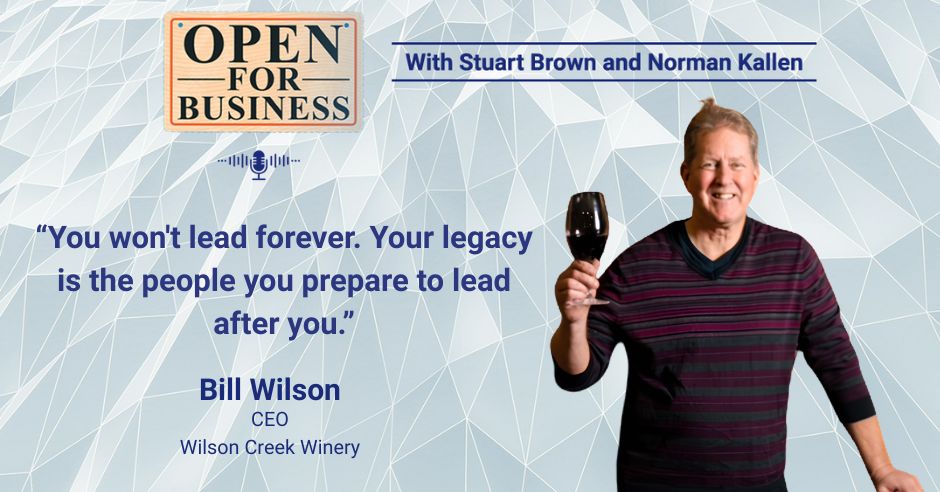
In this episode of Open For Business, hosts Stuart Brown and Norman Kallen speak with Bill Wilson, founder of Wilson Creek Winery in Temecula, California, about building and leading a successful multigenerational family business.
Bill shares how an early career setback in finance ultimately led to an unexpected opportunity to purchase land in Southern California’s Temecula wine region with his parents and siblings. He discusses the challenges and rewards of working alongside family members, sharing lessons learned from decades of growing a business together. He highlights the importance of bringing in trusted consultants and advisors who can provide objective, expert guidance when personal relationships make it difficult to maintain a neutral perspective.
Bill also reflects on his family’s entrepreneurial journey, the sacrifices required to grow their business, and the values that have helped them navigate change while preserving both the company and the family relationships behind it.
—
Pouring A Legacy: The Wilson Creek Winery Story of Family, Grit and Governance With Bill Wilson
I’m Stuart Brown, and as always, I’m here with my partner Norman Kallen. Norm, how are you doing?
I’m okay. How are you?
I’m good. Thanks.
In this episode, we will be joined by Bill Wilson. Bill is a Founder and Principal Owner of Wilson Creek Winery and Vineyards in Temecula, California. For those of you who don’t know much about wines or haven’t been to California, there is more to California wines than simply Napa and Sonoma. There’s two towns in Southern California known as Temecula and Paso Robles. They are wonderful winemaking towns. It’s a great place to visit. That said, this visit is not about winemaking. It’s more than that.
It’s about how Bill Wilson, the founder of Wilson Creek Winery and Vineyards, started out his wine business, how he shifted gears in business and made it a successful business out of this. By making great wines, hosting numerous events, and concerts at his winery. He talks about his trials and tribulations, how he raised funds, how he decided what he wanted to do, and how he built a fabulous winery and venue for events. With that said, Stewart.
It sounds like a wonderful story, Norman. I’m looking forward to speaking to Bill.
Let’s get to it.
—
Bill, thanks for being with us. I greatly appreciate it. We’ve heard so much about you, about your Winery and about your family story. Jump right in. Tell us your fascinating story about the winery, please.
The Shift From Failed Mergers to Winery Ownership
It started from failure. I bombed out in the whole financial mergers and acquisitions and everything else, believe it or not. My last gig before doing this, I was managing director in a merch as an acquisition firm. It sounded great. Everything was great. We were playing the whole KK and ARM. My job was to raise money on my good looks and my partner spent it like he was the second coming. That failed and it was time to move on. I looked left. I looked right. I looked up. I looked down on the whole financial planning world and all that consulting stuff.
I said, “I got to do something different.” I asked my best friend what I should do differently. He says, “I know exactly what you’re going to do,” with that bone-chilling conviction that only a best friend can tell you. He straight up says, “I was just down at Temecula. Remember, we were there for my anniversary and your wife’s birthday?” I’m going, “Yes, that was funny.” He goes, “I got talking with one of the winery owners and he’s a 75-year-old single guy. No kids and wants out. He’s willing to carry paper.”
I’m like, “Holy hell. For the last two years of my life, I was looking for a 75-year-old single guy, no kids, wanting out and willing to carry paper.” He’s like, “A prime candidate for an acquisition. It didn’t matter what industry it was in. We did paper, windows, film, and all sorts of stuff that we marched down the path and we could never put a deal together. I’m in the hospitality business. I know some people with some funds, and your family would be good at it.” I talked to my wife first and she said, “That sounds fun.”
I immediately called my parents and said, “You’re selling your house that we lived in for 24 years, put three kids to college, and have a little bit of equity in your moving to Santa Barbara like the rest of the retirees.” I lost a very good dear friend and business partner, my dad at the time. I said, “What if we took the equity proceeds, put it on a down payment and that SBA loan and got into the wine business?” My mom says, “Are you crazy? We know nothing about the wine business.” I go, “You made rhubarb and dandelion wine in Minnesota in the back. It tastes like wine. I think we can do it.” She says, “That doesn’t make us business savvy in California.”
I said, “Remember, in the merger and acquisition world, the guy who is buying the guy’s company is doing that research for six months about the company, about the industry, and I’ll know more about the wine industry in six months than this guy will ever know because he’s checked out.” She’s like, “It’s your inheritance. What does the rest of the family think?” Without picking up my phone, I call my brother who’s an ordained minister in Sacramento doing church planting. If there’s a deal killer amongst us, it’s him. He keeps the reins on me because I’m out there.
I gave him the whole thing. We do it as a family. We all moved to Temecula. He answered back to me, “Jesus’ first miracle.” Anyway, I got over the religious hurdle. He goes, “What does Libby think? Have you talked to her?” That’s my younger sister. I said, “She’s a pushover. She lives in Solvang now. I’m going to call her.” Without hanging up the phone, again, I call my sister. She goes, “I love a good Chardonnay. We live in Santa Barbara County here and we carry wine glasses in the trunk of our car wrapped in towels so that they don’t break. We go to the wineries in the afternoon. They film for free.” Remember, this is the early ‘90s. She’s like, “Where the hell is Temecula?”
You answered a good question for us. Everybody wanted to know where is Temecula.
Strategic Selection of the Temecula Location
“Where is Temecula?” That’s what everybody says. The answer to that is just over the hill yet a million miles away. We are literally an hour and 25 minutes from LAX. No traffic. We’re 55 minutes from San Diego Airport. We’re 50 minutes from Ontario Airport. We’re an hour from the Palm Springs area. We’re an hour and 15 minutes from Orange County Airport. We’re an hour from anywhere, but we’re an hour from everywhere with no traffic. You’ve got to judge your flights based on traffic because it could be two hours or it could be three hours at LAX.
Anyway, to sidebar that. Why Temecula? She says, “Why not here? Why not Napa? Why not Sonoma?” There was no Paso at the time. I said, “Because we can’t afford Napa. We can’t afford Sonoma. We couldn’t even afford Santa Barbara at the time.” My wife also gave me an ultimatum. She said, “I do not want to be two hours from a city. I do not want to raise my kids as country bumpkins. I don’t want a Nordstrom’s nearby. I want to live in real life. I don’t want to be the farmer’s daughter type thing.” I said okay. Temecula is an hour from all that. We’re an hour and 15 minutes from twenty-some million people.
At the time, 20 million people had no idea Temecula existed. Now, 26 years later, millions and millions of advertisers. I’m proud to say only 17 million people still have no idea Temecula exists, or they think we’re this little country bumpkin wine region started by a bunch of retired school teachers. That’s basically what this area is. We came out and we showed that, “With a lot of sweat equity, a lot of hard work, this is a viable venture.” Big money followed us and now, it’s millions of dollars to get into this industry. It’s crazy.
With enough sweat equity and hard work, almost any venture can become a success.
Anyway, the more we wanted to buy the gentleman’s business, the more he didn’t want to sell his business. Why didn’t he want to sell his business? He’s 75 years old, single, no kids, and looking to pick up on hot chicks in the afternoon after a couple of chardonnays. He was very happy. I knew he was never going to sell when we did just a spot check. There’s a word for mergers and acquisitions. You tell me. I don’t know what it is when you just show up.
Bill, when you first started this, you didn’t have the same vision you have now because you’re going well beyond just wine growing. When did you see that coming or when did you envision that? When did you plan it at all to be where you are now? How’d you make that happen?
It was shared by demand. It was, “We have too many people. What do we do next? How can we expand our bar space? Where do we go? How do we grow? We’re going to be at the weddings. We need a nice wedding spot.” We built a wedding gazebo and then we had a tent. From a tent, we built an event facility, from the event facility too long and that grew, and then upstairs. Everything grew organically. We didn’t go in with a vision.
I did not go in with a vision and say, “I want to be what I am twenty years from now.” I would fail miserably. We just wanted to be a small family-owned winery. My ideal was to live above a sleepy little winery, raising my kids in a place that I worked. That was a very romantic idea when we were a sleepy little winery.
As we grew, there’s no way I wanted to raise two young girls up above a winery on a Saturday and Sunday, because they would knock on the door and say, “Bill, we got a problem,” and I’d run down and take care of it. We stayed in the double wine and then we ended up building a stick-built in the back. We organically grew this business little piece by piece. Nothing said, “This is where we’re going. This is what we’re doing.” It’s just been by demand.
You started talking about the difficulties of financing your business. Our audience is going to be interested in the unique aspects of financing a winery. Taking into account the land, the agricultural products that you’re growing on it, how you produce it, the inventory, so on, and so forth. What types of financing are most applicable to a wine or like yours?
There’s two ways. You got equity finance. Some wineries down the road that have 175 owners that invested a piece into it. They pay them dividends if there’s anything left over and they’re usually not, so they haven’t paid dividends in years. You could go to conventional bank financing just like your house. It’s still blown up to 60% and 75% if you’re lucky. You have to have the assets there to back it. It’s a land play to them. It’s not a business play to them. It’s pure asset finance play.
They’re financing the real estate then in effect.
Correct.
It’s not a cash flow financing.
Correct. You have to have the income. If your income is tied to the business, you got to be that.
Are there specific lenders for the wine industry or as you said a moment ago, it’s land centric?
There’s a couple lenders that are specifically for the wine industry and I’m going to give them a shout out. It’s American AgCredit. They were set up by the Feds to give a little better interest to farmers and agriculture-first businesses, which the winery happens to be. They are a big player in this industry. Sonoma State Bank is a big player. BMO is a big player or they’re just getting into it. They’re trying. There’s a few of them that are a lot more willing.
Bank of America and Wells Fargo and all those guys are now knocking on my door, but they were not knocking on my door when we were knocking on theirs. We stayed true to who gave us a loan until they couldn’t tell our loan package was too big for them, then we got American AgCredit, but we stayed with the SBA lender that gave us that loan in the first place. Our banking is still with them.
I do business with people that did solid for me. I’m very much a people person. Not a business first person. If I like you and I trust you and you like me and I trust you, we’re going to do business. If I don’t trust you or you don’t trust me, we’re not going to do business no matter how good the deal might be. That has saved my ass a number of different times. Let me just tell you.
Loyalty is very important.
It is. I’m not out to screw my friends and they’re here to help me every way they can. It’s a very open and wonderful relationship that we have with our bankers on both sides. The ones that are doing that every day in and out of the bank and checking account to the ones that are financing us. This is not the greatest of times in the wine industry. Everybody’s down. You’ve got all this anti. On Good Morning America, it said, “Zero alcohol. Not a drop is good for you no matter what.” That’s putting downward pressure on the whole industry.
Iran doesn’t help, but the bottom line is, this industry is in steep decline. My banker says, “When Wilson Creek gets the sniffles, other wineries are getting COVID. You guys are doing okay. If you’re down just 8%, 9%, or 10%, you’re doing just fine. Good job. Keep it up. You’re still profitable.” We had to make moves that we’ve never had to make. When you’re a growing business, you never have to let people go because you don’t have the volume or whatever. You’re trying to find your next, “Who can I get in?” You fog a mirror. You got a job. Here you go.” Now, it’s a different ball game, and I don’t like it.
A growing business is always looking for the next great person to bring on—not the next person to let go.
I can’t blame you. You had mentioned a while ago that you have a number of different businesses or verticals within your business. Can you describe what those businesses are? How do they relate to each other?
Understanding the Three Pillars of the Wine Industry
We have our Tasting Room. That’s the hub. That’s the focus. We have a restaurant that feeds the people while they’re here. We have weddings and events. We do concerts. We have farming. We farm over 150 acres. We got wine making. You have to put it in the bottle and they all interlap. The research when I first did this said, “There’re three components to the wine industry. First of all, you have to grow the grapes,” which is biology. I took that in college. Once it’s picked, now you’ve got to turn it in wine, which is chemistry. It’s completely different from biology. It’s a full-time job and full-time degree.
Once it’s in the bottle now, you have to sell it, which is marketing and business and all that other stuff. They said, “If you try to do two of the three, you’re going to screw up one of the two, if not all three.” I’m like, “I got a farm manager. I don’t need to know biology. I can hire a winemaker because I’m not a chemist. I’ve never taken a chemistry class. I don’t like it. I hate it, but I know how to make people feel warm and welcome. That’s what we’re going to concentrate on.” It hit home. The very first year, we weren’t even open. Our wine was being made down the street so that we could have our own wine once we opened.
We’re there with the winemaker and we’re tasting our Chardonnay out of the tank. We’re just like, “This is great.” Their tour guide came up and said, “Mr. Winemaker, I got a tour group here that would love to have you say hello.” I go, “I hate that. Tell them I’m with a client.” He goes, “Come on, Mr. Winemaker. I’d like to hear what you have to say, too. This could be interesting.” I go, “No, I hate that. I just want to make one. I don’t want to talk to people. That’s not what I do.”
When you come to Wilson Creek, you’re going to see a Wilson or somebody dating Wilson or married to a Wilson or children of the Wilson. There’s somebody connected here at all times. We remembered that. We wanted to be real. We’re an open book. Come check us out. We tasted out of barrels on day one. We still taste out of tanks. We take people up in the vineyards. We want to educate people on what we do, so they become more attached to the wine. That’s all integrated.
Somebody comes tasting a glass of wine. They want to go on a tour. We show them the vineyards. We show them the tank room. We walk them right to the restaurant, events and the whole thing. We tell them exactly everything we do and it all winds together. Nobody’s coming out here to just go wine tasting. Nobody’s coming out here just to go to a restaurant for lunch. They’re having weddings. It’s marketing. It’s not a profit thing. Somebody’s paying you to test drive your market.
With me and a bride, I always say, “We’re on the same wavelength with you.” They’re like, “What do you mean?” I said, “I want everybody that comes to your wedding to say, ‘This is the most magnificent wedding I’ve ever been to. The food is great. The wine is great. I had no idea. This was here. I’m going to come back with Uncle Bob and Aunt Susie. We’re going to come wine tasting and enjoy the day.’ That’s my job. That’s my job to make sure that happens for you.” It’s just been a great thing.
A lot of people that come out here think it’s Temacula. They come out here and they think it’s a little sleepy. They’re like, “This is crazy. I have no idea where I am.” You walk into our property and you come through the entrance there. You were transformed into Mediterranean wine country style. People are all hanging out, enjoying and having a good time.
They’re all separated, but yet you can see each other. The people watching are fantastic. We got something for everyone, which in the business you’re not supposed to, but that’s our look. We got from the very sweetest of sweet wines to one of the best Cabernet you’re going to ever taste from a regenerative block that we’ve put a whole regenerative ag practice together. We’re all over the place but we got something for everyone. It’s pretty amazing.
Bill, I have to say that you do practice what you preach. My brother is a Californian and he said, “We’re going to Temecula and Paso Robles.” I was like, “Where?” By the way, it’s three hours to get around LA to get to your place. It was that bad when you mentioned without traffic. You do. It was a fantastic experience. A lot of times, with our business owners, it’s talking about putting the right people in the right seats. That sounds exactly what you did.
Building the Right Team and Leadership Structure
That’s easier said than done. Sometimes, you promote people to a seat that not necessarily they’re good at. If they’re a good wine educator server, do you think they’d be able to manage the Tasting Room? That’s not necessarily the case. You think they’re good and as a chef and then you manage them to take over the whole food and beverage department. That’s not necessarily the right move. You got to stay in your lane.
From the very get-go, we knew that the employees and team members that we have, we treated them like family, if not better than family. Some families don’t treat each other so well, but we are with these people more than we’re often with our families. I call it my work wife or whatever. I’m blessed. My wife’s job is to shop for the Tasting room and put all the merchandise in the Tasting room. She does a great job at that and I see her every day.
The people that are in the meetings and slug are feasting it out, finding and planning and doing all that great thing. I see them more than I see my family. It’s very important to like the people you work with. I want to be the boss I never had. I had a bunch of jerky bosses and I didn’t want to be that. Some people take advantage of my kindness. They’ll take advantage of my non-manipulative approach, but when I bark, I bark hard. I’ll get to a point and then it’s done. I can’t put up with this nonsense.
What we’re doing is we’re going off ramp a little bit by talking about family-run enterprises. A lot of our audience and a lot of our clients wrestle with succession, leadership, family dynamics. Who’s running your wine business? Is it you? Is your mother in there now?
We opened this. We always said, all the kids have done all the work and parents have taken all the credit. When you’re in your golden years, how great is that of a kid to give nothing but blessings to my parents? As I said for years, what’s your job? What do you do at Wilson Creek? My job is to make sure they get nothing but positive comments from the guests that come here thanking us for opening the winery. Thanking us for having wonderful food, great wine and this great facility. That’s my job to make sure they get no negativity. My succession plan is, I want to see my kids running around here and other people run around here making sure that I only get positive comments over here.
My succession plan is simple: I want to see my kids and a great team carrying this business forward, earning nothing but positive feedback.
That’s a succession plan, but to be realistically in the succession plan, they got to be ready for it. You cannot just hand it to them. My oldest daughter is in her 30s. She’s on a track. She has to do certain things before she sits in this seat. She has to know marketing and whatever it happens to be. She’s in our distribution department. That’s where she came out of. That is all sorts of aspects to the business. She is our succession.
With my parents, we brought in a business consultant and said, “Why are you paying your parents a salary?” I go, “Otherwise, they’d have no money.” They said, “Why don’t you just buy it from them?” I went, “Huh?” They’re like, “They’re giving you stock. They don’t do any of the executive-level stuff. That’s all you. Why don’t they just sell it to you and you’ll pay them an interest rate.” This is Circuit 2010. We were able to get the valuation in 2009. We bought the winery from them as the three kids. We all owned it, 33, 33, and 33 basically and the spouses.
I did something they’re not supposed to do. The person that was helping us said, “It should be blood only.” I go, “We’re all married. We all did this post-marriage. They’re going to get 50% of it anyway, so might as well give them part of it up front, so that they feel part of the ownership.” That’s what we did. My dad passed away in 2000. My mom’s 95 and a half. She’s not part of the business and hasn’t been for a while. We’ve always been part of it. There was no gap between my parents stepped away because they couldn’t be here till now. There will probably be a gap when I step out of this, but my job is to get my team so good that I don’t have to be here.
The business coach came in 2017 and asked, “When’s the last time you took a four-week vacation?” I laughed at him. I was like, “What?” He goes, “What’s your schedule?” I said, “I work for 21 days in a row. My wife took me away for three days and came back. I work 21 days in a row. Sometimes 28 and takes me away for three days.” He’s like, “You’re going to burn out. You’re going to kill yourself. By the way, you’re making every decision for your entire team. Stop.” I was like, “What do you mean? I’d get mad if somebody made a decision with my input.”
He goes, “Exactly. That’s wrong. You need to trust them. You need to help them. You need to help them fail and then pick the pieces up and then teach them.” That was the biggest in my life when they said, “You’ve got to go away.” I’m like, “What do you mean I got to go away?” He said, “You cannot be here on the weekends.” I was like, “What do you mean I can’t be here on the weekends?” They go, “You’re managing in the whirlwind.” I go, “What do you mean?”
He goes, “When it’s game on and there’s thousands of people here. You start barking orders and telling people what to do and showing them where they’re missing. That’s not good for anybody. By being here, you can’t stop that because that’s who you are as an entrepreneur, wanting to be the best in the valley and have the best experience. You can’t do that on a Saturday. You got to teach Monday through Friday and then hope to God, Friday, Saturday and Sunday go as well as it could possibly be. You need to go away.” I’m like, “Oh crap. Tell my wife.” He goes, “Let’s go.”
It was home when all this went down. I’m out in Vegas during the Route 91 concert where the mass shooting was. We got caught in that. After we ran and jumped over dead bodies going to the Tropicana. There’s these big signs, “Do your best. Smile. Core value.” All the stuff that my coach says. If you have to post core values, you don’t get it. You got to live with them. You got to breathe them. You got to preach to them. I’m sitting there just separated from a family, wondering if everybody is alive, injured or whatever.
I’m like, “Tropicana doesn’t get it.” What’s most important, was I worrying about the business up until that point? Not a bit. I didn’t think one thing of it for the previous hour of trying to figure everything out. The reality hit me like, “I don’t want to be the next Jackson family wines all over the United States and traveling all over the place. I just want the best Wilson Creek possible. If I have to stay away and take a weekend off on a regular basis, then so be it.”
We bought a vacation home at Lake Havasu. We go out there, and we go skiing a lot. I’m like, “Honey, I need to be home at least one weekend a month so that I can see what’s going on.” I’m here on the weekend, but I come down and I’m biting my tongue. I don’t say anything. I just shake hands and kiss babies, so to speak. My dog and I always just cruise around and talk to people every day, all day on the weekend.
I love this story. I heard it before, but I love it again. It’s great. Even better the second time. You mentioned a few times that you have used business advisors. People always questioned, “Are they real? Are they good? How do you pick one?” It sounds like you’ve had good experiences with your business advisors. Give us a little background on why you chose to use them and the value in that.
The Value of Outside Business Advisors and Consultants
I chose to use them because I had no choice. The family is like, “Bill’s out of control. He’s running this like it’s his own business. He’s not keeping us up to speed.” The first one we brought in was a family business consultant that taught us how to be a family business. He taught us, “You’re either an employee or your family member, which are two different things, or you’re a family member employee, which you better be the best family member employee because every employee you hire is going to go to your level.”
Equal pay for unequal work is the number one killer of a family business. We were absolutely that and then some. I didn’t care because we burned the boats in the bay a long time ago. Failure was not an option and go, go, go and eighteen hours a day. Some other family members didn’t quite have that work ethic or felt that they could not get my way. They brought this second family consultant in to calm me down. The second business consultant came in and said, “If you do not do what I tell you, you’re going to lose everything. If you continue to operate the way you are, you’re going to lose everything.”
Equal pay for unequal work is the number one killer of family businesses.
We said, “You tell us, boss. Tell us what you think.” They did a whole analysis that came in and said, “You’re the CEO. You’re the COO,” to my brother. “You’re fired. You’re fired. You got to go away. You got to work, but you don’t get paid because I gave your husband a promotion.” Anyway, I brought him in and he became chairman of the board. We had him, and he was a mergers and acquisitions guy. He was a business evaluation consultant. You should hire this guy to go in and fix companies. Get them to be more business-oriented than a family oriented or a hobby-oriented business.
He does that and then, they are now marketable as a standalone business. Not as, “I’m investing in you and you’ve got to stay on and work.” That’s not what somebody wants to get out of business or sell a business. They don’t want to work anymore. He’s always trying to get us to sell. Anyway, that was going on for a few years. They had me as well. He said, “You want to be the governor. Your brother should be the mayor. We’re going to have a general manager come in. You’re too family. We can’t do this.”
I went along with it for a while and they brought a guy in. It just didn’t work. I put my fist on a table and I said, “I’m either going to be the CEO and run it like the CEO, or I’m going to go down the road and work for another winery because I’ve gotten offers to do that.” I knew that the way I was, a hard driving that I needed to have a consultant work with me to be a better CEO. That’s when we brought our executive team coach in to teach the executive team. That was a tough lesson.
They said, “Who’s decision is it to change the bottle?” They go, “The winemakers. It’s his.” They’re pointing to me. He goes, “Who’s decision is it to put salmon on the menu?” They said, “It’s the executive chef’s.” “No. It’s his.” If he doesn’t want salmon on the menu, it doesn’t go on the menu. He goes, “Who’s decision is it to raise the prices?” That’s the CFO. That’s his. Every decision pointed back to me. He goes, “If he’s making all those decisions without input from this entire group, he’s got the problem now. Not you.”
He taught me how to get everybody’s involvement so that I could make a decision. As I said, I used to make every decision. Now, I haven’t made any decision. I get them to make the decision and help them coach through if it was a good decision or they just go, “Bill, it’s your call. Do you want this or not?” It’s like, “Let’s go that direction.” It freed me up. Every business consultant that we’ve brought in has freed me up or given me clear direction in the way we should go. It has created value and millions to us. They’re not cheap, but it’s just like having another employee.
They tell you the truth, good, better and different. You better pay attention and listen to it. Otherwise, I got one now. I have a CEO coach that does Vistage for those that don’t know Vistage. He is now chairman of the board. We brought outside board members in. Now, for the first time in our life, we have less family on the board than outside the board.
It’s a dynamic for sure that I trust myself enough that if I’m not doing the job, I’m the first one to head out. I questioned that sometimes, as every CEO does. Am I the right guy at this time of the business? If I don’t change, and if I don’t adapt, then I’m out. That’s tough reality for somebody that started from the ground up.
Are the executives in your business all family members at this point?
No, quite the contrary. They just brought my daughter in because she was so good in some of the succession, some of the planning with our consultant to do our retreat and strategic planning.
Preparing the Next Generation Through Succession Planning
It’s very interesting. You’ve been obviously through the mill with a family business and you’ve had advisors. If another business owner who is in a family business in your position as the CEO came to you, and asked you, “Bill, what advice would you give me to create a family legacy?” What would you tell that person?
I’ve never been asked that before. I’d say you got to get them involved. You’ve got to get them and train them. Get them to take the different hurdles that they have to jump to show that they’re the best. Give them and prompt them up the best you can and then realize, you’re getting old. You can’t do this forever. They’re going to be your legacy. You’ve got to raise them up the best you can.
Forget a family business. That goes with all your executive team, too. You have to get down to where they can take over the business when the new owners come in, they don’t get fired. They’re buying that team because you’re gone. They’re buying that team and continue this or completely dismantle it and they bring in their own team. That would be a shame. That’s not a legacy. The legacy is when the team continues to talk about you for years and years and put a stamp on it.
That’s wonderful. When you have a family member who works hard, puts the effort in but doesn’t have the skill set. We’ve seen this with our clients. How do you deal with that? A lot of them on the extra strategy will look to, “I can’t leave it to my child. They’ll run it into the ground. They put the work in for a great person. They don’t have the skill set. They don’t know the acumen for it.” How do you deal with that on your end?
I’ve seen it happen with one of our suppliers. A 3rd generation family winery. The kids that had the acumen didn’t want anything to do with it. The kids that didn’t, he ended up having to sell. He sold it to a private equity-driven company. The name went away. The legacy went away. He packed up his millions and is good with it because he made a good run at it. Very sad, but the reality is, it wasn’t going to happen.
With us, with me, specifically, it hasn’t happened without the consultants. The consultants come in and give a different vision and a viewpoint that’s not from the family. It’s not personal. You can’t make it personal but it’s still brutally difficult to do. I would find the business consultants that have gone through this, such as the chairman that we hired at the board that we had for many years, giving us that instruction of, “You got to earn that spot. By the way, you’re not earning that spot. You’re costing that company money. I need to transition you out. Let somebody else come in,” because it got beyond us.
My sister was in charge of HR. She has no HR experience. Now, once you start getting employees, it gets crazy. It starts getting sued because you’re missing steps. It’s a pretty simple decision. We need somebody in that position that is a professional. It got beyond us and it might be beyond me. It might be getting to where my love and kindness is and trying to cheer and everything else. I need an ass kicker in here. Let’s go, but that’s not who I am. I’ll bark and I’ll scream if I need to. At the same time, it is personal. I want everybody to do your best. It comes from my dad, basically. The worst beating I’ve ever gotten in my life.
The absolute worst as I was doing something at a party in our backyard that I shouldn’t have been doing. My dad fully walked in and caught us. All he said was, “I’m so disappointed in you.” I beat myself up like you have never seen before. Not one more word was talked about it for 45 years and I finally said, “Dad, that was the worst beating you ever could have given me.” He goes, “I know.” That’s where I’ve come from. I’m disappointed and you’re dropping the ball here. You’re dropping the ball there. I’m disappointed in you. I expect everybody to act like I acted and they don’t like it. They’re like, “You just blame me? So what? Screw you.”
The young generation specifically doesn’t respond to that. Long story, but he’d say that to a grandchild that was going down the wrong path, “I’m appointing you.” They’re like, “So what? I’m still going to go down the path.” It’s management style once you get to look at it. As far as the next generation to take over, I’m in the middle of it. I’ll tell you. In 3 to 5 years, my energy level just cannot keep up with what’s needed to drive this business. Hopefully, I’ve made the right choice by getting the right hurdles. You got to get this. Get an MBA and do this. Get your degree and specifically in wine. You better be a level three WSET. You better know your wine, your numbers, your marketing, and every aspect of the business.
Every single person on that team better say, “She’s the next CEO,” and that’s what they’re all pointing at with my daughter and the whole board sees it. They say, “She is sharp. She’s coming in. She’s done the presentation.” She’s impressed people where I’ve had some executives on my own team now that dropped the ball completely. They’re questioning, “Why is he in that seat?” I’m just using that in case somebody reads this. She’s going gangbusters. I’ve got another son-in-law that wants to take over the Tasting room. He’s like a freaking racehorse in the gates chomping at the bit. I’m like the jockey holding them back, which is exactly what I was.
I am the racehorse in the gate. My brother is the jockey holding back going, “Let’s just take our time on this and let’s think about it first,” but I’m like ready to go. The best thing I can do is get everybody to take personality tests. Be independent. Find out how you think and how everybody else thinks and how you can communicate with how they think. It’s not how you think. It’s how they think, and that’s been eye-opening for us. That’s another good piece of advice I can give you.
Grateful philosophy. Bill, this was a fabulous interview. As I said, you covered just so many elements of a successful business, period. Everything we wanted to achieve and talked about, we did here. It’s been wonderful.
I never know what I’m going to get involved in or say in these things, but thank you guys. You did keep your questions short. I keep the answers too long, but I enjoy doing this. If I can get one piece of advice from somebody when they ask, then that’s a win for me. If somebody learns one little bit about something and they want to talk more about it. I’m an open book. Come down. I’ll buy you lunch even and I’d have a glass of wine with you even.
Which you did. We did and we appreciate it.
Is there salmon on the menu, by the way?
There’s a salmon BLT on the menu.
There you go.
I bet somebody that I could get the chef, put the salmon BLT on the menu because he didn’t want it on the menu with the restaurant management. He’s like, “Good luck.” I go, “What’s the bet?” The bet is, if I get it on the menu, you have to keep my parents’ dogs out of the restaurant because they’ll go and beg for patrons and that’s no good. She said, “If you lose, then you have to wear the shock collar and I will shock you.”
I go up to the shop. I go, “Salmon BLT is going to be on the menu next week, right?” He’s like, “No, it’s not seasoned.” I said, “I don’t care. It’s going to be on the menu.” He goes, “We got to charge $2 more for it.” I said, “Great. Charge $2 more for it, but it’s going to be on the menu. Otherwise, you’re going to be wearing that shock collar with me. You’re going to get a shock.”
That’s great. Again, Bill, thank you very much. We appreciate it.
I hope I helped in whatever little bit.
As I said, you were informative and we’ll come back down again.
Please do.
This is wonderful.
Thank you guys, so much.
—
That’s a wrap on this episode. A huge thank you to Bill Wilson of Wilson Creek Winery and Vineyards for sharing his journey, his stories, and his passion and drive with us.
If you enjoyed this episode. Be sure to subscribe. Leave us a review. Good or bad, but mostly good, I hope. If you’re ever in Southern California, I would encourage you to visit Bill’s winery. Enjoy the wine, the food and the ambiance. You won’t be disappointed. Until next time.
Important Links
- Bill Wilson on LinkedIn
- Wilson Creek Winery
- Wilson Creek Winery on LinkedIn
- Wilson Creek Winery on Facebook
- Wilson Creek Winery on Instagram
- American AgCredit
- Sonoma State Bank
- BMO
About Bill Wilson
 Bill Wilson is President, CEO and Co-Owner of Wilson Creek Winery, a family-owned and operated winery in Temecula Valley Wine Country. After spending 13 years in the financial industry as a financial consultant, Bill pursued an opportunity to become a winery owner and helped build Wilson Creek Winery from a small family dream into a world-class winery.
Known as the home of the Almond Sparkling Wine, Wilson Creek Winery has become recognized for its welcoming, family-oriented atmosphere and broad range of events and experiences. Under Bill’s leadership, winery production has grown to more than 50,000 cases annually, and the property now includes a tasting room, restaurant, wedding and event facilities, concert programming, and corporate event hosting.
Bill is deeply involved in the Temecula community and has long demonstrated a commitment to charitable giving and civic leadership. He served two terms as President of the Temecula Valley Winegrowers Association and currently serves as Treasurer and Executive Board Member for the Temecula Convention and Visitors Bureau. He also serves as President on the Board of Directors for the Rancho California Water District.
In addition to his leadership roles, Bill shares his expertise through wine education classes, public speaking engagements, and articles for magazines and websites. He has played a significant role in shaping the vision and growth of Temecula Valley Wine Country.
Wilson Creek Winery has been honored four times as “Business of the Year” and has received numerous “Best of” awards. Bill has also been recognized individually as the recipient of the Inland Empire Spirit of the Entrepreneur Award, Temecula Citizen of the Year (2010), and Riverside County Small Business of the Year (2015).
Bill takes great pride in the Temecula Valley community and remains dedicated to helping ensure its continued growth and success for future generations.
Bill, our listeners are always interested in the unique aspects of financing a business, and I imagine a winery has very specific financing requirements because you are dealing with land, agriculture, production, inventory, hospitality and long-term growth all at once. What types of financing are most applicable to a winery like Wilson Creek, and are there particular covenants, collateral issues, cash flow considerations or other financing provisions that winery owners need to pay special attention to?