Search Funds, Independent Sponsors and Buying a Business: Alternative Paths in M&A
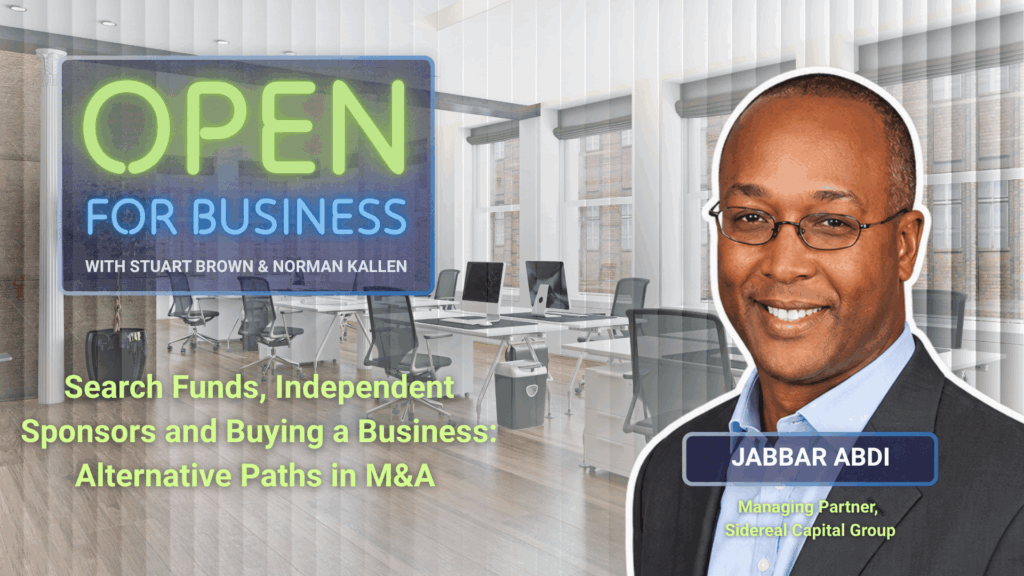
In this episode, Jabbar Abdi, Managing Partner of Sidereal Capital Group, explains the growing role of search funds and independent sponsors in M&A. He discusses how these buyers differ from traditional private equity, what business owners should consider when weighing potential buyers, and why factors like cultural fit, management continuity and plans for employees can matter alongside price.
[Stuart Brown] (0:07 - 0:18)
Welcome back to Open for Business, the podcast offering practical guidance and humorous insights to business owners looking to optimize their professional and personal lives. I'm Stuart Brown, one of your co-hosts.
[Norman Kallen] (0:18 - 0:51)
And I'm Norman Callan, your other co-hosts, and welcome to the podcast. You know, Stuart, over the last several episodes, we've had a number of people on the show who have talked about what are the options for sellers when they want to sell a business? Is it a strategic buyer?
Is it private equity? And recently we had Don Ed Rediger of SES ESOP strategies to talk about ESOPs, another option for business owners, which has become more in the mainstream in today's environment. And today we have another guest to talk about another option that's available for business owners.
You want to go and introduce our guest today, Stuart?
[Stuart Brown] (0:51 - 1:14)
No. Okay, we're done. No, I'm just kidding, of course.
No, we're looking forward to it because I think, and I don't want to give it away, but the topic that we're going to speak of today presents yet another, as you said, Norman, another option for the business owner. And what I'd like to be able to do is provide our listeners with the full panoply of what their options are so that at the end of the day, they can make educated business decisions. That's what it's all about.
[Norman Kallen] (1:15 - 1:17)
That's exactly what it's all about, and that's what we want to do on this program.
[Stuart Brown] (1:17 - 1:40)
With that said, I'm happy to introduce Jabar Abdi. Jabar is the managing partner of Cedereal Compass Investments. And Jabar brings decades of experience in private equity, leveraged buyouts, debt and equity investing, M&A, so on and so forth, all related to the topic at hand.
Welcome, Jabar. Welcome, Jabar.
[Jabbar Abdi] (1:42 - 1:50)
I will say we are dating ourselves by the Ricardo Montelban references, but that's for another day. Certainly, millennials.
[Norman Kallen] (1:50 - 1:51)
I love that reference.
[Jabbar Abdi] (1:51 - 1:51)
I'm sure.
[Norman Kallen] (1:51 - 2:13)
Who? Anyway, let me jump right in, Jabar. Business owners who are considering a sale often think about private equity firms or competitors, and now possibly even ESOPs.
But in recent years, we've heard more about independent sponsors and search funds. Jabar explained to us what exactly those two elements play in the M&A marketplace.
[Jabbar Abdi] (2:13 - 4:26)
Yeah. So in general, independent sponsors and search funds operate almost like a private equity firm in general in terms of the way they go about analyzing a business and doing their due diligence on what they choose to invest in. They become more and more common in general because they sit outside of a fund structure.
So an independent sponsor will be folks who historically, much like myself, have a long history of investing in companies and creating the transactions and working with portfolio companies, but they don't have a committed pool of capital. Search funds, on the other hand, are unlike independent sponsors and traditional private equity firms are usually an individual who has an operating background who will search for a company and conduct a transaction where they are looking for solely one investment, where they will then install themselves as the CEO or chairman of that firm to help these firms grow and realize the growth that they think is intrinsically within the company.
So it's become more and more common as private equity firms or private equity in general has become a more mature industry. With that, there is a real movement of foot amongst limited partners, which are referred to as LPs, to really put their dollars into committed funds where they know they can deploy the capital. So Blackstone, a KKR, sort of the large household names.
And as a result, many of the people who may have started at those firms who have more of an entrepreneurial bent are going to venture out on their own to start their own independent sponsor effort. And the beauty of that is they don't have a clock that's ticking on their investment. There's no time frame in which they need to deploy capital, which these larger firms need to and are on the hook to do.
So as a result, there are a myriad of these folks, especially in the lower middle market, which really is to the benefit of a seller, a small business owner who can get to know and who can get the full attention of these independent sponsors or search fund partners.
[Stuart Brown] (4:26 - 4:37)
Hey, Javar, you just use the term middle market or lower middle market. You know, that means a lot of different things to a lot of different people. Just for purposes of today, how are we defining those terms?
[Jabbar Abdi] (4:37 - 5:30)
That's a fair point in my apologies, but it really is kind of in the eye of the beholder. So the middle market could be upwards of businesses with a hundred million of EBITDA in many respects, which is insane to think that that's a middle market company. But what I refer to lower middle market is kind of two million of earnings before interest, depreciation and amortization and taxes, EBITDA, upwards of, I'd say, 10 million is the lower middle market in my definition.
And then when you go from 10 to 50, as in my opinion, the upper end of the range, that's more of the middle market. So the lower middle market, there are many more businesses that are family owned or founder run that have developed some sort of niche and have a reason for being that would be potentially attractive to an independent sponsor or a search fund.
[Norman Kallen] (5:30 - 5:42)
Independent sponsor, you indicated, it doesn't have a committed pool of capital initially or for the most part. If that's the case, what exactly does an independent sponsor offer to a business owner when you're first approaching a company?
[Jabbar Abdi] (5:42 - 6:57)
It really is the same that you would have with a private equity firm, except you don't necessarily have the large portfolio aspect to worry about. So you're going to get the attention from an independent sponsor. So as a private equity firm with 200 million, let's just say, under management, that being the amount of money that they have in their dedicated fund, an independent sponsor may only be managing, let's say, 100.
So that 200 that I originally stated could be spread across 10 to 15 companies. Just give or take. With an independent sponsor, their 100 would be spread over maybe five to 10.
So you're going to get that individual attention. It's really existential, if you will, to the success of the independent sponsor in terms of the outcome. Also, independent sponsors, more than likely, are going to want to partner with existing management.
So if you have someone on staff or if you're going to remain in the seat as the business owner and just monetize some of your investment and retain equity, that's really attractive to an independent sponsor. It will be, I find at least, or at least our positioning is that we tend to have more of a collaborative approach than the larger firms out there.
[Stuart Brown] (6:58 - 7:05)
Wouldn't you as an independent sponsor look to private equity to actually finance these deals that you find?
[Jabbar Abdi] (7:05 - 7:31)
Yeah. So the way you finance the deals are a myriad of ways. It can be a family office.
It can be another private equity firm. It could be an SBIC firm where they would put in a combination of debt and equity. So yes, you would partner with someone else or if you had the methods or the means to go out and raise it much like a search fund, but you would have to have larger investors to do it over and over again.
[Stuart Brown] (7:32 - 7:59)
Now, let's break that down. So you mentioned, I think, three categories. You said it could be an SBIC, which I'd like you to define and discuss.
It could be a family office. Or it could be private equity. So for each one of those, first, explain what they are and then also explain how they would differ in terms of your negotiation with the business owner, because I want the business owners who are listening today to get the inside scoop.
[Norman Kallen] (8:00 - 8:05)
How does a business owner get comfortable that you'll be able to find a capital to close the deal, which is part of this as well?
[Jabbar Abdi] (8:06 - 9:19)
That's the $64 million question, but to go back to define what these are. So private equity firms are your normal, I hate to say, run of the mill, but private equity firms and we're an independent sponsor may partner with a classic private equity firm that independent sponsor may not have as much sway in the overall ongoing running of the operation if they partner with what I'll call a classic private equity firm. As an independent sponsor, you will then maybe get a seat on the board of directors.
You'll get a management fee and you'll have some small part of the equity, but your day to day working with management is effectively ceded to the larger private equity firm. With a family office, they're really more than likely passive investors and they will set up a structure that would be more akin to you being the private equity firm in charge. So they would fund the acquisition, but they would rely upon you based on your relationship to continue to drive value on the board and within the company.
When you say you, you mean the independent sponsor, not the owner? The independent sponsor, sorry, yes, correct.
[Stuart Brown] (9:19 - 9:20)
Right. Okay.
[Jabbar Abdi] (9:21 - 10:58)
And then lastly, an SBIC, which is a small business investment company where they're focused on providing mezzanine debt, but they are also allowed to contribute equity as well to a transaction. They really see this as a business development arm where they would be similar to a family office. They would sit on the board with you and help guide the investment, but they really have more of a debt hat on because they're looking for that current return to pay the government back and then have the equity as the kicker, if you will, to ride the upside on the investment.
So they would sit on the board and partner alongside of you. And it's far more of a collaborative approach than otherwise. So that's kind of at a high level with all three examples.
But then to norms, but then to norms question, that's the hardest part is to get a business owner to believe in you, to put his or her faith in your ability to get the deal done. Now, the more you've done, the higher the conviction because you're a known entity, people know what you can do, that you've returned capital, that you're not just sort of, as folks like to say, fall off the turnip truck yesterday. When you're dealing with an independent sponsor, I would implore business owners to really do their homework and talk to folks who they've invested with, folks in management, whether they be sellers or ongoing managers within their portfolio companies, whether they've exited or not, to see how they operate.
What was the process like?
[Norman Kallen] (10:59 - 11:06)
So to your point, you're approaching a business owner. How do you determine pricing when you don't know yet the cost of capital?
[Jabbar Abdi] (11:06 - 11:51)
That's really baked into your ongoing model. We assume what would be the highest cost of capital would be the combination of mez and equity. Could you take a moment to just explain mez for a moment?
A class of security that is not first out, which is classically referred to a senior debt, but it is the security below that, but yet above the equity, which has a current return on it. So you pay current interest, but you're not paying principal. Oftentimes, there is something called a pick or payment in time where that value grows over time, and that is then part of the kernel rate of return for the sub-debt or mezzanine lenders, which are one and the same with SBICs.
[Stuart Brown] (11:52 - 12:16)
Right. Let's go back for a moment. When we were speaking a moment ago about the three different types of funding sources, whether it's a SBIC private equity or a family office, and obviously there's others, but let's stick with those for a moment.
Does your role as an independent sponsor change as it relates to the negotiation with the business owner, depending upon the funding source?
[Jabbar Abdi] (12:17 - 12:43)
What we try to do historically is avoid what I'll call classic private equity firms, where we are then for lack of better term sidelined. That, in my opinion, would be tantamount to a bait and switch. If you're dealing with me, one-on-one, we've developed a relationship.
I understand your business inside and out, and then I'm going to turn around and give it to somebody else. That's less attractive and kind of poor form on my part.
[Stuart Brown] (12:43 - 12:53)
I agree with you. If I'm the business owner and you and I go out to lunch and we have a good conversation and we have subsequent conversations and then you say, hey, Stu, by the way, it was nice knowing you.
[Norman Kallen] (12:53 - 12:59)
Now, go talk to Sally over here, particularly when the private equity says, by the way, it's our money, our show.
[Jabbar Abdi] (12:59 - 13:18)
Correct. That is only in what I'll call a desperate situation. I would prefer to go to an SBIC first.
I would prefer to go to a family office first, or even an asset manager. There's a number of different avenues with which you can fund a deal that are not necessarily going to the classic private equity folks.
[Stuart Brown] (13:19 - 13:39)
Making the assumption for a moment, Jabar, that you are still the man. You're in charge, right? What is the process, meaning that in the first instance, after you have the initial introduction and people become comfortable with each other and you start working with that seller, that business owner, what is the process from there?
[Jabbar Abdi] (13:40 - 15:23)
So the process is like any other normal process in that it's incumbent upon me to let the seller know of my status. I'm not hiding the fact that I'm an independent sponsor. I'm upfront about it.
And my job is to then know enough about the business to get them comfortable, have a rapport, to develop this relationship. I still follow along and let's hope they have an intermediary because that person is incentive to get the deal done. And oftentimes, you'd be surprised.
We have won, not based on price alone. You could pay the most money and win every time. But oftentimes, it's because of rapport, bedside manner, understanding the business, having dialogue and stealing faith and trust in the other party.
And the only difference to the seller is that after you've signed an LOI, a letter of intent. So first, there's the IOI stage where you're in the game, initial indication of interest. So that says, here's a range of prices that I would be willing to pay for the business.
And then you do more diligence. And as you do more diligence, you're compiling materials to go out to your investor base. Then when it comes to the LOI, the letter of intent, if we submit that letter and we are selected, there will be no additional hurdles that the seller would have to endure except for maybe time.
And when I say time, if let's say the normal time to close is 60 days, God help me if I've ever seen that really actually hit.
[Norman Kallen] (15:24 - 15:28)
That was my thought as well. I started sweat when you said that.
[Jabbar Abdi] (15:29 - 15:29)
Right.
[Norman Kallen] (15:30 - 15:34)
But in every client says, well, we can close this in 30 days. Yes. Okay, good.
[Jabbar Abdi] (15:34 - 15:55)
But once we've got it locked up, the clock starts for us on the back end to circle the wagons with our investor base. And the one thing that may differ is that we may have an additional management meeting with the seller after the LOI signed that in time are the only difference.
[Stuart Brown] (15:56 - 16:27)
So that's what I mean by process. So basically, and this is an important point, the difference is if you go to private equity, private equity has the financing and you sign a letter of intent, you get into diligence, you go through your normal process in order to close with an independent sponsor. On the other hand, from what I understand and correct me, if I misstate this, please, is you sign the letter of intent and then it's incumbent upon you as the independent sponsor to go secure your capital in order to do so.
It may require another management meeting or so. Correct.
[Norman Kallen] (16:28 - 16:36)
I guess in some ways, that's not this similar to a strategic buyer who says this is contingent on my ability to finance the transaction and find the capital.
[Jabbar Abdi] (16:37 - 17:33)
Correct. But oftentimes, the strategic buyer, whether they be private equity backed has the resources already at hand, or they have some sort of public security, or maybe it's just financing vis-a-vis debt. And here, not to be pejorative or sound dismissive, but the senior debt is the easiest part of the equation to secure, right?
That's really just based on the company and you're getting everything in and lined up. You've got your cadre of folks who you've worked with a number of times, and it's pretty straightforward. Give or take.
The real trick with independent sponsors is how's the equity all going to play in the sandbox together? And what's the structure going to look like? And how's the owner going to participate in that?
Whether you have preference on the new equity coming in and the seller is common shares instead of preferred class. All of these things are to be negotiated.
[Stuart Brown] (17:33 - 17:39)
How is that any different than a private equity deal, though? When you're rolling forward equity, it's the same conversation. It's not.
[Norman Kallen] (17:40 - 17:49)
So it's just really the financing element. Other than what you have said a few times, that was the attractiveness of the independent sponsor to a business owner who's selling. Correct.
[Jabbar Abdi] (17:49 - 18:19)
And to that end, there is kind of an artificial cap on independent sponsor deals to a certain degree where most other firms are not going to participate in your deal. If you're paying eight, nine, 10 times, there's nothing in it for them. But if you've got something that's a little off the beaten path that you've gotten for a good value anywhere from, I'll say, four to six and a half or seven times, that's going to get people's attention.
It's a good and easy way for them to deploy capital with a trusted partner.
[Stuart Brown] (18:20 - 18:32)
Let's flip it for a moment. Jabbar, you're now the owner. You're not the independent sponsor.
As the owner, what should you know about evaluating an offer from an independent sponsor? Give us the inside scoop here.
[Jabbar Abdi] (18:33 - 20:51)
Understanding your culture, right? As they say, culture Trump's strategy, right? I'm consistently amazed at my brethren who come in and tell an owner everything that they've done wrong.
It never ceases to amaze me. But it's no different than whether it's a private equity firm or an independent sponsor. This is going to be a marriage.
And you've got to understand how these people operate in good times and in bad. And I think that's paramount because rare is the time that everything works out according to what's laid out on paper. But I would explore to your point, Stuart, how have you gotten these financed?
What's the time, timeframe? What's the risk involved and be upfront about it? And if they start to be subversive, then it's not for you.
But also understand if you're rolling equity, it's having a more collegial and collaborative approach versus being a small fish in a much larger ecosystem is tough. And from the standpoint of us, what we look for are under resourced businesses. So in general, what we try and do as an independent sponsor is fine, where the base business itself is very interesting, but it doesn't have a lot of the bells and whistles along the value creation landscape.
So oftentimes we are investing in people and systems and KPIs and strategy development, all the stuff that most other private equity firms won't even deal with because it's too much of a headache. And you have to really roll up your sleeves in certain instances to drive that value. And so by the time that we're done with a business that may have started off at two million of EBITDA, and we've grown it to five, but not only have we grown EBITDA, we've essentially put in the other infrastructure around it to make it a really institutional business.
It's inherently more valuable to sell up the food chain to another private equity firm. And this is once again, not to denigrate my brethren, but they like things that are ready made. I'm flipping the house, if you will.
I'm over here taking something that has good bones and investing in it and partnering with the person who owns the house currently to then sell it on the open market to a young family who's looking for a turnkey house.
[Norman Kallen] (20:52 - 21:15)
So your point about partnering, have you sat situations, real life situations where you got a sense in the context of negotiating with a seller, and they're understanding that they're no longer in control once you close the deal. But have you gotten that sense in any deal if you can give us a life situation where you got a really bad feel that this person is not going to go along with that concept, and this may not be a good marriage?
[Jabbar Abdi] (21:15 - 22:11)
Yeah, it happens more often than you think. People often glamorize what we do, but there's a lot of rejection involved, not only in the deal process, but also in the courting phase, if you will. I've been in an instance, there was a metal bender for Black Matter term in Pennsylvania, where we realized midstream that despite us having signed an LOI, that this was not going to be a good fit.
The seller kept dragging their feet, kept asking for more things. They did not give us a good feeling that they were going to stand behind the agreement that we had signed. And so eventually we all parted ways.
We said, you know what, this is not going to work out. And it was kind of a mutual feeling. They went to what I'll call the cover bid and eventually got a deal done with them.
I'd never followed up to see how that deal went, but it happens more often than you would think.
[Stuart Brown] (22:12 - 22:21)
All right, so conversely, would you say that a seller who goes through a deal with an independent sponsor may actually fare better at the end of the day?
[Jabbar Abdi] (22:22 - 22:38)
That's hard to say. To be honest, I mean, as much as I advocate for the independent sponsor community, it's hard to say because there's so many variables that go into a good deal that it's not as if there's one thing that makes independent sponsors better than a private equity firm in terms of outcomes.
[Stuart Brown] (22:39 - 22:52)
Well, let me put you on the spot then. Not that I want to put you on the spot. No, no, you know what, I do want to put you on the spot.
I'm going to put you on the spot here, Jabbar. So can you do you want to put them on the spot? I think so.
Okay. Norman, you're still stuck on the plane.
[Norman Kallen] (22:54 - 22:55)
I'm on the runway still.
[Stuart Brown] (22:57 - 23:21)
Are there situations that you can think of that you've encountered where working with you as an independent sponsor has perhaps worked out better for the company than a traditional private equity buyer would? So for example, if you have a situation where a company perhaps would not have been as attractive to private equity, but yet by virtue of working with you, it worked out for everybody.
[Jabbar Abdi] (23:21 - 25:56)
Yes. So we invested in a business in Upstate New York that was a wonderful family business where we bought out the selling shareholder entirely and they had great EBITDA margins from the get-go. They manufactured a coding for a specific product and product.
What we then did was we did a deep dive into the ongoing business. We bought out the seller entirely because we realized that it was at some level addition by subtraction. He was running this as primarily a lifestyle business and not managing it for the intrinsic growth that it had that was underlying bubbling underneath the surface.
So with that, we took the restrictor plates off to use an automotive analogy. We partnered with the president of the company who had been there for the better part of 25 years, who knew the business inside and out, and we were able to reinvest in that business, to do small things here and there, not the least of which though was to put in an ERP system that allowed us to understand where the real value drivers were coming from in terms of the products and the customers, etc.
And so from that, we were actually able to adjust their pricing strategy. So they made a premium product that had brand recognition in the industry, but they were making less margin on that than they were from what I'll call the lower test product. But we were able to call this out from the implementation of the new ERP system and by just a simple fix, making our customers indifferent because what would happen in frothy times they would buy the premium product.
But when it was sort of a belt tightening or harder economy, they would downshift to the lower priced product. But we said, look, we should be indifferent which they choose. And so we're making the same margin on either product.
We raised the price, which was counterintuitive to the management team. Like, what do you mean we're raising prices on our most expensive product? Yeah, because we're going to make the same margin no matter what.
And so we were able to do that. We were able to do a tuck in acquisition, but we changed the culture of the business. And that was something that I don't think they would have done had they kept going in their current state.
It got to the point where actually the seller wanted to buy back in. He saw what we were doing and asked if he could partner with us yet again. And no, no, we're good.
[Norman Kallen] (25:57 - 26:26)
To that point about the seller staying in the deal, have you had circumstances where, I mean, you're bringing at business acumen, you've done run a number of businesses or your people have, and you're bringing that experience to someone who's just run this business for the most part. Have you had business owners who look like a good fit, but were resistant to the change that realized, well, hey, listen, this is what we're telling you should do. We're not being critical of the business, but looking to make what you think are really positive improvements for whatever reason.
[Jabbar Abdi] (26:27 - 27:08)
Fortunately, it hasn't gotten to the point of real contention where we've had to throw people overboard, but it's it's tough. It is not easy for someone. The reason why they're entrepreneurs in the first place is they have an idea and they're going to go do it.
And it's tough to tell somebody who's been successful to the point where you're sitting across from them, begging them to take tens of billions of dollars from you that they don't know what the heck they're doing. Well, I don't want to be I don't want to be that blunt about not being a good approach, but diplomacy goes a long way. Indeed, but inherently, if they are rolling equity and staying in the seat at some level, they know they need help.
Good point.
[Norman Kallen] (27:08 - 27:08)
Yeah.
[Jabbar Abdi] (27:09 - 28:22)
Because otherwise, they would take all their money and right off into the sunset. And the folks who have left the business, they have a succession plan in place or a strong number two who can step into their shoes or has already stepped into their shoes. We tend to want to keep those sellers tethered to the business in some way because we see them as a resource.
We don't want to make it adversarial. We want your knowledge. We want to know why we shouldn't go by this competitor.
We want to know why you may have tried to go into this market and fallen on your face or avoided this market altogether. Like that's institutional knowledge that is hard to replicate. And I think a lot of folks don't give that as much credence as they should.
So we'll have the seller. If they're not on the board as the CEO, they are a consultant to the board. We have the ability to tap into that institutional knowledge.
But it does happen where people are like, I don't like you telling me what to do. And that's where bedside manner comes into place. And it's like, well, we're all in this together.
And what you don't want to fall back upon is, hey, we bought 51% of your business. So right. Tough conversation.
[Stuart Brown] (28:22 - 28:22)
Yeah.
[Jabbar Abdi] (28:22 - 29:19)
You really don't want to get it to that point. There's a deft touch that's involved. But ultimately, pride is a many splendor thing.
And people want to do well. If they've sold you on, this is what they think the business can do. And we have yet to achieve that.
If they don't put up their hand to say, OK, you know what? I'm not the person. We'll figure it out.
We'll find your replacement. But oftentimes people are really self aware before they get to this point. And this is where a good advisor is helpful.
They'll raise their hand and say, OK, I want to be around for one or two years, but then I'm out. And I think that takes a level of self awareness. That's important because what it then does is allow us to get comfortable being in the business and partnering with you, but also understanding what will work and what kind of leader we need to replace you if you don't have it already on staff.
So then it'll allow us at least a two year window to find that replacement and not just throw somebody in there.
[Stuart Brown] (29:19 - 29:33)
Yeah, that makes a lot of sense. Let's go to chapter two of this conversation. Let's start talking about search funds for a little bit.
With respect to search funds, Jabar, what would you say attracts investors to back a search fund model?
[Jabbar Abdi] (29:33 - 30:10)
It's because it is an essence of one off. You're backing someone who in theory has industry expertise who knows the ins and outs of a particular sector where they have identified a company that they want to buy into and take over. The only other ongoing capital requirement will be in theory if you want to do an out on acquisition.
But you're really backing the individual and their understanding of the industry, the landscape, the company. So it's very similar to a private equity firm, but you're not necessarily relying upon them to create a portfolio.
[Stuart Brown] (30:11 - 30:17)
And so in your opinion, who comprises the investor pool in that case?
[Jabbar Abdi] (30:18 - 31:19)
Well, it varies widely based on your network. It can be very much similar to an independent sponsor. It can be a family office, let's say.
But more often than not, it will be wealthy individuals. You're collecting folks' commitment, half a million dollars at a time, and cobbling together enough critical mass, often from friends and family, former business associates, former individuals that if you're spinning out of a private equity firm, you may get one of the senior partners to back you in that regard. But what they're backing is the individual and the capabilities of that individual.
And so if you were to be looking for someone like this, or potentially partner with someone like this, looked really deeply into how they went about getting to the table. What's their background? Where were they an operator beforehand?
What type of business culture, I think, is even more important with this person because they're going to be sitting in the day to day of your business. If you want to maintain an equity stake in the business, that's something that you would really need to think about.
[Norman Kallen] (31:19 - 31:44)
Yeah, it sounds so many ways similar. Some of the hurdles you have to deal with an independent sponsor as well to get the comfort level as to who's going to run the ship and what is the proper place for the former owner and make sure they're willing to accept that. I want to jump in for a second on the economics of the sponsor.
How do you get paid? Where's the money come from? You talk about a waterfall.
What does that mean in the context of what does it mean? Besides your investment, how do you otherwise make money as an independent sponsor?
[Jabbar Abdi] (31:45 - 34:08)
Sure. So the classic structure with a private equity firm is you raise a big pot of money. You are then charging your underlying investors from whom you've raised that pot of money, a management fee, 2% on that for as long as the fund is operating or investing.
It's really very similar for an independent sponsor. You are taking a management fee on the equity that the company will pay you as the independent sponsor. So oftentimes it's a percentage of EBITDA, anywhere from 5% to 10%.
And that will help with overhead, help you keep the lights on, and you would also get your expenses paid if you go to a board meeting or something along those lines, which is very standard for private equity firms as well. But where the difference is is in the waterfall, as you said, Norm, who gets paid and how? So oftentimes your underlying investors get paid first until they reach a certain hurdle rate of return.
So if that's a 10%, 8%, whatever that number is, they get their money and a small return. And then as the independent sponsor, you start participating. You will then hopefully, it's all negotiated, by the way.
So there's no standard across, but you will then get a catch up on your portion of the equity. You've now caught up in terms of your ownership percentage. You've now then got your 10% return.
And then that starts changing at various levels. So okay, I've got this return. I've now hit, my underlying investor has hit a 2x return, a 3x return, and above.
And so what I will then do is work into what I'll call the classic 2 and 20. So in a classic private equity sense, the private equity firm gets to enjoy 20% of the profit of any investment that they have. We then work back into that.
And the better the company does, the higher my likelihood of getting to 20%. If I only get a 2x return, then maybe I'm somewhere in the 10 to 15 range. I will get to the full 20 if we hit 3x or above.
People are incented to partner with us because they get paid first. And we are then only incented on the upside if we do well. So our incentives are aligned that way.
[Norman Kallen] (34:08 - 34:15)
How transparent are you with the business owner to understand who gets paid, how much of where the capital comes from to get paid?
[Jabbar Abdi] (34:16 - 34:47)
Oh, very. Yeah. I mean, they're privy to it all, obviously, during documentation.
There's no hiding the ball. Once you get it signed up, then you share with them. Like this is how I make money.
And so oftentimes, depending on what class of shares they're in, I don't make money until they make. So to really show that this is not something where I'm hiding the ball, that I'm in it too. I'm singing for my supper to make sure that this investment pans out for everybody and I'm going to do everything in my power to make it so.
It's not misaligned in that regard.
[Stuart Brown] (34:48 - 35:01)
No, I think that's really an important element here. I think we could spend a lot of time unpacking the financial model because I know that I will be candid with you, Jabbar. I understood a lot of what you say, but not all of what you say.
[Norman Kallen] (35:01 - 35:04)
I'm in the same boat, Stuart. Thank you.
[Stuart Brown] (35:04 - 35:21)
Yeah. So we could definitely spend the whole session discussing that. But I think it is sufficient for this purpose to say that the investors get a return on their investment and then you take a piece and then there's a sharing between the two after that.
Is that fair?
[Jabbar Abdi] (35:22 - 35:35)
Yes. It's effectively called the catch-up, which some firms will allow you to do and others just say it's all on the come. So every negotiation is different, but that's kind of our standard template that most people don't throw up on it.
[Stuart Brown] (35:36 - 36:02)
So if I'm a seller, because I want to focus on the business owner here, if I'm a seller and I am rolling forward equity into the deal, by the way, rolling forward equity meaning that I am exchanging a certain amount of my equity in the company I'm selling for equity in the buyer as opposed to taking cash. So it's just a different type of consideration. Correct.
If I am rolling forward equity, where do I fit into that waterfall?
[Jabbar Abdi] (36:03 - 36:41)
At a variety of different places, but it's all about negotiation. The way it works is the outside investors will be in a preferred security that is senior to my equity and senior to the rolling or the seller's equity. But then at some point, it converts and everybody's of the same class.
So once they've achieved their hurdle rate of return, I am not necessarily senior to the seller's equity. I'm definitely junior, more often than not to the new equity coming in. The only difference is that I participate off of the return that the preferred investor receives.
[Stuart Brown] (36:41 - 36:59)
Let's change the topic a bit, because I want to make sure that we have some time for other areas I don't want to talk about. So how do search funds and independent sponsors typically approach leadership transition? Because I know from a seller's perspective, that can be ultimately important.
[Jabbar Abdi] (37:00 - 38:44)
That's something that you need to understand going into an investment. This is not something that you make it up on the fly. As I alluded to earlier, oftentimes the seller will have an idea of what they want to do beforehand, and you give them the lead way to do so.
Oftentimes writing it into an employment agreement, or even I often write it into the indication of interest as well as the LOI, just stating upfront, if you want to get out, we'll help you get out in this time frame. But really, as I mentioned previously, figuring out if they have someone in-house that can step into their shoes, and they will always have opinions on if they do have that person, they will shatter from the rooftops if they don't. That's when you have to go out and find someone.
That's why I ask for at least a year to two years to be able to start that process after the deal's done. But really give that person time to get in, to get settled, to understand the business, and to then make the changes necessary. But behind the scenes, that is a whole other process where you're interviewing people.
If you may or may not have a cadre of folks who could step in, that you have relationships with, if you are specifically targeting a certain sector, whether it be healthcare or otherwise, if you've got someone who's you can just plop in and they know manufacturing or whatever the case may be, or you use the search firm and do a lot of homework to figure out if this person is the right person. One of the big things that I am really against is if someone has big company experience, I don't necessarily think that they're the right candidate to go into a smaller business because they're usually used to having all sorts of things at their disposal that they may not have in a smaller organization that maybe have been historically resource constrained.
[Norman Kallen] (38:45 - 38:50)
Could that impact culture as well because they're coming from a different organization? Now it changes? Correct.
[Jabbar Abdi] (38:50 - 39:18)
But I mean, there's a whole cottage industry of executives who have been in a private equity situation and they've monetized that situation. They've done very well for themselves and they're looking for the next gig. Keeping in touch with those folks, there are a number of different avenues, whether it be a lot of the organizations that we take part in, whether it be ACG or XPX or some of these other leadership organizations, that you can get in contact with someone who could be a good fit.
[Norman Kallen] (39:18 - 39:32)
I like to explore. Experience is a wonderful thing, whether it's you've been around this business for a long time. I love to get a sense of some of the things you've learned on the positive side from really good experiences, some of the negative things you've learned from bad experiences that you could share with us.
[Jabbar Abdi] (39:33 - 42:14)
I think in general, from a bad standpoint, nothing ever goes to script. It's just the way it is. And you can understand that.
You can have something that could tell you that you will triple leave a da in five years. That's not going to happen. But it's really setting the stage for with the seller or whomever sitting in the chair to say, we're going to work through this together.
I'm in a situation now where I have a CEO who is bright as can be. And he laid out a strategic plan about how we were going to get from two million of EBITDA to 10 in a five year span. And it has not come to fruition to date.
And while he is a proud man, you can see that it's impacting him. You really have to tell him to take pride out of it. And let's just put a plan in place.
Okay, if we're not going to get to 10, let's figure out how to get to five of EBITDA. Let's just no pun intended chop wood to get to that because ultimately that will be a great outcome, no matter what. So it's taking the yes, everyone wants to do a good job.
There are back and forth about how we come across to folks and working relationships have ebbs and flows. But ultimately, the goal is that we're all aligned to get this thing done. So let's just put our head down and get it there.
Now, on the flip side, we had one investment where the seller, it was a flexible packaging business. The selling shareholder was really operationally focused. He was the father of this family.
He was an engineer by trade. And he could tell you the ins and outs of everything. And he was really focused on what we like to call picking up nickels on the shop room floor.
But his son, who had grown up in the business was poised to take over and sit in his seat. And we look at that initially with a jaundiced eye because he was a little on the young side. But this is a young man who the more homework you did on him in terms of talking to his references, his background, he was a true leader.
And you could see in the numbers, when he started in sort of a forward facing sales and operations role that there was exponential growth already going on within the company. And so that was a light bulb moment for us where others would pass to say, this guy's too young. He doesn't know what he's doing.
We were able to lean in and say, yeah, we know you want your son to take over. We're good. We've done our homework enough to know that he's not Tommy Boy or whatever pejorative you want to put in there.
Ultimately, the investment was a success. He continued to grow the business. And we made just under three times our money on that one.
[Stuart Brown] (42:14 - 42:22)
So, Javar, let's get a little more macro for a moment. What trends are you seeing in the lower middle market, M&A environment today?
[Jabbar Abdi] (42:22 - 43:24)
There is a lot of deals coming about for a variety of different reasons that I won't bore folks with. But a lot of folks, if they've survived the financial crisis, COVID, a number of different things, we've now reached the stage of exhaustion coupled with what we lovingly refer to as the silver tsunami with all of the baby boomers who were entrepreneurs who went out there and started these businesses and built these things. And other just like, I'm just plain tired.
So, there's a lot of businesses coming to market of varying quality. And that's not to say that the business you've built is not worthy. It's more of it may not be the right fit for an outside investor at this time.
And often, there's also a disconnect between what people think their valuation should ultimately be because they play golf with a buddy at their country club. And that guy got a valuation of 10x for his business. And what do you mean, my business is only worth five?
And when I mean x, that's the multiple of EBITDA.
[Stuart Brown] (43:25 - 43:34)
Javar, our listeners will know what I'm about to say. But every business owner that we talk to, valuation is never an issue because it's always at least $100 million.
[Norman Kallen] (43:34 - 43:44)
Sort of beat me to the punch. Every speaker we've had on this show has run across the same issue. A friend, I read it in the paper, whatever it might be.
Of course.
[Jabbar Abdi] (43:45 - 45:09)
And I realize I'm arguing against myself because everyone wants a proprietary deal. That's where a good intermediary, a good advisor will come in handy to really guide you as to what's really the value of your business. There's so many different things that go into it.
As we've discussed the depth of your team, is this really a defensible? Do you actually have intellectual property of some sort, whether we process or otherwise that really differentiates you? Are you dependent on a large customer, right?
Customer concentration is big at this end of the pool where you've gotten into business because you were able to serve this one customer and you've been able to grow around that customer, but that customers continue to grow and grow. They still are about 60% of your business. That's going to scare off a lot of folks.
Unless it's a strategic, a strategic is an existing firm that's a competitor of yours, won't really have an issue with that because they're just going to absorb you into their existing structure. That's going to be a cap on your multiple. All of these other things, the market dynamic, all of these trends where it's tough and we're in a high interest rate environment.
So debt is no longer as cheap as it once was and not as plentiful. So that also has a negative impact on what people are willing to extend themselves into. So there's a lot going on, but you have to be an optimist to be in this business.
So there's obviously ample opportunity to find good value as well.
[Norman Kallen] (45:10 - 45:22)
Chippo, on the general topic of this industry, when you run across a business owner that reflects on the years they've been in business and growing their business, what advice might you give them about choosing the right successor and not simply the highest bidder?
[Jabbar Abdi] (45:23 - 46:20)
That comes down to feel and again, doing one's homework, right? Meeting with these folks a number of time, breaking bread, doing your background, homework on the individuals, their former investments, their former CEOs, all of it because you're never really going to know until you jump off the ledge together and then you're married and it's hard to extract yourself. And especially if you roll equity, you've still got not an insignificant amount of money still tied up in this.
So it seems trite, but that's the biggest thing. Just understand that growth is the imperative, right? If you don't think that there is growth left on the table in your business, it's going to be a hard road to hoe because that's the holy grail of what everybody's looking for is growth that can be realized, preferably organically, but yes, also through acquisition.
But if you start to backslide, if you're a cyclical industry, that becomes a harder and harder equation to solve.
[Stuart Brown] (46:21 - 46:31)
We've covered a lot of ground here today. Let me ask you this and maybe you want to take a minute to think about it and while you're thinking Norman can sing us a song, but that you don't want to happen.
[Norman Kallen] (46:31 - 46:31)
Trust me.
[Stuart Brown] (46:32 - 46:43)
All right. But in any event, what are the few takeaways from this conversation that you would expect a business owner to focus on? Because we've discussed, as I said, several different topics here.
[Jabbar Abdi] (46:44 - 47:32)
Focus on what you want to do, what you hope to get out of this. I'm also in a situation in my marriage where my wife has taken over her family business a number of years ago. And that comes with its own set of challenges.
But really understand what you hope to accomplish by selling your business. Is it to alleviate headache? Do you want to take care of your employees?
Is your legacy important? Because ultimately, if you're going to necessarily retain equity, you're like Sayonara, I'm going to go sit on a beach in Florida someplace. But if you're really up for the challenge of, I need help, I need guidance.
I think there's some untapped value here that we can realize.
[Norman Kallen] (47:33 - 47:34)
And I care about my employees.
[Jabbar Abdi] (47:35 - 47:58)
And yeah, and truly, I think that's something that you really need to understand what you hope to get out of this because everything's different. Nothing is for free. We all know that seriously, just the way I was raised, it's imperative to me to look a seller in the face to say, okay, are you ready for this?
Because oftentimes people, all they see is dollar signs.
[Stuart Brown] (47:59 - 48:04)
So you're suggesting ready being both financially and emotionally ready? Correct.
[Jabbar Abdi] (48:04 - 48:58)
Because I will say you're trading your crazy family for me. And you see me as an intelligent, level-headed business person. But we're also going to have difficult conversations if things don't go according to plan, right?
You're not going to have to worry about some of the other stuff that may be family-related. But with that said, we have expected growth trajectories, right? Which do the math on the implied growth rate year over year to get to the end goal.
And just understand that like you're no longer doing this on your own. You're no longer in the seat where you get to say what goes, right? There's now a board of directors.
There's other constituencies that need to be taken account of, not the least of which is debt responsibilities, which I understand are a four-letter word for most small business owners, which gives them the willies.
[Norman Kallen] (48:58 - 49:08)
And I understand why. As you said, as a business owner, you really need to take the time and look in the mirror and figure out exactly what your strategy is and where you want to be. Correct.
[Jabbar Abdi] (49:09 - 50:10)
But look, by that same token, we'll help you develop that. We'll help you figure out how we're going to grow this. And what I try and do is before the LOI phase, I want to lay it out to them.
This is what I think we can do. Tell me where I'm wrong. This is not a one-sided conversation.
I try not to have it be an edict. It's like, all right, here's my hypothesis of where the value lies. Tell me what's right.
Tell me what's wrong. Let's make this a collaborative approach to grow your business. And if things go well, the piece that you've left in the business, the equity that you've rolled over will hopefully be worth twice as much as it was when we started, if not more.
That's riding the upside, right? Getting that second bite of the apple is everybody likes to say over and over again. But I think that's the imperative is really understanding what you're in for.
And it's not different from private equity versus independent sponsor. It's all similar sides of the same coin. So everybody's expecting growth and we want to be partners.
Great closing.
[Norman Kallen] (50:11 - 50:20)
Appreciate it. Again, I want to thank Jabbar Abdi of Zadirio Compass Investments. Jabbar, if people want to get in touch with you, they have a company they want to sell, they want to invest.
[Jabbar Abdi] (50:21 - 50:30)
You can reach out to me at JABI at S-I-D-E-R-E-A-L capital.com.
[Stuart Brown] (50:30 - 50:34)
Terrific. I really think, first of all, I know I learned a lot. So thank you for that.
[Jabbar Abdi] (50:34 - 50:41)
Thanks for having me, guys. It's a pleasure having known you guys for a number of years. I'm just excited that the podcast is booming.
[Stuart Brown] (50:41 - 51:13)
So, well, thank you for that. So again, thank you for joining us today for Open For Business. I hope you've enjoyed today's episode.
We certainly did. Be sure to subscribe and leave us a review on the podcast platform of your choice. Good reviews for me, Norman.
It's up to you. We'd also love to hear from you. So check out our website at stevenslee.com.com.com.
Open For Business, where you can email us, listen to past episodes, so on and so forth. Again, thank you very much. And we look forward to you tuning in for our next episode.
Thank you, everyone.