Wealth Strategist and Author Ken Himmler Uncovers Business Owner Blind Spots
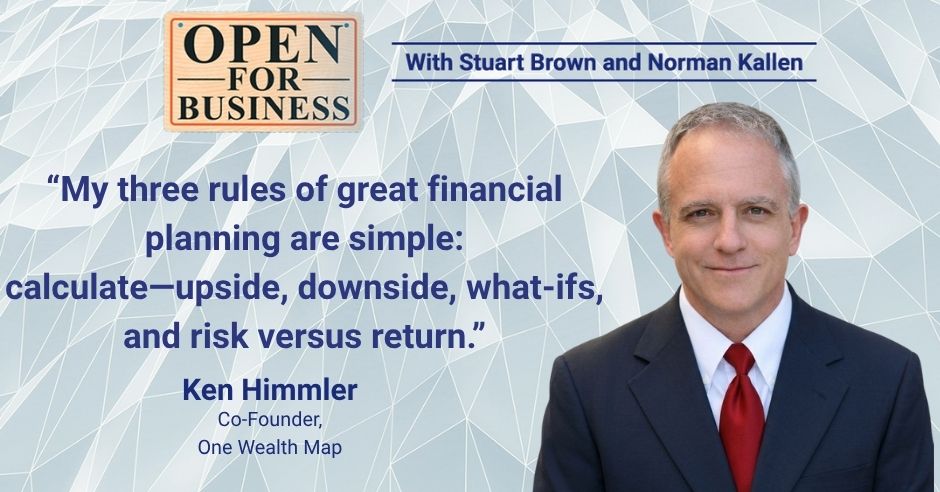
Ken Himmler joins Stuart Brown and Norman Kallen for a compelling conversation about the blind spots that often prevent business owners from building lasting wealth through their companies. Drawing on decades of experience advising entrepreneurs through growth, succession and liquidity events, Ken explains why success requires more than intelligence or hard work — it demands the right advisors, the right strategy and the right mindset at every stage of the business lifecycle.
Ken shares why growing companies must continually elevate the sophistication of their advisory teams, moving from “little league to the big leagues” as the stakes grow higher. He explores how a cohesive team of cross-disciplinary advisors can help owners expand intelligently, strengthen cash flow, prepare for a successful exit and align business decisions with long-term personal goals.
The episode also examines the personality traits common among the most successful business owners, why emotional intelligence often matters more than traditional credentials and how overconfidence can quietly limit exponential growth. Stuart, Norman and Ken discuss why net worth without healthy cash flow can create a false sense of security, why succession planning should begin far earlier than most owners realize and why the next generation of leadership is not always found within the family.
Packed with practical insight and real-world perspective, this episode is an essential listen for business owners seeking to build not only greater wealth but a more meaningful and sustainable life.
Wealth Strategist and Author Ken Himmler Uncovers Business Owner Blind Spots
Welcome to the show where we explore the people, ideas, and innovations shaping today’s business landscape. I am Stuart Brown, and as usual, I am here with my partner, Norman Kallen. Norman, how are you doing?
I am good, Stuart. I am good. How are you?
I am doing well, thank you.
Good to hear. Tell me what is going on.
We will be joined by Ken Himmler. He is a veteran wealth strategist and a financial educator. He has spent more than 42 years helping business owners and families navigate succession plans, business sales, retirement planning, and major liquidity events. He is also the co-founder of One Wealth Map and the author of the best-selling book, Live Rich Stay Wealthy, which I think we all would abide by or subscribe to, which sold more than 25,000 copies in its first two weeks.
Ken has been around. He has been featured in major media outlets such as The Wall Street Journal, NBC, and ABC. We will be discussing with Ken the current focus of his practice, helping business owners uncover the blind spots and uncoordinated advice that can quietly undermine succession plans, family wealth, and successful exits. Let us get it started.
—
Ken, welcome aboard. Again, thank you for being here. You often talk about “financial blind spots for business owners.” What are the most common blind spots you see among otherwise very successful entrepreneurs? Before you answer that question, explain to the audience what financial blind spots are from your perspective.
Defining Financial Blind Spots for Business Owners
These are things that when people work really hard for the money, and they think that they are going to have some result, and then they do a transaction, and they do not see that result. That could mean more taxes. It could be a failed sale. It could be a failed note that they are holding for the sale of the business. It could be one of the big ones, which are employee lawsuits that happen right after a sale.
That is a very common one because employees sometimes think that they are entitled to more than they are. They think now the business owner is super rich, and they claim all kinds of things. There are a lot of blind spots, but in summary, it is just not knowing what you do not know because there is a lack of a cohesive team that has experts with experience who can tell you about those blind spots.
You run across business owners who are excellent operators of the business, very successful. Why is it so successful as an operator when it comes to either long-term wealth planning, preservation planning, or succession planning? They are so bad at it.
It is called the confidence complex. Typically, it is more so with males than it is with females. Statistically, if you look at successful sales, women are much more methodical and detail-oriented. Men are very competitive. They think everything is going to work out. Some of them talk about this as what is called a positive quotient. Sometimes, business owners are too positive because if they have done well and they have run successful businesses, they think that they can apply that everywhere.
That relates to the same idea as physicians who have a God complex. They are very educated people, but I do not know if you have seen this statistic, but out of private planes that are licensed to doctors, they have 80% higher crash ratios than any other profession. They are too overconfident. They think they can do anything. I have run across, years ago and still do, doctors who think because they are smart and educated, they can grasp anything, and they will be good at anything. They are not.
The Little League Coach Problem and Fragmented Advice
It is to your point, leave those things to the professionals who can do them and learn from them. I totally agree. That moves on to point number two, where the blind spots are, not having a cohesive, educated, experienced team. A lot of times, and I explain it this way, what I have learned, because this is now going on 40, this July will be 43 years of practicing, this is all I have ever done. I have got a lot of experience, thousands of experiences. What I try to recognize are patterns of what happens over those experiences.
One of the patterns that I see commonly is what I call the Little League coach problem. As we all know, when you are a kid and you start playing baseball, you get a little league coach, and typically that little league coach is at the level of little league. As you move up, if you play high school, you move up coaches, you move up to college, you move up coach quality. If you go to the pros, you’ve got the best. The problem is, relationships are formed when somebody starts a business, and they get the little league coach, because that is what they can afford at that time.
As they grow their business, they do not upgrade their coaches because a lot of them just do not want to break a relationship, and they do not look at it like a sports team. A sports team says, “Look, if you are not performing, we have to cut you, trade you, bench you.” Most business owners say, “I have been working with my accountant for twenty years. He knows everything. I love him to death. We golf together.” What is the reason that you cannot fire him? It’s because if he is your friend, you tell him you need to upgrade advisors. He will still be your friend.
If he is your friend because you are giving him business, he is not really your friend, and he is tying you to that relationship. The biggest problem is that business owners do not upgrade their coaches. What happens is they fragment. If we look at the perfect situation, it is not available to everybody. I will use a great example, the Goldman Sachs family office.
Now you have the highest-quality legal, tax, investment banking, and insurance services. In a family office at Goldman, everything is combined together. They are all under one roof, communicating together, working together. You usually have ongoing meetings where they are all communicating together. I ask every business owner, when was the last time you had a meeting with your CPA, your lawyer, your financial advisor, your insurance agent, and whoever is putting your M&A together, and they all work together around one single table to develop one single plan for the betterment of your outcome?
Nobody says yes. They are fragmented. The business owner has to run down to the lawyer, then to the CPA, then to the financial advisor. The business owner is supposed to be the expert at making sure they are all connected and all doing the right thing. You get gaps, you get overlap, and therein lies large losses and potential liabilities.
That is a very astute comment. We see that often as well. How do you then speak to a business owner to say, “You need to coordinate your advisors, your professionals,” because a lot of times a business owner does not want to do that, to your point earlier, because it will offend someone. Who does that for them when they say to you, “I cannot do that. Someone has to do that, so I am successful and have the right people in the right seats.”
There is what I call a confidence scale of cost. What that means is if you are confident enough, you can go to your advisor and say, “This is what is best for the business,” and their feelings do not get hurt. You are not worried about hurting other people’s feelings because, just like a baseball team, just like any professional team, the manager is not going to go to the pitcher that has been tanking and say, “Listen, I do not want to hurt your feelings, but you have not been performing.” It is like, “Here is your scoreboard. Here is how you are going to keep on the mound.
You either perform, or you do not perform.” It is a known fact, but when you get to businesses, it is so interesting how they do not look at it like a team. They look at it, “We got a family.” Your business is not your family. Your business is teammates that everybody is required to perform, including your advisors. If you cannot come to the conclusion of saying, “Listen, I got to have a hard talk with you,” you should not be running a business to begin with, just like you would never be allowed to manage or run a professional team if you do not have that acumen of being able to go to those players and say, “Either you improve or you are cut, benched, or traded.”
Your business is not your family. It’s a team where everyone—including your advisors—is expected to perform.
Let us unpack that for a minute, because I think you are talking about, and correct me if I am wrong, you are talking about a couple of different scenarios. One is the ongoing business environment for that company, per se. The other is in connection with a liquidity event, a sale. It is two different scenarios. In the former scenario, where you are talking about ongoing business and the business owner or owners have this group of advisors, are you suggesting that the group of advisors should meet regularly with the business owner, let us say, monthly or quarterly at least?
It is a nice suggestion in a rose-colored glass world, but the fact of the matter is, I, a little bit of history. I worked for a family office for about nine and a half years, and everything was under one roof, so that is all I really knew. When I went out and hung my own shingle, and the only reason I did that now in retrospect, had I just stayed with that firm, I probably would have made more money, had a better lifestyle, and had more free time. I was in my mid-twenties, and I had a lot more hubris and confidence than I did since.
I said, “Just like every entrepreneur,” I think Michael Gerber talks about it in E-Myth, “the entrepreneurial journey and mistake is I can do better than my boss.” You just do not know what you do not know. I went out on my own, and laughingly, I had almost zero income for five years because I could not reassemble what I had because of the amount of capital that would take to go and hire inside counsel, inside tax analysts, all the different people, I did not have it. I had to relegate myself after I learned my lesson to run a fee-for-service, fiduciary financial planning service, and we did tax planning for a fee and tax prep.
All the other services, I did not have the capital to bring in. Here is what the problem was. When I tried to coordinate all of the other advisors, maybe they kept their CPA, and I am trying to coordinate with a CPA. CPA does not want to coordinate. That is not their business model. They want to transact and get through things as quickly as possible. They are on their own little island. They have their own little process of how they do things. Same thing with the lawyer, same thing with the multiple insurance agents.
After whatever it was, 25 years of feeling like I was herding cats, I decided to sell because I thought, “I just cannot do this. I cannot bring everybody together.” Let me give you an example in day-to-day operation. You go to the lawyer, and you say, “Listen, I want a buy-sell agreement. Here is what I have discussed with the client. Here are all the different financials.” I get a draft, or sometimes I do not even get a draft because they keep me out of the loop. Now I am chasing that loop down, but then I get a draft, and I am like, “What is this? This is not anything that we talked about.”
They talked to the attorney, and he said, “Yes, but I have made some decisions that I think were in the best interest of the client.” How do you know that if you did not know all the financials? You are always chasing this. I would love to say that if somebody could figure out how to get all these independent professionals around one table, I would love to know how to do it, because I tried it for 25 years.
When I sold that company, I sold that firm in 2014 to a large private equity company. Now I had more money than I knew what to do with, ever would need. Now I said, “Wait a minute, I am going to carve out some capital, and I am going to start a family office.” Now I had the capital to go and physically hire all those people under one roof. That made all the difference in the world.
How do you convince the business owner that that is the best course? Most business owners have never done it that way. They are used to fragmented discussion points. Again, occasionally I see your point with the CPAs, with the accountants. People are very protective of their little fiefdom. They are always worried that someone will step over that and be frightened to death. By the way, accountants are no different than the controllers. We see a lot of accountants who do not want to encourage a transaction because it is a nice annuity to do the tax returns every year. If they are not audits, certainly the reviews, etc. How do you convince the business owner, “This is in your best interest. This is going to work for you.”
It is interesting. You can break that up into business owners. I have a couple of different levels of personality that have developed over the years. The first one is the DIYer. There is absolutely no hope for them. They will never succeed at a massive level. They are the people who think that they can do it all themselves. They are smarter than everybody else. They are not humble. You have the next level up, which is the skeptics. The skeptics will step back, and maybe you can convert them into a collaborator, but most of the time, they are just so skeptical of everything that they are not going to listen to a thing you say about coordinated teams.
These are the two bottom levels. I find it interesting as the personalities relate to their net worth and their cash flow. DIYers, lowest net worth, lowest cash flow. Skepticals, lowest net worth, lowest cash flow. Now, you move up to the upper two levels, where you have collaborators and delegators. Collaborators are pretty good, but sometimes they want to throw too much of their opinion in, and they are good because at least they are humble enough to say, “Yes, I think I need some help.”
You have to be very careful not to say, “This is what I am getting from advice from three different people, but I am just going to do it my own way.” We see that sometimes, with collaborators, they want to be too much of the mix. It would be like me going and hiring a surgeon to take out my appendix and not going under, going, “Wait, doc, hold on, I am here. I want you to cut there, and I want you to tuck there.” It does not work sometimes, right?
It depends on the level of the collaborator. The best people and the most successful people I have ever seen are the delegators with inspection. It goes back to that old saying, always inspect what you expect. A delegator basically hires. They spend most of their time finding the right team, the right people to coordinate, but then they still inspect, meaning there are outlined KPIs, there are outlined deliverable reports that they can look at.
The most successful people I’ve seen are delegators who inspect. It comes back to the old saying: inspect what you expect.
I would not say it is a matter of trying to convince all business owners. I have gotten to the point after these many years. If I label somebody as a DIYer or a skeptic, I am done. I am not even going to go down the road of explaining anything. They can live in their own little world. I do try to help those people who are collaborators and definitely the delegators. The delegators are the ones who we see the biggest returns and biggest outcomes. Where do you get involved then?
When someone contacts you and says, “Ken, I need your help. I have a family-owned business. I am not quite sure what to do, how to do it. I am not sure I have the right people for the right place. My son wants to take over the business. I am not sure he is the right person for it.” Are you involved in those discussions with families to assist them? That is a little bit of what you do on the coordination side.
Yes. The process is probably much like yours. There is a collection of data, a discovery process, and then a decision. Are we even going to work with this business owner? For me, at this point, it is interesting that in the first ten years of practice, you are 90% based upon what a client is willing to pay you, 10% how they treat you.
We know, trust me, we know the feeling.
You get to my old age now, and now it is 99% who that person is, because we know that we can help 90% of people, but we do not want to deal with those people who cannot work with us to help themselves. The personality hurdle is the first one. Two is a cost-benefit analysis, because we may not be the right firm for everybody. We go through, and we do a tax plan, an asset protection plan, a corporate structure plan, liquidation planning, and then how does that integrate back in? That is a big gap. Many people have these two separate teams that own businesses.
They have their personal financial advisor, which generally is not, again, a professional-level coach because they stuck with them from the beginning, or they might use one of these big wirehouses or financial institutions. Most of those guys sit in a cubicle, they pass a test, but they are not deeply educated and do not have the experience. On the other side, they have their business advisors. They got their CPA, they got their lawyer. The problem is that no one is bringing all these pieces together into one unified, cohesive plan.
They got to retire. I would tell you, I would say 50% of all the businesses that we meet with would have sold years beforehand if they had coordinated their business and their personal financial planning together. A lot of them come to us, and they will say, “We do not know if we can retire or not. This is what our accountant is telling us.” We said, “You could have probably retired, you could have sold this thing and retired a decade ago.”
Again, you have this protectionism. The financial planner on the personal side or the financial advisor on the personal side does not understand what that client could do with a sale or how to operate it. He is not getting the advice of, “You could have sold this thing years ago and picked up another job or hobby or traveled the world or whatever.” The gap is that business advisors should be the same as personal advisors. They should be cohesive.
What is your advice to that family business owner who is considering a liquidity event, whether a succession plan or a sale, when, let us say, she has her daughter in the business, and she knows full well that her daughter is probably not capable of managing the business successfully going forward?
Navigating Family Business Dynamics and Succession
You are probably asking the question as a parent. What is the best thing you can do for the child? Do you want to put that stress on your child? Do you want to put that kind of potential disappointment that you are going to be disappointed in them? They are going to be disappointed in you. Again, if you ran a professional baseball team, would you put your kid in there with nepotism? Let us just say, “It is my kid, so I am going to let them star on the team.” No, it is a team. It is a professional athletic team. You’ve got to treat it like that. If you have practised nepotism. Listen, I have tried doing it. I have tried bringing one son in, and I had to fire him, and I was very clear about it.
How did your wife feel about that?
My wife and I were very clear with him. We did that when he was, I think, 14 or 15 years old. Of course, he went through his little emotions of anger, sadness, and resentment, and we just kept telling him, “We run a team here. You are on the team. If you do not perform like every other team member, you get the results of how every other team member that does not perform is going to get.” As he is now closing in on 30, he said it was the best thing that ever happened to him. Best thing.
He said, “That is what shocked me into knowing that I need to perform.” To give you an example, one son, he started going to design school, FIDM, in LA. I could not believe it, but that darn school cost more than Harvard. As I was choking on the bill six months in, he came to me and said, “Dad, this is ridiculous. Waste of money, waste of time. I would have fired that professor on day one. I am helping that professor show how to design certain things.” He said, “Here is what I want to do. I want to quit school and go work for somebody because I will get better experience.”
I said, “Whatever you want to do.” On one side, I am like, “It is the best thing.” On the other side, I am like, “Thank God, no more checks like that.” He did that at age eighteen. By 21, he was actually the project manager. Now he is running multiple teams of, I do not know, twenty people with no college education. He is managing all those people who have those college educations. If you are a parent, your job as a parent is not to be a friend. It is to be a leader, and a leader is going to make hard decisions. That is where good parenting skills and hard decisions come in.
That is absolutely correct. Obviously, sometimes someone outside has to read the riot act to the parents to explain it to them because it is very hard sometimes when you are inside to do that. Let me ask you, how often have you been called upon by a parent to say, “Listen, I cannot have that conversation with my child. I want to use you as the crutch to help convey that message.” Has that happened to you before? Have you seen the good, the bad, and the ugly in that regard?
Probably once a week. I just had it yesterday. The wealthy guy has two sons. One son is very financially astute and listens to his dad. The other one is a manager of a restaurant, and he shared with me, “He just will not listen to me.” I said, “Look, it is okay.” I said, “There is that old saying, ‘A prophet in his town has no respect.’ You can never gain. He looks at you like my dad. ‘My dad is old, he does not know anything. I know better.'”
That is just every child’s makeup. My dad had two PhDs, and I grew up like that. Like, why would he do it? As I got older, I was like, “Now I get it.” I am not immune to that either. I said, “Sure, of course, I will meet with him individually.” He goes, “Just tell him the things you are telling me because I know what I need to do, and he needs to do the same things, but he is not going to listen to me.” I am called to that duty all the time. As I say, like 75% therapist, 25% tactician.
As you are saying, we had a former guest, a guy by the name of Jeff Savlov, who is in the business of speaking with the children of ultra-high-net-worth individuals to prepare them for what they face as they go through their lives. He took the same position you did, that a lot of people just effectively ignore reality and say that “My kid, just by virtue of being born to my family, is capable of running this business.”
It bleeds out into so many different areas. When we are helping a client decide on certain things, they will ask us, “If we design our family trust, do you have any experience with who might be a good choice as a trustee?” While we are not lawyers, so we do not tell them, advise them, I can share with them that I was a professional trustee for about eleven years with some of the country’s wealthiest families. I can tell you who I would never name as a trustee is a child, ever, especially if they are siblings.
I will tell you, probably 50% of the time, clients listen, 50% of the time they are so immune to reality. It is, “My kid is so smart. He is so good with money.” Money creates emotion. The lottery statistics prove that. What are the statistics? Ninety percent of all lottery winners lose the money within five years, and at least 70% of lottery winners need therapists, and they go into depression. Why would your child be any different in your business or even as the trustee of your trust?
Let us switch gears a little bit. As you are pointing out, business owners are often very heavily concentrated in one asset, namely their business. How do you help clients think about diversification as they are approaching an exit?
Concentration Risk and Diversification Strategies
It is really the same thing. You get some clients that we manage and have assets under advisement of about a billion or so, and if you get somebody that has concentrated positions, I just got one just a couple of weeks ago, 100% in the tech market, and his response is, and I have seen this so many times, “I have been in the tech market. I know the tech players. I know exactly what they are going to do and how they are going to do it.” I was there in 2007 and 2008, where I got all these people coming to me from Cisco and Cisco Systems, the tech players.
I had all these people, and I would say, “Look, you got all your stock options, all your 401(k) stock, everything is in Cisco. You need to diversify and not be so concentrated.” Maybe 50% of the people listen to me. I will give you one example of this. I had a guy, and I will never forget this guy. His name was Rodney. Cannot mention his last name, but he came to me, and now you are talking about 1999, and he had a hundred percent in Cisco, and just to give you an idea, way back then, I think it was $3, $4 million, something like that. I tried to talk them off the ledge.
“Rodney, look, you’ve got to diversify, not concentrate.” “No, I have worked for Cisco for 30 years. I know them inside, nothing is going to happen.” The tech market crashed, and NASDAQ went down 60% in 2000. It was $3, or $3.5 million. It went down to like $700,000. He had to go back to work at a grocery store, a bag of groceries down here in Florida at Longboat Key. He takes the remaining $750,000, and he starts buying these lots, the land lots in Punta Gorda in Florida, near Sarasota. I am doing his tax returns every year. Knowing this guy is not listening to me about any logic whatsoever.
We all remember what happened to real estate in 2005 and six. It went through the roof. It went up 1000% for no apparent fundamental reason. Now he takes the $750,000, and he has got $7 million in current value within a very short period of time in these lots. What do you think I told him again? “Rodney, you got everything concentrated. You lost it once.” “No, I am smart.” He kept quoting Roy Rogers, “Well, they do not make any more land, so it is the safest investment.”
That is very interesting as well. Given that, what are the business risks that business owners today, in your opinion, are least prepared for? For example, economic, tax, litigation, regulatory, geopolitical, and family. Just changing the business environment, how to adjust to that.
Addressing Business Risks: Stress, Taxes and Litigation
The biggest issue right now is that I see business owners want to sell because they are stressed out. They are stressed out because they do not have a plan. They do not have a good team. I have been there. Listen, I have had some teams that literally aged me because they just were not right. I have gone through the same mistakes of “I can coach them, I can help them.” They are good people at heart, but they just made life miserable.
The biggest issue right now is that many business owners want to sell because they’re stressed—and they’re stressed because they don’t have a plan.
I ended up just having to fire that entire group of people and start over again. A lot of business owners just do not have the confidence to do that, or they just do not want to rebuild. They get into this position of “I am so stressed out, I just want to sell.” What happens is they are selling out of emotion. What bites them is the huge tax bill. I have seen this uprise employee lawsuit, and it is incredible. Of course, it depends on what state you live in.
Obviously, California is probably one of the worst, but any litigious state, what happens is these employees think, “That rich guy, he has got all the money, and I am working for these paltry wages, and I am entitled to more.” I am going to claim ADA violations. I am going to claim pregnancy discrimination. I am going to claim unpaid wages or unpaid overtime. We all know how that works out. You will never win as an employer. Never. The legal fees are going to bury you so much that you might as well just settle. They do.
Let us talk about the post-liquidity event. How often do you meet with a business owner and you talk about, “Have you put together a plan for what you can do after you sell a company, assuming you are not part of the transition team or the transition period is light, is short?” Have you had that conversation? How does it typically go? How many people actually plan for that?
Almost none of the people have planned for that. That is why they usually hire us, because what they need to know is what is the most tax-efficient way to sell. Will I be able to retire with the income that I need from that sale, based on the deal structure of the liquidation? How do I avoid, reduce, and eliminate taxes? Yes, I would probably say that the deal structure and the initial way somebody is setting up a liquidation event are equally as important as having a plan for what they do with the money once they liquidate.
They are coordinated, right? If you have the proper deal team in place and an experienced accountant, lawyer, wealth planner, and so on and so forth, that team coming full circle should work on a coordinated basis with the business owner to allow the business owner to know upfront what she is going to net out of the deal and frankly what she needs in order to live the lifestyle that she wants to live.
Yes, as a matter of fact, we are going through that right now. The client basically wants to sell this company to their employees. It is a great idea because in this particular instance, these two employees have been there since the start, like 30 years. They can run the company. They run it now, and they have the ability to borrow the money. In the deal structure, we are talking about what the difference between the down payment and holding a note is, and whether the note should be interest-only or amortized.
That is coordinated not only with the deal terms, but what does that look like from a tax perspective for cash flow for the sellers? As we know, asset sales versus stock sales are very different. The down payment will constitute what you pay in tax that year. Deal structure on the remaining note. Amortization, interest only, balloon. That has a conduit into the tax planning and can severely increase or decrease the amount of cash flow and solidity that the seller has.
Let me ask you, from a non-wealth perspective, from a non-financial perspective, how often do you ask the question, “What are you going to do when you retire? What are you going to do with all this money? What is going to happen? What are you doing with your life and your family, and have you planned for all that?”
It is the first question. I know some clients get a little irritated if we book an hour-long meeting. The first 40 or 45 minutes are understanding them, their family structure, what they are going to do, what their health is like, all non-financial questions. What I find a lot of times is that people do not have a transition plan. They want to sell because they feel they are older, they just want to get out, they have been doing it long enough, and then they sell. I will give you a great example of this.
I had a very famous doctor as a client, and this guy was in neurosurgery. This is probably going back about twenty years. I took him on as a client when I was in Florida, but he was in Syracuse. This is no joke. This guy came into my office, and this was back in the day of Palm Pilots. It is to you how long ago it was. I am trying to talk to him about his financial situation. This is no joke. I do not know how he did it. He had two Palm Pilots. He is going like this, and he is working on both of them, answering stuff. Finally, I am getting a little perturbed.
I said, “Doc, can you put those down because I do not think you are paying attention to anything I said?” He put them down, and he recited everything I said from beginning to end. I was like, “I want that brain.” I do not know how he did it, but he did. He was. I do not multitask well, but this guy did it. Anyway, we set up a retirement plan for him. He sold his practice, sold everything. You would not believe that within nine months, he had no plan. He kept saying, “I will get to it. I will figure it out.” He had no plan. Within nine months, when he came in, this guy had lost probably 50% of his cognitive ability.
After three years, he ended up going to a nursing home facility. It is really important that you find out what your passion is, create a why, create a reason, and create what you are going to do. It should be rooted in passion, not hobbies, not golf, not travel. Those all burn out after you go through that little honeymoon phase after you sell, which is usually about 24 to 36 months. Once that honeymoon phase is worked out, it is like marriage. Once the honeymoon is over, you’d better figure out how to work it. Same thing when people sell, they do not have a plan. It is not healthy.
What are you saying? Give us an example or two of a passion that you have seen people successfully implement post-sale, as opposed to golf, tennis, or mahjong.
No problem. I would say the people that I see are the most fulfilled are those people who find intent on helping other people, whether setting up a family foundation, getting involved in voluntary services, or setting up another business that might be their passion. Most of the time, people sell it because they are stressed or they are tired and they need something novel. When you give them maybe a new business, some of them get fired up, and they lose 20 or 30 years off their life. They are young again.
It is interesting to say that we had a speaker on our interviewer, interviewee, a while back, who talked about the second act and talked about voluntarism, about charity, etc., when they posted the closing. It is really nice to hear. It is the same message that people are really motivated when they plan beforehand and get involved in these charitable events. It is really nice to hear that. I want to cut over for a minute and ask about your book, Live Rich Stay Wealthy. Give us a little summary of how you came up with the idea and what it really speaks about.
It mainly went to the fact of how fragmented the financial industry is and how people make really bad decisions based on emotion, and they do not form their decisions based on calculations. One of the things I have always said for many years is that if you ever asked anybody what the three rules of real estate are, it is location, location, location. My three rules of great financial planning are calculate. You calculate upside, downside, what ifs, and risk to return.
You have the basis for good decisions. Not that they are always going to work out, but if you use calculations as your methodology, then you are going to have a higher winning percentage of good financial decisions. Really, the other part of that book is how to hire the right people and then how to oversee them. I go through the disparities in legal, accounting, and certainly financial advisory services of these guys calling themselves fiduciaries, but really, they are selling annuities and mutual funds.
You have got the other guys who are calling themselves wealth managers. The minute you ask them about a tax question, they will say, “I cannot answer that. You’ve got to see your CPA.” What does wealth management really mean, then? You will even see some of the statements from the biggest planning companies, investments, and tax planning. You say, “If I do this Roth conversion, will it work?” “No, do not do it.”
There is a bias there because they do not want to lose the assets under management. They are not doing any calculations. This is a giant. I would say it is like a hand grenade with fragments going all over the place, with the different kinds of advice you can get. I really try to nail down in that book, how do you interview the right people? What are the questions to ask? How to verify who they are, what they say that they are, and then how to assemble the team, and then how to oversee the team.
It is a little different. I like that. Do you believe that entrepreneurs or your clients confuse net worth with financial security?
Defining True Financial Security Through Cash Flow
Completely. I have guys coming to me, they are like, “I am worth $30 million.” “What are you making per year?” “I am making $500,000.” “Okay.” I do not care what your valuation is. If the stock market never taught you that, then you need to have a new lesson. The lesson really is, what is the cash-on-cash flow that is coming out? That really determines your financial security because the bottom line is you take your company and it is worth $30 million. Try going down to the utility company and paying your light bill with your valuation. Your light bill is paid by cash flow and nothing else. Financial security is based upon the assets you have that can provide cash flow, not what it is worth today.
Financial security is built on assets that generate cash flow—not what they’re worth on paper today.
That is important. The context we talked about earlier was between tax and financial planning. As you said, look at what you are going to sell the company, what you are going to sell your company for, look at what cash you are going to have remaining, and, as Stuart said, can you live off of that? You can only do that, as you said, use the terminology, if you do the calculations. People do not like to sit down and do that.
You are right. I have to tell you, Ken, that if this were an article rather than a podcast, what you just said is what I would highlight as the most important comment of the entire article. You are right. I think you are absolutely right in that regard. Thank you for saying that, especially for the people who cannot really appreciate it. Hopefully, they can now. Do you see in your travels, and I am assuming you are dealing primarily with high net worth individuals at this point in your career, do you see a tendency among affluent business owners to become overconfident because they have been successful in business, but not financially per se?
It really depends on the size of the business. What I found is that the larger the business, the more ill confident that they are and they are open to, they are humble enough to take advice. Here is what I find. Between about the two to $10 to $12 million in revenue per year, they are overconfident. When I meet with the $25, $30, $40 million a year company CEO owner, they are not. That is what has made them get to that point. They are humble enough to say, “I do not know anything, everything about it. Educate me. Tell me upside, downside, summarize options.” That two to $20 million, $15, $20 million guy is like, “I built this, I know what I am doing, look how successful I am, I can make any decision the right way.”
Let me ask you on the exit side of things, how early on in ownership of the business should the business owner start to think about exit planning, both from a financial perspective, from an operational point of view, and certainly from a family perspective? How early in the game? When do you start thinking about that? When you get to that point, whether it is a planned sale or an unsolicited offer that you get, you are ready to go.
If I had the choice, the answer would be the minute you organize the company. I will give you a great example of this. This is going back probably 25 years ago, I had a physician, he is an MD, not a practicing MD. He came in to see me for a tax plan. I am doing his tax plan. I said, “What do you really do?” He goes, “I am not an MD. I do not wear a white jacket, but me and two of my two medical school buddies we all got together. We created this little research company because we are good at chemistry, and we are developing this new chemical to kill citrus canker,” which, at the point, even living in Florida, Tropicana is running around the corner from us.
I did not know what that was, but apparently it is a fungus that, once it invades an orange citrus grove, it just wipes it out to the point they have to burn the trees, they have to burn the dirt. It is an expensive problem. I said, “Wait a minute, how big is this problem?” He said, “It is worldwide.” I said, “Citrus is actually the least-produced product here in the US compared to the total citrus market.” I said, “Wait a minute, how much would this be worth?” “Millions and millions of dollars.” I said, “How do you have this set up right now?”
He says, “We have it set up in a partnership.” I said, “My gosh, who did that?” He said, “My CPA.” I said, “We’ve got to change that right out of the gate.” We reorganized into a C-Corp, and then he had two partners. Now, keep in mind, I went to the partners, and I had this same discussion with them as I did with my client. Neither of them followed what I told them to do. What I did with Art, with my client, is I set up what is called a ROBS Roth, and we converted $25,000, which was the current valuation that we came up with of this chemistry company.
We converted $25,000 into his ROBS, the ROBS bought the company’s stock, and the other two did not do it. They still owned the C Corp stock, but they would not do what I was suggesting. To make a long story short, three years later, he sold that company for $25 million, and it is all in his Roth, 100% tax free. If you ask me when the perfect time is to plan, it is before you start your journey.
That is the time to figure out what is in your backpack, not when you are in the middle of that journey. Obviously, many people have been operating for a number of many years. I would say there are three levels. In five years, we can work wonders with five years. We can undo all the bad tax plans. We can reorganize certain capitalizations. You get to about three years, and it gets a little bit less. You get one year, the least amount of efficiency possible.
We are coming to the end of the hour. Let me ask you a question because I think about it like this. You are the audience, and you have taken in all this information today. Now you are thinking to yourself, because everybody internalizes, “Which characteristics do I most look like here? What have I done wrong? What have I done right?” Toward that end, when you look at clients who have had successful transitions, both financially and personally, what do these successful people tend to have in common? I want our listeners to match up to what they actually do.
Common Characteristics of Successful Transitions
If I took my hundred million dollar clients, put five of them on my fingers, every one of them has a pattern. They are humble. They listen. They do not try to make it out like they know everything. They act like those top-end CEOs. That is the mindset that makes them successful. The minute you get somebody like, “I know this, I know that, I do not want to hear about it. This is my belief. This is the way I have always done it,” I already know which direction they are headed.
Many people we talk to are in a similar situation, so many things are emotionally driven. It is really difficult to be dispassionate and be factual and say, “Let me just look at the numbers, look at the calculations, stop getting emotional because it is your family.” If it is a family-owned business, and a lot of times, if it is money, it is a personal thing, but you have to do that. You have to be dispassionate about it to be successful.
I would say a business owner should probably measure their EQ and their emotional quotient, go online, there’s a whole bunch of tests, and really measure what your EQ looks like and how you make decisions. There are studies out there on the EQ of the top athletes, the top performers, the top politicians, the top CEOs, studying their EQs and starting to make changes to match their EQs. Your business will be better, and your decision-making will be better.
That is a good conversation for another day because I think emotional quotient is really important. I was at an event that had a speaker talking about that, and I had never known about it. To your point, it was amazing how valuable that information is.
Yes, no doubt. I wish I could pull a piece of their DNA out at the beginning of the conversation and go, “What is their EQ?” because then I can determine how successful I am going to be in helping them.
That is a great point. That is terrific. Ken, thank you very much for joining us. We really appreciate it. I think that you have successfully guided a number of our audiences through what could be a very thorny situation. Again, thank you very much.
Thanks for having me on. It has been a lot of fun.
The real takeaway here is that you have to be a good listener to people like you and to people around you who provide you with quality advice. Thank you. I am going to say it in a bit of a different way. I am going to say it, probably not in a politically correct way, but I think you’ve got to get over yourself.
Without a doubt. That is correct. Listen, if you are running a professional sports team and your player sucks, and he is, you’ve got to tell him, you’ve got to get over yourself, and just the way it works. If you think about yourself as a sports team manager, it is much easier.
I think that is a great analogy. Thank you. I appreciate it. On a more personal level. Thank you so much, and have a great weekend. Be safe and enjoy.
Sounds good.
That wraps up another episode of the show. This conversation with Ken Himmler was a powerful reminder that building wealth and preserving wealth are often two very different disciplines. Thanks to all of our audiences for tuning in. If you enjoyed this episode, please subscribe, share the podcast, and leave us a review. Only good reviews, by the way. We look forward to another conversation with leaders, advisors, innovators, and others shaping the future of business, wealth, and entrepreneurship. Until next time, stay focused, stay strategic, and keep building for the future.
Important Links
- Ken Himmler
- Ken Himmler on LinkedIn
- One Wealth Map
- One Wealth Map on LinkedIn
- Live Rich Stay Wealthy
About Ken Himmler
 Ken Himmler is a veteran wealth strategist and financial educator with more than 42 years of experience helping business owners and families navigate succession planning, business sales, retirement and major liquidity events. He is co-founder of One Wealth Map and author of the bestselling book Live Rich, Stay Wealthy, which sold more than 25,000 copies in its first two weeks.
Ken previously hosted the Money Talks radio show for ten years and has delivered more than 480 live presentations about wealth preservation, retirement readiness, and financial planning. He has been featured in major media outlets including The Wall Street Journal, NBC and ABC.
Today, Ken focuses on helping business owners uncover the blind spots and uncoordinated advice that can quietly undermine succession plans, family wealth and successful exits.