Afterwork with Joel Malick: How To Prepare for a Fulfilling Retirement
People often see retirement as a never-ending vacation, a time to relax, and a special opportunity to pamper yourself. But instead of sitting around the house or wandering aimlessly without actual goals, you can make it more fulfilling with the right preparation and mindset. Norman Kallen and Stuart Brown sit down with Joel Malick, author of Afterwork, to discuss how to prepare yourself emotionally and psychologically for a meaningful retirement. Joel challenges the traditional notions of retiring, emphasizing why it must be spent on intentionality, giving back, and finding purpose beyond leisure. He also explains how to properly integrate play during retirement to strike the right balance in achieving personal growth, finding genuine happiness, and securing your finances.
—
Afterwork with Joel Malick: How To Prepare for a Fulfilling Retirement
Welcome back to the show. Norman Kallen here, with my business partner and co-host, Stuart Brown.
Norman, how are you?
I’m good. How are you doing?
I’m fine, thank you. I’m looking forward to our episode. It’s going to be super. We’re going to be joined by Joel Malick, who’s going to be discussing a very timely subject for everybody from 20 to 70, which is retirement. You may be thinking, “If I’m twenty years old, why am I thinking about retirement?” I don’t know about you, but I was thinking about retirement at like 13, 14 years old. It’s a pretty timely subject, and everybody will learn something from this one.
It’s a great subject, particularly one of our focus areas, the business owner. You’re right, the old expression, begin with the end in sight. Retirement is the end in sight. You have to keep that in mind.
We also have to define what retirement is. I don’t want to steal Joel’s thunder, but retirement means different things to different people. We’ll have to get into that conversation.
It’s a great topic, as you said. Before we jump into that, what’s going on in the world? Let’s take a minute and bring everybody up to speed. What are some of the biggest issues out there, the biggest concerns that everyone has as they look out on the world?
Let’s start with something simple. How about the economy? It’s no big deal because there’s uncertainty, there’s fear, there’s job loss, there’s inflation. I guess we can pick every letter of the alphabet and come up with something.
Does the word tariff mean anything to you, Stu?
I’ve heard of it before. Today it’s off, tomorrow it’s on, the next day it’s off again.
Understand this is not a political show.
Not at all. All we’re trying to deal with is certainty, whether you are a business owner, whether you have money in your retirement account. The biggest fear we all have is uncertainty, and that’s where we are in the economy.
Is your 401(k) now a 201(k)? We don’t know.
Good expression, exactly.
The question is, and it ties into what we’re going to talk about, do you have the right financial plan to retire, and do you have the right emotional plan to retire?
People are too focused on the first part, not the second. The second can be as difficult or as good as you want it to be, and to make retirement as good or as bad as you want it to be.
It’s not all bad. It’s almost springtime, the flowers are beginning to bloom, and it’s almost baseball season.
Daylight saving time, too.
That’s right, and March Madness. We’re recording this during March Madness. In my opinion, nothing is better than watching March Madness.
Did I tell you my wife has won three times in March Madness, not surveys, what do they call them? We bet on March Madness contests or whatever.
The brackets?
The brackets, three times. My wife has no knowledge of basketball. She picks them based on the nicknames of the schools and the colors. It’s unbelievable. People think that she’s an expert, has no clue about basketball.
Tell us who’s her number one pick.
We haven’t gotten through that yet.
She got to start it.
I know. Whether you’re a lover or a hater of certain teams, we’ll see how that goes. I reaped the benefits of a new TV or some money. That $10 goes a long way. Why don’t we get started? We’re going to welcome our new guest and move on from there.
Excellent.
We’re joined by Joel Malick. Joel is a Colorado-based financial advisor and author of a best-selling book entitled Afterwork: An Honest Discussion about the Retirement Lie and How to Live a Future Worthy of Dreams. Joel, welcome aboard. Thank you for joining us. We appreciate it.
It’s great to be with you, guys.
Introducing Joel Malick
Thank you, Joel. Before we get started, tell us something about your background, how you got started in this, and how retirement became such an important focus of your life.
That’s a good question because I’m not actually retired, so I’m not an expert. I have six kids. I’m still very much in the throes of raising them. I live in Colorado Springs. I went to college in Seattle as a soccer player, and I also went to school as a part of that.
What position did you play?
I was mostly wing. I was the one doing defense and offense on the outside, a lot of running.
Stu was a soccer player and a football player too.
Football player.
The short football career, though.
My son was an excellent soccer player, and it was fun coaching all those teams. I’m sure with all your kids, you’re going to be coaching for a long time.
I tend to be more of a spectator because my kids don’t seem to want to hear from me a lot.
You wonder why that is the case with our kids.
I love watching them. That’s one of the greatest blessings. At that time in Seattle in the late ‘90s, investing was a cool thing to do. I had no idea what I was getting into, but it was an interest. I got into the business. Over time, as I developed longer-term relationships over twenty years with some clients, I started to get to know them well, and it’s more of a relationship than it is a client-advisor relationship. They would share things with me that were beyond their finances.
As I personally continue to grow and get older, the older I get, the more I face some of these bigger, deeper questions. We started to connect on those. I found that to be a lot of fun to talk about in the meetings. Instead of dotting the I’s and crossing the T’s of the financial stuff, we started talking about why maybe someone wasn’t enjoying retirement and what the issues were. You start to pull back that onion, and it’s like, “That’s interesting.” Originally, it was going to be a white paper that I was going to write, something that my clients could use.
We originally self-published on Amazon because we wanted it to be a resource for those with whom we were rubbing elbows. Eventually, I got connected with a publisher, Tyndale. You may have heard of Tyndale. That was a cool story. The bottom line is we want to see people live a life of impact. We believe that when they do that, it tends to be less about them and more about others. It’s interesting how all that plays out. Now, I’m still studying it. I’m learning more and more about this subculture out there that people are doing similar things to what I’m doing, but we’re not connected yet. We all have this understanding that retirement is not all it’s cracked up to be.
We’re going to talk about retirement, but how do you define retirement? I’m sure a lot of people want to understand.
Why Many People Are Not Retirement-Ready
That’s a great question, Stuart. If I could jump in before that, my question is, in your discussions with your clients, did you find most people were ill-prepared for retirement, not financially, but emotionally?
For sure. Part of the problem is we’ve only been doing retirement for about 100 years, roughly. Some people retired in maybe the 1700s, 1800s, but by and large, we tended to run our lives by the sun and not the clock. We were farmers and ranchers. The revolutions that came along moved us more into the cities, into industrial growth.
That’s where we’ve started running more of a working life. At 65, we weren’t seen as useful anymore because we were older, and we couldn’t stand in an assembly line for twelve hours. There were some structural things going on. The Great Depression catapulted us into the retirement season of our lives because unemployment was 25%. There were some real movements going on around the country.
I think FDR had to eventually respond. The Social Security Act was born. We put a stake in the ground at that time and said, “It’s 65.” This whole retirement experiment is pretty new when you think about how long we’ve been around. At the end of the day, we’re learning that maybe retirement isn’t exactly what we want. There haven’t been many generations to try out retirement.
You keep using the word. What does retirement mean in this context?
It’s interesting because at the beginning of our book, in our intro, we talk about some of the synonyms of retirement, which are to cease or to be put out to pasture.
That’s everybody’s perception when you say retire.
It’d be less useful than we once were. For us, retirement is our broadest way to help people understand that you’re moving into the next season of your life. When we say it, some people might think, “You’re a lawyer and you retire from practicing law, or you’re a business owner, you sell your business.” It’s also true for maybe the homemaker whose kids are transitioning out of the house. That’s a major retirement transition for them. They don’t think about it that way, but it’s a big deal. The way we’re defining it is any major transition where you’re stepping away from your primary identity. When you retire as a lawyer, Stuart, that’s a retirement transition. It doesn’t matter if you go get another job, but if you step away from practicing law, that’s a retirement transition in our mind.
Retirement is our broadest way to help people understand that you are moving into the next season of your life.
I hear you, Joel. Mentally, I retired about twenty years ago from the practice of law, but that’s a whole other story.
That’s why you find Stuart on the golf course so often. Good for him.
The way it’s been painted is seasoned to do what you want. You have more time. See those places you didn’t get to see, play a few more rounds of golf, maybe some pickleball. All of these things are great things in and of themselves. I would like to be sure not to bash them because I like playing pickleball. My son and I go out and we golf every now and again. I enjoy a good trip. I like to see new places.
I can understand the illusion of that being your permanent reality. What we don’t understand is that when we’re working, all of those things are experienced in the context of the fact that we have an identity. We’re a lawyer who’s taken a vacation, but we come back and we practice, or we’re inserting ourselves in whatever narrative you want.
You’re stepping out of something for a minute, taking a break, then you’re stepping back into that thing. When that thing becomes who you are, it becomes a little more complicated because you’re no longer taking a break. You’re no longer stepping back into a pre-structured purpose. People are surprised to learn that a permanent vacation isn’t all that enjoyable.
That’s depressing. I have to tell you.
Is that also why there are plenty of people who cannot retire for that reason? They don’t know how to do that. They don’t know what to do. Work is a focus for them. Work is a purpose.
I don’t want to jump too far ahead, but generally speaking, the expectation that retirement is going to be great and enjoyable is very high. We go in with probably misaligned expectations. You know how it is with anything, if your expectation is off and then your experience is one thing, you think something is wrong. In reality, your expectation was probably just not quite accurate. Apart from depressing Stuart, I think there’s an answer.
Please don’t. I still have to work with them.
There’s a way to do this better. In order to do it better, we have to address our expectations. We have to figure out what we want and what my expectations should be. It can be one of the greatest seasons of our lives if we come at it the right way, and not this way of thinking that a permanent vacation is what we want when we just need a good break. I call it a retirement Sabbath. One other book I read on retirement coined that term. I love that.
What I want to encourage people to do is step away for 6 to 9 months. Don’t give yourself much to do. Take in a little more golf, a little more pickleball, maybe some gardening if you like that, or whatever your hobbies are. Dive into them. Don’t have a fixed schedule. Take a good, long break. Before that, let’s think about retirement differently as a season where we want to be planning how we’re going to give back, how we’re going to lean into other people’s lives so that when we’re done with this nice long break, we’re not coming back after the retirement sugar rush and saying, “What am I going to do to fill my time? Is this all there is?” As you guys know, where you live, the winters can get long. You’re not golfing in February.
What To Do After the Sugar Rush
That is true. You raised an interesting point. In your book, Afterwork, you describe the sugar rush of the first 90 days or so of retirement as often leading to dissatisfaction and despair. Once the honeymoon period is over, what do you do?
I liken it to a marriage as well. It’s like you got your honeymoon season. It’s a great season. It’s meant to be enjoyed. It might last longer for certain people. For those of us who have been married for a long time, we know that the real thrust of the marriage isn’t lived in the honeymoon season. It’s lived in the daily grind of maybe you raised a family, or maybe you’ve had arguments. It’s not all honeymoon, and retirement is the same way. You go into retirement, you’re like, “This is unbelievable. No alarm on Monday. We’re going to some fun places.”
“I’m sleeping. I’m not stressed at night.”
“The man is not telling me what to do anymore.” You go down the list. I get it. That sounds fantastic for a period of time. The problem is that after a while, that begins to wear off. You realized that you’re hardwired to live with purpose. Your purpose cannot always just be seeing new places. I don’t know anything about your golf game, Norman, but if it’s anything like mine, your purpose cannot be shooting in the high 80s. It’s got to be something more meaningful than that.
We love that purpose quite frankly.
I’m trying to tee Stuart up as best I can here.
I appreciate it. Your use of the term purpose is meaningful to me. I’ve always lived it, believe it, whether it’s work or on a weekend, you need to get up with a purpose. Otherwise, it gets tiring very quickly.
Get to think about this. What’s going to get you up in the morning, nine months into retirement, on a cloudy, rainy, snowy day on a Tuesday? It’s probably not planning your next trip. There are these things that don’t end up filling you up. Part of the problem is that we’ve defined retirement as a season of self-seeking.
The Power of Paying Forward
In your book, you mentioned these ten keys for designing one’s successful afterwork, if you will, or retirement, or the last third of our lives, which, from my perspective, is a little depressing to think of the last third. I would say the next chapter.
I like that expression, too, the next chapter. You talk about these disciplines, and I think they apply not only to retirement in many ways. I see those as your daily life, too. You said a moment ago about giving. When you pay it forward sometimes, whether it’s paying for somebody’s coffee somewhere, it’s such a great feeling. You just have to learn how to take that to the next level. I think it’s part of this.
That’s a good point. There’s a Nelson Mandela quote I heard recently that I wanted to share because it hits the nail on the head here. He said, “There can be no greater gift than that of giving one’s time and energy to help others without expecting anything in return.” Beginning to see your life as you’re in a situation now in retirement, where you don’t have to work for money, probably, you’ve got double the amount of time that you’re used to having, and you’ve got a lot of wisdom.
There can be no greater gift than giving time and energy to help others without expecting anything in return.
You’ve seen some stuff. You’ve been through some things. You face a lot of suffering, probably. A lot of trials, a lot of highs, too, a lot of good moments. Does it feel like the time to be checking out and stepping away? It feels to me, this is the season to expand your horizons. Maybe now you’ve stepped off the train tracks, where during your career, it was so determined. You didn’t have much time. Now you’re still driving, but you’re in more like a four-wheel vehicle out in the desert.
You’ve got a little more leeway to choose what you’re going to do and where you’re going to go. What I like about that is that if you can use that time wisely, you can have a blast. There’s nothing bad about spending a couple of hours a day helping somebody, and then maybe going and playing golf or mixing it up enough where you’ve got the flexibility to enjoy life a little more, but don’t walk away from making an impact. I would argue that you should build your calendar around the impact you’re going to make.
You should build your calendar around the impact you are going to make.
I like the idea of still doing the fun things that you want to do, but changing your mindset a little bit to where you’re a little more missional in what you do. Faith is very important to me. When I’m grabbing a coffee with a friend or I’m playing around a golf, I know that the person I’m with is dealing with some stuff and whatever it is you’re doing, pickleball or I know we use those, that’s a low hanging fruit options, but you can translate it into anything you want. It’s cool to worry a little less about your score and a little more about the person you’re hanging with.
It’s one of those things that sometimes takes a while to get the hang of it and understand what it means. Once you start to do it, all of a sudden, you reap the rewards emotionally. You have to take that first step to give it a try and realize something good, “I felt good doing that.”
It’s a practice. I would call it a practice, a discipline. You have to have awareness, which is one of the chapters in our book. I think intentionality is the best way to describe it. It’s like when I go golfing with my son, for instance, he’s gotten into golf, and I’m loving this because I’m not going to golf really. I’m a decent golfer and I love golf, but I love hanging out with my son. In my mind, golf is the way I get to hang out with my son.
I don’t know how old your son is, but that’s when I started playing golf with my son. I told people to spend four and a half hours with my son, something where we’re not arguing over anything. We don’t talk about what’s going on in the house. It’s an enjoyable afternoon. It’s talking about the golf game and talking about sports. It’s a fantastic afternoon. It’s a great way to spend part of the day.
First of all, I’ve come a long way because I used to care about how I shot back in the day. That would ruin my afternoon or whatever.
I’m raising my hand. By the way, my son has chilled me back to, “We’re having a good time. Be quiet. Don’t worry about this.”
That’s an easy example because he’s my son. If I went with a friend, it’s like, “Why am I showing up? What can I bring to the table? What encouragement? What types of resources?” Maybe they’re dealing with something with their family, but am I aware? Am I showing up with an intentional awareness to let that 4 or 5 hours also lead to some impact, or am I just there to play golf? The reason this is important is that if you live your life with this missional purposeful mindset, it doesn’t matter what you’re doing.
As you mentioned, Norman, you can be at the coffee shop and feel like, “I’m going to buy this person a cup of coffee.” It can be super simple stuff. It doesn’t have to be expensive, but when you’re walking around your retirement life with this idea that I’m here with a purpose, and my purpose happens throughout the day, all day long. It doesn’t just have to be when I’m volunteering or when I’m serving on a board. This mind shift is super critical for people to make as early as they can. It’s important, specifically, for business owners.
Are you saying as early as they can pre-retirement, or when they enter the retirement phase themselves?
No. Most of the things in our book are best suited for someone who’s not yet retired.
I wanted to clarify that for the audience.
Planning Your Retirement with Purpose
Essentially, what you’re saying is that planning is key.
Plan the finances for sure. Work with a good advisor who can help you, but don’t just assume you’re going to enjoy retirement because you might not. It actually can lead to some pretty poor results. The highest rate of divorce is for those over 55. Suicide rates for those in their older ages are as high as teenagers
You hear the joke all the time. When I’m going to retire, and I don’t want to play husband and wife here. She says, “I don’t know what I’m going to do if he’s home all day.” As funny as that is, it’s pretty sad as well. Hopefully, that’s not the case because I can see that happening when you talk about divorces. You’ve got to think ahead of time, so you have something to do with your life.
Just think about it, guys. If I had you retire tomorrow, and then I made you watch the news about 3, 4 hours a day at home with no real thing to pour yourself into, it would color your outlook pretty quickly.
Certainly with the news, there’s no question about it.
We try to encourage people to turn that off, go for a walk instead, find some purposeful things to do, but we have to start entrenching these mindsets before we retire because they’re not easy. It’s not easy to live on purpose in retirement because you’re tired, or maybe your health is struggling. I’ll tell you this quick story. There’s an organization in town that I sit on the board of. It’s called Crossfire Ministries. There’s this one gal whose husband passed away 7 or 8 years ago. I believe she’s almost 90.
She has lots of reasons to make excuses as to why she’s not doing well or why things aren’t going great. Instead, she comes down to Crossfire three days a week, and she cannot even drive anymore. Instead of sitting at home and doing that, she takes the time to arrange rides to and from every day. She’s super thankful, but every time you ask her how she’s doing, she says fabulous. She’s become known as Fabulous Sherry.
Her only job there is when people come in to access our services, she gives out hugs and makes sure that they know they’re loved. That’s a purpose. Imagine if she didn’t have that thing, her life would be so different. We’ve got to figure out what our thing is going to be. Maybe it’s a couple of things, but those things, you have to work at them.
Integrating Play into Retirement
It’s interesting because in Afterwork, you mentioned a gentleman who I share the name of, Dr. Stuart Brown, who is brilliant, by virtue of his name. In any event, he’s a psychiatrist who leads the National Institute for Play, which in and of itself is fascinating. In your book, you quote him as saying, “Play is a basic human need as essential to our well-being as sleep,” which is incredible. Getting back to the concept of definitions, how is he defining play from your perspective? How does it relate, per se, to fun and entertainment and what have you, or happiness in general?
One thing I love about having my kids at home, and I know I’m going to miss, is that we will get together in the evenings and we’ll play something. I mentioned soccer in our family. We are all a soccer family. We get in the basement, because it’s winter, and we play a family soccer game. It can get a little rough at times.
It’s fun, though. Your kids are at the stats. Let’s knock that over. Let’s go.
Our hearts are pumping, and we’re breathing heavily. Why play is so important for adults is that there are so many things that check the box. You start thinking about physical health. It’s great to play pickleball because you get out there and you’re staying fit. The studies show that stress reduction is reduced when you play because of how the body works. You increase your creativity quite a bit when you’re playing.
Whatever it is you’re playing, it could be anything from art to sport. Your creativity increases. While you’re doing it, you’re improving relationships. It’s a cocktail of great things in your life that you can bring together through play. Most people feel like, “I’m too old for that,” or “I’m too whatever,” or “That’s silly.” I think you’re doing yourself a disservice. It’s good to put yourself in situations that might feel a little silly and try something new.
Silly is a good expression. Sometimes you have to do that to get your mind in the right place. You’re right. It doesn’t have to be soccer. It could be anything. That’s fun to play. There are so many things out there, whether it’s cornhole or whatever it is. You’re doing it with somebody or with a family member.
I’m trying to figure out, when all my kids move out, maybe my wife and I’ll have to go 1v1 with the soccer goals up. I don’t know. She will probably still beat me.
I’m not going to get into that. Stuart knows what my wife and I sometimes roll around with. I’m not going to get into that, but it’s fun.
It’s interesting you say that because over maybe the last five years, the advent of pickleball has taken off throughout the country. It was always known as the retirees’ sport, but no longer. You can watch professional pickleball and ESPN. I’m happy to admit that I do sometimes because it is fun.
It’s a great game. What I love about it, too, is that depending on who you’re playing with, they have a different approach, but you come up to the line where the kitchen is at, and you’re there. It’s more of a hand game than anything. You’re not necessarily running all over the tennis court either. It’s good for people who say, “I’ve got bad knees.” So what? My dad and I play, and he’s struggling with a major hip issue, but he was amazing at ping pong. He’s great at pickleball.
At the end of the day, it’s like, between Sherry, who I mentioned, whose husband passed and she cannot drive, and her health isn’t great, getting out of the house, and some of these more mature people like my dad playing pickleball, there aren’t any excuses. You have to write your script in a way that gets you out of the house, gets the news off, gets you around people, gets you living on a purpose, gets you being aware and intentional. It’s not that hard to do, but it’s not easy either.
Planning the Business Exit
Joel, you mentioned a few moments ago that you often counsel business owners about retirement, and we do as well. One thing we always say is that when you start your business, that’s the day you plan for the exit of your business. I was wondering from your perspective, when you meet with your clients, again, we’re not talking about financial retirement here, we’re talking about more emotional retirement. At what point in time do you begin? I imagine you have clients who are in their 20s, all the way up to 70, 80 years old, or whatever.
The business exit approach that you take legally is probably similar to what we want to help people with on the purpose planning side. Don’t start to plan your business exit the day you get the letter of intent.
Do not start to plan your business exit the day you get the letter of intent.
I’m telling everyone the same thing. You never want to do it then. It’s a disaster.
Truth be told, we are trying to figure out how to incorporate the non-financial side of planning. Our book has only been out for two years. We’re on the front end of realizing we want to do it differently. Our cause, which is our mission statement, is advancing your financial health so you can boldly pursue your purpose. In our mind, we want people to no longer feel like retirement is a season where they need to get involved in their finances, or they should have a good strategy and review that regularly.
It should be more focused on why you were created. What do you wake up for on days when you cannot go play outside? What is it that’s going to get you motivated? If we want to help people develop that more, what we’ve learned is that the earlier you can begin thinking that way, the easier it is, by far. It’s probably the same way with business exit planning. You’ve got someone who has been planning for fifteen years. That’s probably not the most challenging exit of all time.
Determining the Right Time To Retire
Let’s make the assumption that the person we’re counseling has more than enough financial wherewithal to retire. How do you instruct them, or how do you counsel them to make the decision whether or not they’re emotionally ready? What are the elements that go into that? I would imagine that whether you’re 30 and have made a ton of money or you’re 60 and you have enough money to retire, you start struggling with the concept of, “I’m now able to retire, but do I want to retire?
Let me come at that from the stance of I haven’t counseled a lot of people specifically on here’s what you need to do. I believe I know what you need to do, but I cannot sit back and say, “Here are the fifteen years of case study from Roger,” who I counseled eighteen years ago. Eighteen years ago, we weren’t talking about this. I think this theme has begun to express itself over the last five years.
Not to take away your thunder, but there are a lot of books written on this because people recognize the real importance of it. The mental health element of it.
Wall Street Journal, USA Today. It turns out these people had enough money, and they’re not all that fulfilled and happy. What gives? We thought this dream was supposed to be a dream. The way that I’m trying to do a better job of talking to people about this is to think about your entrepreneur, as an example, who sold a business. They have to have a challenge. They’re probably type A. Even if they’re not, they’re type B who’s got a little type A in them. They have to have a challenge, and the challenge cannot just be a vacation.
It cannot be getting better at golf because golf is hard to get better at. People are like, “I’m going to get better at golf.” You spend a year golfing, and you’re worse somehow. You don’t know how that happened. They need a little bit of a grind. In addition to the challenge, it cannot be like one problem to solve. They like grinding. They like long hours. They like coming home feeling like they’re spent. Don’t you guys enjoy it? We’re like, “Man, I gave it my all today. I’m tired.”
You also like to be in control.
Control is a big one for the business owner. They need to have the opportunity for creativity because generally, a business owner is probably pretty high on strategy and leadership. Getting involved in roles that aren’t just board service, but are maybe a little more involved in helping run an organization. Maybe it’s not a full-time gig. Maybe they’re only putting in 10, 15, 20 hours a week or something, but they’ve got a big say in the strategy, and they feel like they’re putting a sufficient meaningful effort in and not showing up for a two-hour quarterly meeting and making some board decisions.
I find that it’s not just in the title, it’s in what you’re doing underneath the hood. I would also say, more philosophically, that you want to make sure that your retirement has a fair amount of emphasis on other people. I don’t know what that looks like for everybody, but you want to make sure that you’re using your gifts, your expertise, the things you’ve learned over the years from cutting your teeth on some stuff and all the wisdom you have. You want to use it to help others in some way. I think mentorship is a great outlet.
I was going to say that early on. Mentorship is fabulous.
I’ve never heard anyone say, “I wish I wasn’t a mentor.”
There are so many organizations that want people with experience to mentor younger people, whether it’s business owners or any field. It’s a fabulous way to give back.
It’s an interesting twist, though, because people are entering retirement thinking more time for me. More time to do what I want. We’ve got to shift there. I’d be encouraging them to say, “First of all, this should be a different-looking season. Take your retirement Sabbath, totally unwind, but you’re going to be ready for something. Trust me. You’re to be ready for something. Let’s figure out what that something is before you take that Sabbath, and then let’s make sure that we mix in a lot of the fun stuff. Let’s not make ourselves so busy that we’re just chasing busyness.”
That’s a very good point. You don’t want to just be chasing busyness and filling hours. I agree with that.
I’ve got clients who are retired. I cannot even get them in for a review. They’re so busy. I’m like, “What are you so busy with?” That’s not what we’re talking about. We’re talking about being intentional with your time. I’ve got one good client of mine. He’s pretty good at the whole scheduling thing. He’ll block out a day to go over. His kids live in town, and they are in the throes of that busy season where they’ve got young kids and they’re running all over. You remember how that was. He’ll go over to their house a day a week for a half day and say, “What can I fix?” I’ve got eight things in my house, and my wife is like, “This isn’t working.”
“Any day now, honey. I’ll get to it.”
It’s scheduled. He loves illustrating children’s books. He’s got that blocked off on his schedule. For these three hours, I’m illustrating. What it helps him do is helps him protect a mix of what he loves doing. It helps him avoid getting too busy with busy stuff. It helps keep him focused on his purpose. Using a calendar wisely can help. I love the idea of if I’m sitting down and I’m counseling someone, I’m like, “Keep a calendar, put fun stuff on it, but make sure there’s plenty of stuff about other people, and plan all of this before you retire.”
Redefining Your Bucket List
One of the things you talk about in your book, towards the end of it, is the concept of redefining your bucket list. Walk us through that for a moment, and what that means.
Everyone knows what a bucket list means. That bucket list usually has things like, take a guess. Throw a couple out. What do you think?
Travel.
See Egypt. A couple of them might be like visiting all the Major League Baseball stadiums. I’ve a client who wants to go camping in every single state. I think that’s fantastic. I love adventure. I think that everyone’s life should be filled with some sense of adventure like that. Those are not bad items. I think what we’re talking about is whether they are your only items.
I’ve had the experience of talking with people who do one big trip, and the next thing is the next big trip, and they’re planning that. The big trip is bigger and better than the previous trip. A couple of clients have gone all the way around the world and done all that, and they come back and they’re like, “It’s good to be home.”
What we want to be intentional about our bucket list are some cool things you can put on there that would be super unique that have to do with your giftings towards an organization or towards others that you could begin to put on your bucket list. This idea of fast-forwarding to the end of your life and having a conversation with yourself on your deathbed, maybe we have a chance if we’re lucky enough to be there, surrounded by our family, and we’re reflecting. What are the things that you think you’re going to reflect upon that you’ll wish you had done more of?
It’s not going to be, “I should have worked more hours.”
It’s not going to be. You’re going to be thankful for the ability to have worked and poured yourself into something, because work is a blessing. To what extent? Did you sacrifice your family life for work? Did I miss all those family soccer games for work? I’m going to want to wish I could play one more family soccer game. There’s no doubt in my mind.
We use this as a filter to look backwards and to decide how we’re going to spend our time now. It doesn’t mean we shouldn’t work. It’s not like, “I’ll play. The family soccer game is only cool because I worked all day and I provided.” It’s in the context of everything. You might say things like, “It’s probably not going to be. I wish I could play one more game of pickleball,” which is not. It’s not going to be one more thing about golf. That’s why I encourage people to still play those things because there are a lot of benefits that we talked about, but do it with a missional mindset. It’s the missional things that, at the end of the day, you’re going to be most hoping you could do more of.
Self-reflection is a great exercise. That’s all part of it.
We talk about the bucket list. Put the things on your bucket list that you know in the end you’re going to wish you could have maybe tried or done. You’re going to look back with fulfillment instead of regret. A lot of people live the retirement standard life, and they look back and they aren’t fulfilled. To me, there is so much more in each of us than we want to give ourselves credit for. It’s a shame that you would take a guy like you, Norman, or you, Stuart, and you would sail off into the sunset, make life more about you, and not even be fulfilled with it in the end.
Put in your bucket list everything that you know you will wish to have tried or done. This way, you will look back with fulfillment instead of regret.
It’s interesting you say that about the bucket list because when I speak to clients who are contemplating selling their business and then say, “Maybe another few years,” or what have you, oftentimes, I’ll say, “What do you want to accomplish beyond work?” If you’re 65 years old, theoretically, you only have a few more good years to be able to get out there and run around like a seventeen-year-old, so to speak. The question is, what do you want to do? What do you want out of it?
That’s a hard question for a lot of people. They cannot answer it. I believe, Stuart, that a lot of your clients, when you ask that question, don’t have an answer to it..
I was at a conference, and there were a couple of breakout rooms. Brother and sister came in to speak to me in a breakout room. We were at a conference for mergers and acquisitions, and they wanted to talk to me about succession planning and potentially selling this pretty big business. The doors were closed. All of a sudden, the door swings open, and this older gentleman with a walker comes in. He looks at me and he looks at them. He says, “Get out,” to them.
He shuts the door and says, “Those are my kids. They’re too young. They’re not ready to run this business.” I didn’t ask them how old they were, but they had to be in their late 50s. This guy was easily into his mid-80s. He’s telling me they’re not ready yet. Retirement, in my opinion, is a relative thing because he was still working. He was not retired. Maybe his bucket list was running his company until he dies at his desk.
Some people want to die at their desk.
I think it’s an identity crisis.
It’s a horrible statement when you think about it as a human being, when you talk about living your life with meaning, going through retirement with a sense of meaning to it. We’ve all seen people like that.
Maybe to help him reshape a goal or how we should look at it is that his goal years ago should have been treating them with this mindset of, “I want you to take this over. It’s one of my goals for you to take it over,” and planning and preparing them. A lot of times, people don’t know how to leave work because it’s their identity. It takes a fair amount of work to make your identity about something bigger than just work.
Letting go is very hard.
I think it’s a lot easier to transition when work was a part of your identity, and not all of it. There’s no way for it not to be part of your identity because it’s what you do more than anything else in your life if you’re working or if you’re raising kids. It’s impossible to think that you can totally separate them, but you need to work on figuring out who you are outside of whatever your primary function is, whether it’s owning a business. That person was never able to see themselves as anything different than the business owner.
Public Reception of Joel’s Book
Joel, you said you’ve had your book out now for a couple of years. What are some of the feedback? Have you got people who’ve written to you, emailed you, or called you? I’m curious, how have people reacted to your book?
It’s been cool. We’re not on the New York Times bestseller list yet. The feedback has been encouraging. People have said from “This made a huge impact in my life” to “There was some good info in here. It’s all pretty common sense.” I would agree with that. It is common sense. I think what they mean to say is it’s not hard. I think it’s what they mean to communicate because it’s not common sense in the idea that making retirement about everyone but you, and you’ll be happier. That’s not common sense.
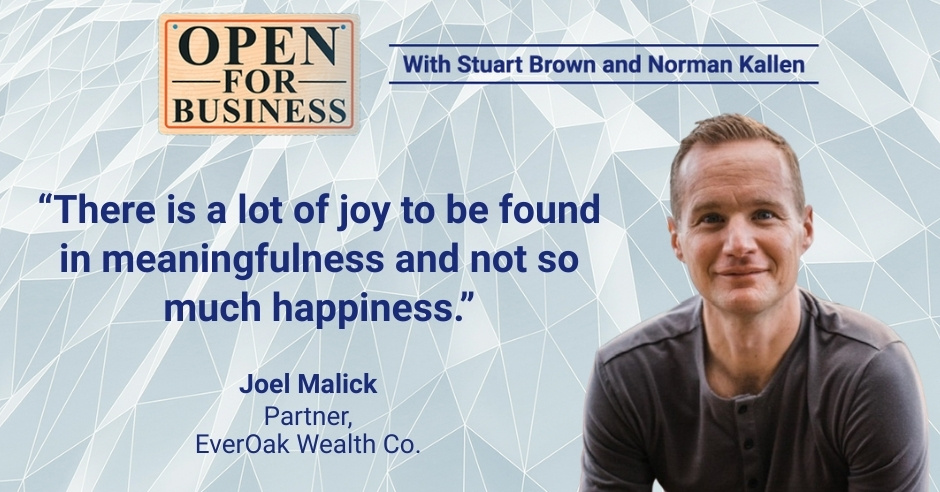
Common sense is to work hard, save money, and let the last third of your life be more about play and indulgence. What I think is coming across in the book is that there is a lot of joy to be found in meaningfulness and not so much happiness. What I mean by that is happiness is something that you try to gain. You try to gain happiness through the next nice car, the house, the new whatever, or the trip.
Those things do provide happiness, but you always need to one-up them to keep the happiness coming. The next time you do it, it’s got to be a little bit bigger, a little bit better. Meaningfulness is not looking to gain something. It’s looking to change something. That’s what I try to get across in the book. Alex and I wanted to come up with a theme of we want you to enjoy the season.
It’s not about another 60-hour work week, but it’s about mixing in a beautiful mix of play, adventure, purpose, and meaning, and not just buying the retirement lie, which is the subtitle of our book, which is, “You earned it. Make it about you. Go enjoy it.” Some people do. It’s interesting. I’ve got some people I know who are living their traditional retirement, as they would think it is defined, and they don’t know why anyone wouldn’t enjoy it. That’s out there, and maybe that’s you.
To each his own sometimes. It’s not being critical. If it works for you, God bless you. It works for you.
I believe that there’s something in each of us that’s unlocked when you’re like, “I love this. It’s not overcomplicated. I’m not overthinking it. I’m living out a more meaningful existence. It’s so much better than all the trips I could take, all the rounds I could play, all the games I could win.” When you find it, you’re like, “How did I ever do it any other way?” That’s where we’re trying to land.
Great closing. This is Open For Business, and we’re with Joel Malick, the author of Afterwork. Joel, this is an absolute pleasure and an eye-opener. I’m going to go home and do my journal.
Joel, we do have one last question for you. I want you to think about this for a moment before you answer it, because it is critical. Star Wars or Star Trek, and why?
Star Wars.
Why?
It’s because my boys like it. We enjoyed the new ride at Disney World. It was a lot of fun. It was called Rise of the Resistance. Very creative.
That’s great. We’ll mark it down. Joel, thank you for your time.
We had a lot of fun.
Important Links
- Joel Malick on LinkedIn
- Joel Malick
- Joel Malick on Instagram
- Joel Malick’s email
- Joel Malick on Amazon
- Afterwork: An Honest Discussion about the Retirement Lie and How to Live a Future Worthy of Dreams
- Tyndale
About Joel Malick

Joel and his wife Holly live in Colorado Springs, CO where they are having fun raising their six children and their high-maintenance dog June. Joel recently co-authored the book Afterwork: An Honest Discussion About the Retirement Lie and How to Live a Future Worthy of Dreams. He feels called to develop content that inspires people of all ages to dream a very different retirement dream; one filled with purpose and meaning.