Betting on the Jockey, Not the Horse: EisnerAmper’s Alan Wink on Raising Capital
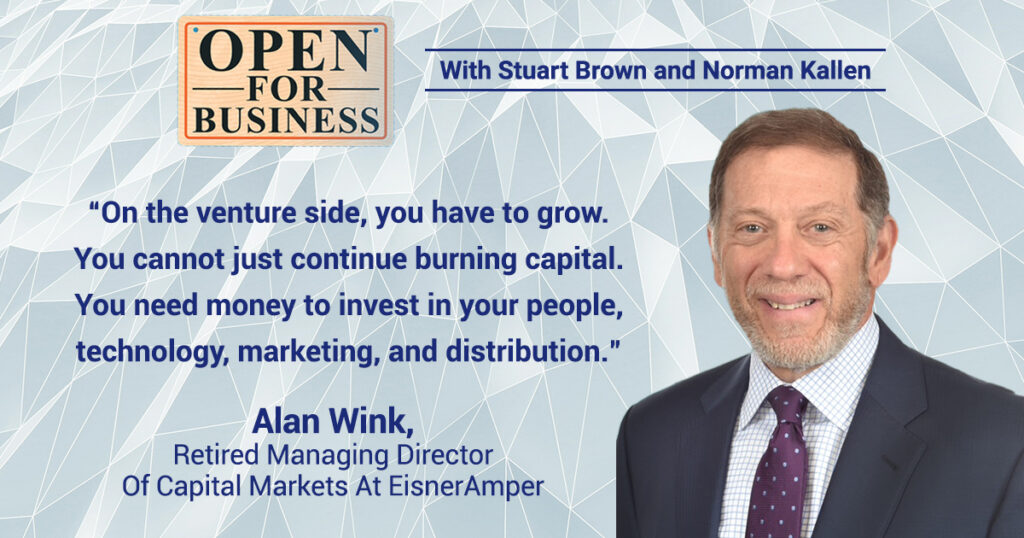
What if the biggest mistakes founders make when raising capital have nothing to do with their pitch — and everything to do with timing, team, and expectations?
This fast paced, founder friendly episode features Alan Wink, recently retired Managing Director of Capital Markets at EisnerAmper, one of the largest accounting and advisory firms in the U.S. With decades of experience in venture capital, private equity, and capital strategy, Alan breaks down what entrepreneurs really need to know before taking on outside investment.
What You’ll Learn
- Why investors bet on people, not products – and why team quality outweighs early metrics.
- How much to raise and when – the misconceptions that derail founders early.
- VC vs. PE vs. family offices – who they are, what they want, and how they think.
- Why coachability matters – and how alignment influences investor decisions.
- The “game of thirds” in venture capital – and what 10x expectations mean for founders.
- Why fundraising always takes longer than expected – and how to plan for 18–24 months of cash flow.
Alan shares why investors care far more about future projections and unit economics than historical performance. Founders must show they can solve a meaningful problem, scale efficiently, and deliver returns that match investor expectations. Alan also emphasizes that taking on third party capital is a marriage – one that brings accountability and investor oversight. Alan shares how founders can perform effective due diligence to vet investors as carefully as investors vet companies.
Why This Episode Matters
Alan’s experience advising technology, life sciences, clean tech, and emerging growth companies gives him a unique vantage point on what separates fundable startups and mid-stage companies from the rest. His guidance is practical, realistic, and essential for any founder preparing to scale.
A concise, high-impact conversation packed with insights you can apply immediately.
Betting on the Jockey, Not the Horse: EisnerAmper’s Alan Wink on Raising Capital
My name is Norman Kallen, and my cohost is Stuart Brown. Welcome to the show. We are business lawyers, but this show is not about the law. It is about you, the business owner, and the unique challenges you face every day. Norman, how are you?
I am good, Stuart. How are you doing?
I am doing well. Thank you. I am very excited because this is going to be a really informative episode for our audience. Our guest is a guy named Alan Wink. Alan is a former managing director in the capital markets group at EisnerAmper, which is one of the country’s largest accounting firms. Alan advises companies, both early-stage startups and established middle market businesses, on how to raise capital, structure deals, and position themselves for long term growth. Alan is the real deal.
He brings a rare perspective. He has seen capital from every angle. He has worked directly with angel investors, venture capital firms, private equity funds, and the founders themselves. We are going to talk about what capital really means for business. When founders should seek it, what investors should actually look for, and how business owners can build companies that are not just fundable, but retain value and endure over the long term.
—
Alan, welcome to the show.
Nice to see Stu and Norman again. Hope all is well.
Thank you. Hopefully, everything is good with you as well.
Looking Back to Alan’s Career Journey
Alan, let us jump right in. Norman and I have done our best to describe your career and what you do for a living. Can you give our audience a better understanding of what you have done and what it is that you are an expert at?
Let me give a real quick elevator pitch of my career. Rutgers University undergrad, Rutgers University MBA, started my career with Pricewaterhouse many years ago, when it was not PricewaterhouseCoopers. I spent a couple of years in what is now a Big Four audit environment, and figured out I wanted to do something else with my career. I actually went back to business school, got an MBA in finance.
I actually spent thirteen years on Wall Street doing corporate finance transactions, probably did about $3 or $4 billion of corporate finance deals, primarily in the financial services space. Twenty-seven years ago, I joined a relatively small accounting firm based in New York and New Jersey called Amper, Politziner & Mattia. We were probably about 300 or 400 people at the time. We were looking to grow, and I was hired really to help them build a management consulting practice.
In terms of providing additional services to our audit and tax clients, and fast forward, Amper, Politziner & Mattia merged probably 12 or 13 years ago with a firm called Eisner in New York to become EisnerAmper. That firm, which I joined 27 years ago, which was 400 people, is now probably about 5,500 people, and we are actually partially owned by private equity. My role at Eisner Amper changed several times over the years.
I was actually one of the partners who helped to build our technology practice about 20 years ago, 22 years ago, in New Jersey, when the New Jersey industrial space was changing from manufacturing and distribution to tech and life sciences. I guess my position also changed over the years. The head of capital markets with EisnerAmper is really helping clients in three different areas. One is capital formation, helping them to raise debt and equity capital.
Two was corporate finance, helping them with mergers, acquisitions, divestitures, strategic alliances, and joint ventures. Three was helping clients to develop and to execute growth strategies for their businesses. A lot of that surrounded the capital markets in terms of raising capital for their clients. Most of my career, Stu and Norm, has really been lower end of the middle market. Companies probably have $2 to $200 million in revenue. That is the sweet spot for me.
That is probably our sweet spot as well. This is going to be a good conversation for people tuning in. Let us get right into it. You spent your career helping companies raise capital. When you sit down with the founder for the first time, what is the biggest misconception that they have about capital? What do they usually get wrong that you have to sit down and say, “Let me give you the lay of the land?”
Norm, I have spoken around the country on this topic. There are two misconceptions that founders have. Number one is how much money should I raise? You do not want to raise more than you need. What I always tell clients is raise what you need, not what you want. The biggest misconception is that they are either raising too much or too little capital.
Founders must raise the money that they need, not what they want.
That has a lot of implications surrounding valuation and additional capital raises down the road. Number two, which I also think is a huge problem for entrepreneurs and venture founders, is that they rarely understand why the person sitting at the other side of the table, the person providing the capital, says no. As you both know, when you go out to raise money, you hear the word no far more frequently than you do yes.
That is really an issue. Founders do not understand what investors need to see to write their name on an agreement. They do not understand the returns that an investor needs to see to say yes. You almost have to start from the exit and work your way back. Can this business be as big as an investor needs it to be so they can get an exit and provide capital back to their limited partners?
What Investors Should Look for in a Company
I am assuming, having seen this from both sides of the table, that you have been counseling companies, and you have also counseled investors. From that perspective, when investors evaluate a company, what are they looking for beneath the surface? Obviously, the business owner wants to raise money because they want to continue to operate their business and they want to grow it. What is the investor looking for? What should the business owner know?
First and foremost, when you think about the three things that an investor is looking for, it is team, team, and team. It is the old adage. They invest in the jockey and not the horse. It is funny, I was talking to a VC on the West Coast several months ago, and we started talking about AI. Let us be honest, we can all talk a little bit about AI, but who knows what this stuff really means and what the potential is.
Even this very successful VC said to me, Alan, at the end of the day, I am not sure we understand all the implications for AI, but we are investing in people that are much smarter than we are, who really understand this, who have a really interesting model. At the end of the day, investors want to invest in compelling technology that has a place in the ecosystem, and the market is big enough that the company can become large.
At the end of the day, investors want to invest in compelling technology that has a place in the ecosystem.
We all have seen companies, we have all seen business plans, and the entrepreneur says, “It is a $6 billion market, I will get 90% of the market within five years.” I guarantee it never happens. It has got to be a significant enough market because you are not going to be the only player. There are going to be additional players in it.
When does the light go off with a business owner that says, “Listen, whatever I can do with what I have, I have maxed out. I cannot take it any further?” How do they know, or when do they know? When do they recognize that I need someone else? I need additional capital from whatever source. What are the signs that it is going to tell a business owner? That is where I need to go. I need to speak with someone about that. That is going to let me get to another level because it is just not happening with this organic growth.
You have got to remember, let us break it out into the venture play and maybe the more typical middle market growth company. On the venture side, you have to grow. You cannot just continue burning capital. You have to grow at some point. If you do not have the capital available to do that, you cannot even think about organic growth.
You need capital to invest in your people, invest in technology, invest in marketing and distribution, you cannot possibly do it without that outside capital. Also, outside capital provides expertise that you do not necessarily have in-house. Everyone says, “I do not want to give away the business,” but the reality is that this is obvious.
I would rather own a small piece of a big pie than a big piece of no pie. Raising capital and dilution are not necessarily bad things. Even as companies raise more than their first round of capital, everyone gets concerned about dilution. Dilution is not bad. Dilution means that the business is growing, you are hiring good people, and you are in the marketplace.
You just want to make sure you have enough equity at the end when you exit, that it is meaningful. Most VCs, when they come in and invest in the first couple of rounds, want to ensure that the founding team is incentivized to grow and to continue working the 90, 100 hours a week that are necessary to build the business.
That is really an important factor for an owner to realize. You are right, and for an investor to realize that you want to incentivize the owner. Owners are too often caught up in dilution and worried about it because I think they hear the noise from other people.
It is funny, Norm, if you go back to the COVID years, and people were raising money at crazy valuations. The venture markets were saying they were white hot, which was an understatement. These founders are jumping up and down that they raised all this money at valuations higher than they ever thought they would get at this stage. The market turned, and all of a sudden, they took the money, but were not able to accomplish what they wanted to. They got to a point where the money dried up. They had to go out and raise again, and now all of a sudden there is a down round, and everyone is thinking, “This is horrible.” Down rounds certainly do not incentivize management teams to work really hard.
Let us just define a couple of terms. Can you just explain a down round just for our audience?
Down round is I raised money today at a valuation of $18 million. Eighteen months later, I go out and raise my A round, and now my valuation post-money, my pre-money is only 14 million. All of a sudden, everybody gets squeezed. When you look at venture capital, the way it works is you raise a pool of capital, you accomplish certain goals and milestones. You go out and raise another round of capital at a higher valuation, and you continue doing that.
The same thing could be said almost for the IPO markets today where so many companies, if you look historically over the last five years, even though the IPO market has not been that vibrant, a lot of companies that raise public money three years ago at a valuation of X and look at the valuation today in the public markets, most of them are below the IPO price. That is a problem.
Distinguishing Venture Capital and Private Equity
Let us go back to the private capital markets, though. Characterize for us or define for us who these investors are. We are throwing around a lot of terms here.
Let us think about the earlier-stage companies. You are an entrepreneur, and you are building an idea in your garage. You might have a small team around you. The first money you usually raise is what is called friends and family. Some people will say friends, fools, and family.
The three F’s.
That gets you started. You have to go out and raise what is pre-seed or seed money. Typically, you will go to high-net-worth individuals, maybe a family office, maybe an angel group. Angel groups have certainly proliferated over the last ten years, with hundreds of these across the country. There is even a group that governs them called the Angel Capital Association, the ACA.
Where can you get information about who these angels are? Angels tend to be high-net-worth individuals who have made a lot of money and want to give back to the ecosystem. An angel group will probably pool together 500,000 to a million five, and it could be a convertible note, or it could be a safe. In certain cases, it might be a priced round. That gets you to the point where you can almost go out and build your minimally viable product.
After that, you might raise another small angel round or a bridge round. You are probably going to go out into the marketplace and deal with institutional venture capital firms. VCs come in all shapes and sizes. They invest in different industry verticals, and venture capital firms are really organizations that go out and manage a pool of money from limited partners with the expectation that they are going to go out and invest in companies that are going to grow significantly over the next 5 to 7 years.
How do you distinguish between venture capital and private equity?
Private equity is probably later on, when companies have grown significantly, and they are established, they have an established customer base, and private equity is going to invest in these companies to take the company from 50 million in revenue to 300 million in revenue.
Essentially, in investment parlance, it is like the C, D, and E rounds. When you are already on the marketplace, you have proof of concept already with your product. You have a market, but you need to expand it even further.
You have got to remember, until recently, private equity really stayed away from “technology companies.” They did not want to invest in businesses that could be influenced by a change in technology adversely in their industry. That has changed over the last five years because there has been so much money raised in the early 2020s, and now you have to find a place for that money.
Private equity got into the tech business like everyone else, with some of these later-stage companies. When you look at a typical institutional investor that goes out and raises capital from a limited partner, limited partners could be high net worth individuals, it can be university endowments, it can be insurance companies, numerous categories.
They go out and raise money, they get paid a fee for managing that money, they get a carry in the profits of the fund, and their responsibility over a ten-year horizon is to go out and invest that capital and get returns. Those returns are funneled back to the limited partners. If you look at the lifespan of an institutional investor, they usually spend the first 3 to 4 years investing the capital in numerous businesses.
They spend the next 4 to 6 years finding exits. One of the problems in the industry today is that the exit market has been very slow over the last 36 months. The IPO market has been dormant. There have not been a lot of exits from large corporations. As a result, these funds do not have the capital to give distributions back to the limited partners. That is where we are standing right now.
You are seeing some signs that the IPO market is beginning to come to life. If I were a betting person, I think 2026 is going to be a banner year. Maybe that is not going to happen right now because there is still a tremendous amount of uncertainty in the marketplace. The only thing that is certain in this marketplace is uncertainty. That is really causing our IPO markets to delay.
When a founder is raising capital, and we talked about dilution as a potential and not necessarily a bad thing, what are some of the good and bad things that a founder may not anticipate when they take on institutional capital? How does it really change how they run their business when they have third-party money? It is their business, which obviously it is not anymore.
We spoke earlier about the positive nature of raising money from third parties. They have capital, they have some expertise, maybe they have access to other things that could benefit your business. All of that does come with a cost beyond their equity component. All of a sudden, you truly have a partner in the business. It is not you making all those decisions with your team.
You now have an investor who sits on your board, and maybe all of a sudden, now corporate governance is going to change a little bit. You are going to be a more professional organization. You are going to have to get in front of your board once a month or once a quarter and present where the company is going. At certain times, it is not going to go well. You are going to have to accept criticism.
You now have a different reporting relationship than before you took on the capital. That is not necessarily bad. It professionalizes your organization. Honestly, bringing in the right capital partner can certainly help down the road when you go out and raise again, in that all of a sudden, you have credibility when a well-placed VC invests in your business. All of a sudden, everyone stands up and takes notice. If they have done their due diligence and invested in you, you probably have something.
Stories of Founders Who Got Their Capital Strategy Correct
That is a fair point. Let us talk about that. Maybe we can dig in, and you can give us a couple of examples because you have worked with companies at every stage at this point in your career, from startup to acquisition. Can you share a story or two about a company that got its capital strategy correct and, conversely, one that did not go so well? Which unfortunately, people like hearing that stuff.
Of course, I cannot give you the names of companies.
Just spell it. It’s okay.
It is interesting in that so many companies take on capital, and they do not do due diligence. The person writing the check, supporting your business, is going to do an awful lot of due diligence on you, the team, the business, the industry, and customers. I have seen so many instances where the founder, the venture CEO, takes money but has not done due diligence on the investor.
It is not the relationship he or she thought it was going to be. Life becomes really hard and maybe not as satisfying as before. I have worked with a number of founders over the years who, because they did not do that due diligence, eighteen months later, walked out the door, or in certain cases, have actually been fired.
Talk about that due diligence for a second, if you would not mind. A company CEO, a founder, what does their due diligence look like typically to make sure they got the right fund?
Most importantly, I would speak to other CEOs who have invested in other companies. They do not have to necessarily be in your space. Just get an indication of how this fund manages its portfolio companies. What are the expectations? What is the process? What is the governance? You have got to remember that as the CEO, your most important role is ensuring the company can get to the next level and continues to grow.
As CEO, your most important role is ensuring the company can get to the next level and continues to grow.
A lot of founders do not want to be caught up in some of the governance issues that they are now exposed to. They just want to see their technology get to the next level, make sure the code is right, find some customers, and begin to scale the business. The other stuff, even working for an accounting firm the way I did for 27 years, even some of the compliance stuff that they are expected to do, they would rather just give it to the accounting firm to do.
They do not want to worry about it. They want to give it to a third party. They want to concentrate on what they do best. That is right. Building out the technology, making sure there is market acceptance, and moving it forward. You want to understand how that VC runs the business. Even though the VC might not be the majority owner, they usually act as if they do, and you are going to respond to them as if they were the majority owner.
In effect, are you saying that you cannot just look at the business deal on the piece of paper? You cannot just look at the lowest rate and the best potential return. You have to dig below that and go to the subjective criteria as well as the objective criteria.
Stu, I think sometimes the subjective criteria are even more important. I will go back to what I said earlier about some of these crazy valuations that were being thrown around in 2020 and 2021. A lot of people did not take the highest valuation for the reasons we discussed. Valuation is important, but it is not the be all end all. What is important is the people. I tell people that when you take on a third party capital, it is like a marriage.
You are going to be connected. You have got to treat it the same way. Many deals fall apart because the two parties did not know each other well enough. All of a sudden, the VC comes in and dictates strategy. You are the founder, you have been running this business for the last 3 or 4 years, and someone is telling you what to do, who you feel does not know anything, or some young MBA who is half your age is telling you what to do. Some people get upset with that.
Just some people. Let us flip it to the other side for a minute. A PE comes in, how do you differentiate the companies that actually are successful in raising capital from those that, as you said, most companies do not get the yes? They are fighting the no. How do you differentiate the two? What are some of the key elements that go into what a PE looks at, whether it is a venture capital fund, private equity fund, and say, “This is a company we want to invest in?”
A couple of things. Let us talk about people, first of all, before we even talk about the business, and you are going to hear this phrase over and over by both VCs and by private equity people. They want to invest in coachable people. You hear that sports analogy all the time. People who can accept criticism and go on to the next play and become a star. The same thing goes with founders and CEOs of businesses. Are they coachable?
People who can accept criticism go on to the next play and become a star.
Are they going to accept criticism? That is important for the dynamics of a company. From a business standpoint, you want to make sure that the business is solving a compelling problem, its solution is solving a problem, and the problem is big. There could be other competitors, but the problem is big enough. A lot of people can make a lot of money. The other is where the investor believes that the team is highly competent to do the job.
Isn’t that part of the investor’s job, too? I would imagine that when you are, we have represented several startup businesses, and they may have tremendous ideas and good skills with respect to the business plan that they are trying to accomplish. They do not have a full suite of C-qualified professionals. They do not have a professional chief financial officer. They may not have a professional chief operating officer. Isn’t that, in part, what one of the benefits that an investor can bring to the table?
He can. The other skill that you would want to see in the founder of one of these businesses is the ability to bring a team together. The ability to know the right people in the industry to call upon. He can attract high-quality people to the business even though they cannot be paid a market rate of salary. Even though the team might not be put together, he knows who is going to be the chief marketing officer and the chief technology officer. He knows enough people that he can bring those people together, and he is a good enough leader to be able to attract them and retain them.
You are assuming on that basis that he has that knowledge or that information, he just needs the capital with which to do it.
Biggest Red Flags in Financial Due Diligence to Avoid
Let us go back to diligence for a minute. When you were talking about due diligence, it got me thinking. I have often seen in small businesses problems with the financial statements. From your perspective, Alan, what are the biggest red flags that investors see when they dig into the financial diligence?
That is an easy one, Stu. It is funny. Investors always look at, especially in venture capital, historical performance is really meaningless because there is very little revenue, which is just expenses. I think where they really hunker down and sharpen the pencil is when they look at financial models and projections.
If the investor does not understand them, if you, as the founder, cannot explain them to an investor, and if you do not understand the unit economics, you have a problem. The unit economics are the ones that are really important because let us be honest, projections are not worth the paper they are written on, but you should understand if you sell one widget, what happens. The understanding of unit economics as part of a financial model is critical.
Listening to a recent program, one of the things they said, which is right on point with what you are saying, is do not chase sales, chase profits. Understand the margins because that is what is going to make your money and allow you to grow.
I agree with that, but in the earlier stages of a business, you have to chase sales. You have got to have referenceable customers. You have got to have customer traction that changes as these companies age a little bit. Look at OpenAI. If you had a model in front of you of the number of billions of dollars that have been spent without a cent of profitability. That is where we are.
You are right. Early on, you just need sales. You have got to get out there. You have to have proof of concept that people like your product and want your product. You are correct. That is why I think one of the biggest problems you have is that companies are undercapitalized when they first start. An enormous hindrance to a company when they do not have the capital, because I am not sure venture capital will buy into it at that point if they are undercapitalized.
Think about going back to what investors look at. Let us just use a real concrete example. I will throw one name of a company out there. SpaceX. Everybody wants to invest in Elon Musk. They say that the SpaceX IPO, which they think is going to happen in the third or fourth quarter of this year, will have a market cap of a trillion dollars. That company has not made a dollar of profit yet. I do not think so. They have spent a lot of money. That number is going up every minute, but it is Elon Musk. Think about what he could raise money for. I am telling you that is who he is. There is only a handful of those kinds of guys out there.
A lot of people learned their lesson from the late ‘90s before the bubble burst. People and companies were at potential market. They had market share, but they did not have real sales or real earnings yet. They were not valuing them in a traditional way of valuing a company. They were still buying into that. They were doing those IPOs back then, and they died on the vine. You are right. The factors are so important, these different elements as to who is doing it.
There was an article in the journal this morning. It was an IPO in 2025 that first day of the offering, the stock price was up 250%. First day, 250%. Everyone was all over the underwriters because they priced it way too low. Fast forward five months, six months later, and the stock is selling below the IPO price. That is the world we live in. That is the world we live in. You think about the AI community, and it is even going to be crazier. These valuations are insane.
Common Mistakes in Negotiating with Private Equity
Alan, we had a few episodes ago, a guy named Adam Coffey spoke with us. He wrote several books, but his primary focus is on private equity from the private equity side because he has been through the mill, and he was a fascinating conversationalist. Toward that end, we asked him several questions relating to companies that are ready for private equity and what the founder should be considering. Let me ask you one of the questions we asked Adam. What mistakes do owners commonly make when negotiating with private equity?
That is a great question.
That was his answer, too.
It is funny because the reason that private equity got into the venture space is that it goes back to the fact that the IPO market has been so quiet. All these really great venture-backed companies got to a point where, in all their thinking, they would have already done an IPO. The IPO window closes, they are running short of capital, and they need to raise a large round, hundreds of millions of dollars. They would typically do that with an IPO. Now, to continue the momentum the company has, they have to go out and raise money.
Their growth was not significant enough for the venture capital firms to go back and invest again. The only other option was really private equity. That is how they got involved. They could not raise large pools of venture capital because their growth trajectory was not fast enough for the venture capital market, but it was sufficient for the private equity market.
We were talking about all this in the last year and a half, the market has slowed down somewhat.
That is an understatement.
Fair point. Even though there is a lot of this called dry powder on the sidelines, people are still looking to acquire, private equity is still looking, and needs to make money. It needs to have a return for its investors. Hearing a lot today is about the private credit market, where private equity is lending. Can you give us a little background on that and what you are seeing in that marketplace?
You have got to remember the difference. Even in the private lending market, they are not getting the equity that they would normally get in a pure equity deal, but they are getting a couple of points at the back end. They are loaning money to these companies. They are getting the coupon return in terms of the interest, but they are also getting a small piece of equity as the backend. It has become more popular because these companies need to raise money, and the VCs are slowing down.
There is a factor as well that the lending environment with the banks and the regulatory environment with banks makes it more difficult to meet some of these covenants now in the environment that they are looking to an alternative source for funding, and private equity is stepping up.
There has been a lot of talk within the government about loosening some of the lending standards in this country so banks could be more effective and more aggressive. Who knows if that is going to happen?
Are you seeing more private credit step in where traditional bank relationships would have existed previously?
Absolutely. I expect to see that happen over the next couple of years until the marketplace opens up again.
What do you see the role of family offices being in this discussion? We have not talked about family offices. First of all, Alan, explain generally what a family office is for our audience.
Basically, a family office is when a family has access to a whole lot of capital, whether they sold a business and all of a sudden have $100 million, $200 million that they want to manage. They set up a family office to manage that money. Some family offices invest in one company. Some are almost funds in themselves in terms of investing in multiple companies. It is very much a private equity model. They are hoping that they invest $10 million and get back $40 million. The family manages this or uses a third party to manage it.
Are you seeing more family office transactions, fewer family office transactions relative to private equity these days?
I am seeing fewer. It is just another source of capital when a company approaches me about raising capital for them. It is another source of capital, like private equity or family office money. At the end of the day, it is high-net-worth individuals.
Is the Private Equity Market Too Crowded?
We talked about all this dry powder, and it seems in the last few years, with 21, 22, and 23 being very active private equity markets, it seems everybody opened up a private equity fund. The proliferation of private equity was enormous. Is there a case now that there is just too much private dry powder chasing too few deals or too few quality deals?
You have got to remember that institutional capital, in a lot of regards, does not have the best reputation. We have all heard the stories about private equity investing in a business, and the only thing they care about is profitability. All of a sudden, they make significant changes in the business. They reduce overhead wherever they can to get that EBITDA number up. Sometimes that is not in the best interest of the company. It is in their best interest to maximize their value. I probably should have said this earlier. When you think about venture capital, the best way to describe it is that it is a game of thirds.
What does that mean?
When you think about whether I am a VC, one-third of the investments I make, I am going to invest a hundred dollars and get zero back. I am going to write the whole thing off, and that is going to happen over a 7 to 10-year time horizon. One third of the deals, I am going to write a hundred-dollar check, and I am going to get a hundred dollars back seven years later, ten years later. It is not a really good investment. A third of the deals are the ones that are going to give me the fund return, where I am going to get that 10X, 20X, 30X.
When you think about what the goal of a venture capital firm is to get a 10X return in seven years. If you do the math, that is about a 32% IRR. That gets back to the point I made earlier about founders not understanding what the person on the other side of the table needs to write a check. You have to prove to that investor that you can do that. Can I get a 10X return in seven years? Can that happen? It sounds easy, but it is not. You have to convince the person on the other side of the table that you can do that. That your team and your technology are the right team to do that.
It goes back to what you said early on in this discussion. The founder who is looking to raise capital needs to do his or her homework. Needs to be honest with their calculations and themselves as to what they are capable of doing, because if they do not, they will not be successful in raising capital because they cannot answer those important questions.
Norm, we have all seen financial projections that our clients have done. I have never seen one that has been right. At the end of the day, just to write down on paper that I could take the business from zero in revenue today to $150 million in revenue four years from now, the proverbial hockey stick. If you do not have an explanation of how you are going to do it, you are never going to raise capital. I guarantee it. You have got to remember, these investors see these pitches ten times a day with companies with a proverbial hockey stick. It means nothing.
Is the private equity market too crowded today? Are there too many private equity firms? Are there too many dollars chasing deals? Conversely, are there not enough dollars chasing deals?
There is too many dollars chasing too few quality deals. I think that is what is going on.
There is too few quality deals. Is it because they are just not there anymore? People have found them. What do you think the reason is for that?
Look, there is a lot of reasons. Private equity has invested significant investors in manufacturing and distribution companies over the years in this country. We all know the number of those companies has declined immensely. Bill Gates said it years ago, we are an innovation economy right now. Private equity is probably going to take a role once that innovation has grown and blossomed, and is looking to put together a deal with a larger company. It is a different economy than when private equity came into existence years ago.
Why Founders Should Never Get Tired of Raising Capital
Alan, put yourself into the shoes of a business owner, and you are going to raise capital, whether it is private equity or venture capital. What is keeping you up at night?
The length of time it takes to do it.
Why is that?
It is funny. There is a saying, the best time to raise money is when you do not need it. What happens is that founders get caught up in growing their businesses and building their technology, and sometimes get lost in the weeds in terms of their cash projections and cash forecasts. You do not want to run out of money. That is the worst thing that could happen. Founders think that, “I have enough cashflow for the next four months. I can raise money.” It takes longer than that. It really does. I hate to say it. Even going out to raise angel money today, they have become smarter investors.
They are doing more due diligence. It is a time-consuming process. When you go out, and you want to raise enough to maybe provide you with eighteen months of liquidity, I think when you get to month nine, it is time to start thinking about your next round of capital and aggressively go after it. I always say to founders, you are going to be fundraising as part of your job forever. Until you have an exit, it is a fact of life. What will keep me awake is the amount of time that it takes to raise money.
Founders have to admit that fundraising is part of their job forever. Until you have an exit, it is a fact of your life.
It is an enormous distraction. It has got to be very tough on the founder. To two things that are significant in their business life.
We have all met companies that want to hire investment bankers to help them raise money. A lot of capital providers would look at you and say, “If you do not have enough contacts in your space to raise money, why do you have to hire a third party?” You know enough. You should be able to do this.
You should know enough people that you can get on the phone, and whether it is calling your law firm for help or your accounting firm, you do not have to hire a third party to raise money for you and pay a fee. If I am putting money into your company, I do not want 5% or 6% of it going out the back door to a service provider. You should be able to do it yourself. You are my entrepreneur. I am banking on you. You should be able to do it.
Discussion Wrap-Up and Closing Words
You are not making any friends in the banking industry today, are you? Alan, this has really been eye-opening. Thank you. This was a great discussion, and I think a really great subject and an important subject for our audience. The middle market, low middle market business owner. Thank you, it has really been enjoyable. Thank you for your time.
I appreciate the time. Anytime to talk to you guys. It has been a lot of fun.
We do have one final question that we usually ask our guests. First of all, are you a beer, a liquor, or a wine connoisseur? Which do you prefer?
Probably a wine guy.
What is your favorite varietal?
I spent ten days on a friend’s vineyard in Mendoza, Argentina, two years ago.
Do not tell me it is Malbec.
I am going to say Malbec.
I like it. It is not my favorite, but I like it as well.
I learned enough in those ten days to be a little bit dangerous. It was fun.
Whose vineyard were you on down there?
Tamarelli Vineyards. It was a trip of a lifetime.
It is gorgeous. Actually, Paul Hobbs, who is a well-known name in wine. I was at a tasting with him a few months back, and he is very much, and he has an enormous place down in Argentina. I bought some of his Malbec, which was actually very nice.
It was good. That is a more difficult question.
No, we like to end on a happy note. Alan, this was great. Thank you for your time. This was really good.
Pleasure, guys. We do appreciate it.
Important Links
About Alan Wink
 Alan Wink recently retired as Managing Director – Capital Markets for EisnerAmper, one of the largest accounting and advisory firms in the U.S. and continues to consult. Alan assists clients with capital budgeting, capital structuring and capital sourcing. Alan has 20 years of financial and consulting experience, having served as Director of the Interfunctional Management Consulting Program at Rutgers Graduate School of Management, a program he helped build into one of the largest business school-based management consulting practices in the country. He started his career in accounting, spending six years on the audit staff of a Big 4 accounting firm and a Fortune 500 Company. Alan left the accounting field to expand his horizons in the area of Corporate Finance.
Alan spent several years as Director of Financial Analysis for AmBase Corporation (NYSE), where he led approximately $2 billion of corporate acquisition activity. He is also a past Vice President of Capricorn Management, a $100 million private equity fund specializing in restructuring and turnaround opportunities.
In addition, Alan has served a leader in the EisnerAmper Technology Group, providing a variety of industry-specific services to technology and life sciences firms, including business and strategic planning, marketing and competitive analyses, financing assistance, and operational and financial benchmarking. He has worked with many early stage and emerging growth companies on developing the appropriate capital structure for their position in the business life cycle. He maintains an active contact base with angel investors, venture capital funds and private equity funds. Alan also understands the level of returns private investors are trying to realize and devises strategies that allow both entrepreneurs and their investors to achieve desired return thresholds.
Specialties
- Strategic & Business Planning
- Capital Structures
- Mergers & Acquisitions
- Capital Formation- Angel Financing
- Venture Capital
- Private Equity
- Technology
- Life Sciences
- Clean Tech
Credentials & Education
- Rutgers University: Accounting/Business Administration
- Rutgers Graduate School of Management: MBA, Finance
Affiliations
- New Jersey Technology Council: Board Member; Electronics, Advanced Materials & Manufacturing Track Advisory Board
- Jumpstart NJ: Board Member
- Association for Corporate Growth
- New Jersey Institute of Technology Venture Advisory Board
- New Jersey Merger & Acquisition Forum
- FemtoBlanc: Advisory Board
- Rutgers Preparatory School: Treasurer; Board of Trustees; Executive Committee