
Beyond the Balance Sheet: The Human Side of Family Businesses with Jeff Savlov, LCSW
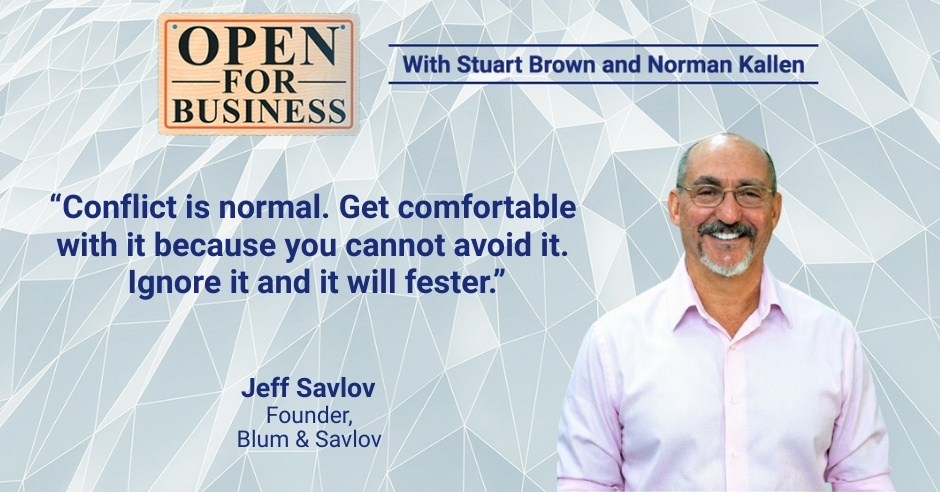
Family businesses, especially uber-successful and wealthy ones, are often seen as untouchable and otherworldly. But in reality, they are just like any other family: they have their own dynamics and experience inevitable conflicts. Stuart Brown and Norman Kallen chat with Jeff Savlov, Founder of Blum & Savlov, who talks about his consulting work for high net-worth families who balance personal relationships with business transactions and generational wealth. He explains how older and younger generations can work better together, the right way to handle conflicts, and how to properly introduce in-laws in a family business. Jeff also presents strategies on making business transitions as smoothly and conveniently as possible to secure a positive and long-lasting legacy.
—
Beyond the Balance Sheet: The Human Side of Family Businesses with Jeff Savlov, LCSW
Welcome, everyone, to the show. Our guest works in one of the most fascinating and emotionally complex arenas in business, the world of family-owned companies and multi-generation wealth. Jeffrey Savlov is the owner of Blum & Savlov Family Business & Wealth Consulting group, where he helps families strengthen communication, develop responsible next-generation owners, and successfully transition both leadership and wealth.
He brings an unusual combination of psychology, governance, and real-world business experience to his work. This makes Jeff a trusted guide for families navigating big decisions, deep-rooted dynamics, and high-stakes transitions. If your family owns a business, manages wealth together, or simply wants to maintain harmony across generations, this episode is for you. Let us dive right in.
Welcome, Jeff. Happy to have you on the show.
Thanks, guys. It’s good to be here.
How Jeff Got Through a Rough Childhood
Jeff, how did you get into this profession? Tell us the whole story.
It is a profession without even a name. You guys can say accountant, attorney, or financial advisor. Most people have something they can say. I do not really have a version of that. I have a story. My elevator needs a long elevator ride. I need a tall building. I guess we have that. Basically, my dad was a blue-collar guy, Army after high school, the Korean War. He is in Germany, and he learns printing as a trade, printing maps for the war effort in Korea.
He comes back, blue collar, union, working for other people, hating it, wants to work for himself. He and my mom decided to take all their savings, which was not much. She was a stay-at-home mom at the time, with all their savings and a home equity loan, and tried to start his own commercial printing business in New York City.
At first, it was really hard. My mom still remembers getting really close to applying for food stamps and hoping that she would not have to, and then things turned around. Not only did she avoid food stamps, but the business took off. Good news, bad news. The good news is that it took off, and we did not need food stamps, and we ate.
The bad news is my dad was not a guy who knew how to run or be a leader of a company, and he was losing his marbles. We will stick with losing his marbles. I was going to high school and college whenever I could, into the city. We had a second location in New Jersey, in Monmouth County, and that was easier for me to be involved in. My dad was just so overwhelmed. Who do you think he took it out on, guys? Who did Jeff’s dad take his anger out on?
Surprising, right?
Just a lot of yelling and frustration. I am just there. I am not even asking for money. I am just trying to help the family business be successful. My mom sees this unfolding. This is like 40 years ago. She finds a family therapist who was actually working with families and business, which is really a more last 20 years thing, or maybe 30 years. This was before that, but she, in her wisdom, found someone.
My dad and I approached the therapist and said, “We would like to do some work together.” She said, “I can help you, but mom and your older and younger sisters have to be involved as well.” We were like, “They have nothing to do with the business.” She said, “I do not care. This is a family issue. I work with families. You bring mom and the sisters, or we are not working together.” My dad and I said, “Okay.”
My dad was not a therapy guy. He was 6’4″, 285 pounds, and not a therapy guy. He was old school, but my mom, 5’2″, 98 pounds, said, “You are doing this.” Harold did it. In the midst of it, the therapist is asking my dad questions like, “You do not do this.” If you do not ask dad about his childhood and his parents, you did not do that, but she did. We were riveted by what it was like. He starts talking about his father, my grandfather, and how he left Latvia, Jewish, snuck into Mexico, got to New York, and managed to get his mother out.
This is my dad talking about his father getting out and then getting his mother. He finds out that the whole family, everyone else back in the old country, is wiped out. They had letters and pictures they were sending back and forth, and then boom. The Nazis wiped out almost all the Jews in Latvia, almost all, if not all. He has his mother here, so my dad’s father, as a young man, keeps it a secret from his own mother.
Basically, he does not tell her that the family is wiped out, makes up stories about how well everybody is doing until she dies as a way of protecting her. Now that the traumatized guy is raising my father. The therapist is asking about this. “What was his anger like?” My dad said, “He was an angry guy.” She said, “The belt?” He said, “Yeah, everybody used the belt back then.” My dad went, “This part is really the crux of it.”
In the movie, sometimes something happens in therapy, and everything changes around, but that is pretty unrealistic. This happened to us. This one moment changed everything. My dad said, “When I was going through all that belt hitting and all that awful stuff, I said to myself, I know I am going to get married and have kids one day, and I made a promise to myself I will never lay a hand on my children.”
In that split second, dad went from this angry, scary guy to, “He never hit us. We did not know what was not happening.” We knew the yelling was uncomfortable and scary, especially at 6’4″ or 285 pounds, but he never laid a finger on us. In that moment, it was clear that he went from an angry guy to anger as an act of love, yelling as not hitting. It just shifted it for my sisters and me. “This could have been much worse.”
He did this on purpose. It was a beautiful experience. After that, I said, “I do not want to work here. I do not like commercial printing. It is never what I wanted to do.” I am graduating from college. I went to sales and marketing. I worked in consumer products. I worked in technology. I had a really good run at a young age. My father’s full support. He did not even love commercial printing, and he was glad to see me do something else.
I had a great run at a young age, and I just was not fulfilled. I walked away from all that early success in the business world, moved back with my parents in my late twenties, where we had all grown up and matured. It was more like roommates, and it was really good for us. I went back to grad school. I studied family dynamics, group dynamics, child development, and parenting. I got licensed as a family therapist.
I did seven years of postgraduate work at a psychoanalytic Institute, got certified as a psychoanalyst, 30 plus years ago, I started a private practice, really thinking, “This is my passion. This is what I am going to do for the next however many decades.” By coincidence, a couple of my early therapy clients were either operating businesses or generating generational wealth through inheritances. They were coming to me for marriage counseling or because their teenager was smoking pot in the basement all day and not getting a job, therapy stuff.
They had significant wealth, and I got to really know them very deeply and see what the challenges were. It is not as rosy as people think being really wealthy. There are a lot of challenges. How do you bring up kids who will be productive? How do cousins 10 or 15 or even a hundred? I have worked with families where a hundred cousins owned a business. How do you decide on distributions or investing back into the company with a hundred cousins? I do not even know a hundred cousins.
That is what we want to get into eventually.
I said, “There is something here that is not therapy, but draws on all my psychological and family systems and communication background, and my business background.” Lawyers and accountants, and wealth managers are not typically trained in family communication and psychology. I had this middle road in between all that. I started to coach and educate and facilitate meetings for these families and grew it to where this is my full-time gig.
I work with operating business families. I work with families that have generational wealth. Along the way, I mentioned I had a lot of education and experience in child development and parenting. I just saw something that was needed, which is coaching for parents with very significant wealth before they have kids.
When kids are still under five years old, there is so much opportunity to create character and work ethic, and accountability. That happens with 2, 3, and 4-year-olds. If you wait until 17 and 18, that is too late. Good luck trying to get an eighteen-year-old to set the table and do the dishwasher when they have never done it before. It is a lot harder. 2 and 3 year olds actually love to start putting dishes in a dishwasher. You started early.
I developed something called the Purposeful Legacy Family Project, which is where I coach couples before they have kids, couples with really young kids, on how to really have stewards of wealth who will be responsible and work hard and get an education, and do good philanthropic work with the family money. If this when done with intention, significant wealth can be a very beautiful and productive thing, a generative thing, as opposed to the heartache and pain that we think of in the stereotypes, “trustofarians” and all that stuff.
Generational wealth can be a beautiful and productive thing. It does not have to lead to heartaches and pain.
Why Some Family Businesses Resist Talking About the Future
Jeff, let me ask you, you brought up an issue with your dad not being comfortable with going to counseling. Families are often resistant to talking about the future. It is a tough conversation to have. How do you create space for that conversation? How do you get people to feel comfortable enough to say, “It is important. We do not talk about it.” The path forward is more difficult.
At some point, ultimately, we are talking about death. At some point, you acknowledge that you are going to die. This is really hard for a lot of people. I do not know how insurance guys do it, because it is really talking about death all day, whether you talk about it or not. Part of it is just talking about going back. What is the story? How did you create this? Every family I work with, no matter how wealthy.
I work with the top twenty wealthiest families in the world, and I have worked with $5 million, $10 million smaller businesses. Every one of them, if you go back, usually it is just a couple of generations in most families, somebody had a really rough life and did some really risky things. My grandfather was a stowaway on a boat. He snuck on a boat to Mexico, and then he somehow got into the United States, became a citizen.
If he had not done that, we would have been just as dead as all his brothers and sisters. That is really one of the main ways in “Tell me how you got here.” Some people had taken some risks, worked really hard, had some tough challenges, and sharing that with the family, even young kids, is a great way in. Every family has these amazing stories.
Cultivating stories is one of the best ways. From there, it naturally moves to, “Where are we going? How do you want all this when you are no longer here?” People are uncomfortable with death, I will often say, tongue in cheek, “Let us just say aliens come down and take you and your wife and never return. What do you want your kids to do with it?” They know I am talking about death, but it gives them a chuckle, and it helps to move forward.
How do you know aliens have not come down by the way?
That is a whole other podcast. We will have to book another one for that.
That’s exactly right.
Stuart, on that for a second, I have a great ghost hunter you can interview one time, too.
How To Determine If a Family Business Is Heading Towards Conflict
We will put that on the list. Jeff, give us some early warning signs that you have found that show that a family business is drifting towards conflict. That said, “I’ll tell you something.” Most family businesses that I have worked with, just in my microcosm, are all dysfunctional in some way, shape, or form.
I would say there is no such thing as a functional family. Every family has its own dysfunction. The other way of looking at it is saying all families are functional and they are just complex and messy. That is as good as it gets. There is no perfect, wonderful thing. What was your question? You faded out a little. What are the signs?
What are the early warning signs that a family business is drifting towards conflict?
Conflict is fine. It is how you manage it. It is part of the family. Is it really, is it productive conflict? Can people sit down and say, “I am uncomfortable with what you said. I am uncomfortable with your idea. I do not love your idea. I am willing to talk more about it, but I have a different idea. Are you willing to listen to it?” That is one kind of family. The other kind of family is someone has an idea, someone says, “F you, that is ridiculous.” It blows up, and nobody talks to each other for a couple of weeks. It is not, “Is conflict coming?”
Conflict is a part of life. It is part of marriage. It is part of the family. It is part of friendship. Can you be productive with it? That is really the goal is to be productive. The signs that it is not productive is, like I said, people do not talk to each other. They develop silos in the business so that nobody has to interact with each other, but that does not affect it at the ownership level. Even if you have all your kids or grandkids in different little silos within the business, they are still going to have to work together as owners and make decisions together. It is only delaying the inevitable.
How Older Generations Should Prepare Younger Generations
Jeff, one of the things that I see a lot of is that you have the older generation start the business, running the business, as the president and CEO, and they bring in a younger generation. How do you deal with the fact that sometimes the older generation, no, we are not talking about death, we are talking about it is time to “We are going to make you the CEO. You will oversee everything, but you really are not there. You should not be there to run the business anymore.”
How do you have that conversation, “It is time to move on?” Either you have a younger generation who is capable, or you need to bring somebody else in who is capable to run the business because they have achieved a certain level. That older generation either does not have the skillset, or something is going on that they need to; I will not say whether to step up or step aside.
The families that are really intentional about developing the next generation, like making them work. I am a big fan of working somewhere else, and not all families want to do that. Some families believe, “My kids are the best resource. I do not want to lose them.” You are not losing them. If they go somewhere else and never want to come back, then maybe it was never meant to be. If they go somewhere else and learn a bunch of stuff, it will make your company better. Just going right into the family business, I see very little value in that personally.
If children go somewhere else and never come back to work in your family business, maybe it was never meant to be.
You need to get your butt kicked by somebody else.
Somebody who can kick your butt. When you have the last name of the company, people will never kick your butt, and you will never get tough feedback. You never get the sense of, “I accomplished this.” I have seen next-generation family members who are doing a great job, but there is still this little, “I came here right after college. I never got a promotion at an outside company. Do I really deserve this?”
Even if they are doing a good job, they wonder. It is good for the self-esteem and the sense of accomplishment of the next gen person. Some of these have a certain kind of personality. I wonder if you guys would agree, especially male entrepreneurs, and they are intense, and they want to be in control, and all that is wonderful for being entrepreneurial, taking risks, starting a business. It is certainly not the best for incorporating your family into the business.
Some of these folks do not let go when the kids are developed, and they are driving the kids nuts because the kids have proven themselves. Some of these guys do not let go. I say guys, but it is more than ever, women too. Especially in the world of family business, female CEOs are taking over at higher percentages than in the non-family world. Sometimes the kids are developed, and they cannot let go.
Other times, the kids are not developed, and the parents will not let go because they are afraid it will all fall apart, and they do not want to fire the kids or bring in non-family. The earlier you start saying that, you make it a meritocracy, and you make clear to the next generation what a meritocracy is. I have an article I wrote about the concept of meritocracy and a lot of family business concepts. If you have elementary and middle school kids who start to understand this is not going to be given to you, you are going to have to earn it.
If you think you might want it, try really hard in school now, in middle school and high school, go to college, and work somewhere, and prove yourself. That is the road to getting into the family business. That is a beautiful way to set the stage for success, knowing that they have to prove themselves instead of you getting the last name, you are coming in. “I can do it. You are my kid. You can do it.”
Stuart and I had a conversation with some people to follow up on this, about the most destructive word you can use in a business is entitlement. When you have the next generation who has a sense of entitlement and that is why I am there. We have found that to be just a horrible situation for people, not just for the father, but for the next generation. When they feel like, “He is my father, therefore I am entitled to step in and do the following.”
What Happens If the Incumbent Management Cannot Let Go
I want to flip it on you, though, you are talking about the next generation. What about the incumbent management, the founder of the business? “It is hard for that person to let go.” How do you counsel that person?
Once in a while, I will get just a really healthy, grounded person who has interests. The founder has interests outside of the business, like golf, has always wanted to do woodworking, and they are putting up a shed in the backyard and developing a woodworking shop. They have these other interests, and they trust their kids, and they develop their kids. In their early 60s, they make plans to travel with their spouse and let the kids take over more and more, with some good mentoring along the way. That does not happen a lot.
That is rare, unfortunately. I am thinking of one family in particular, and they stand out above all the rest. Most other times, it is messy. Sometimes the founders bring me in, hoping I am going to fix their kids. It turns out the kids are doing a great job, and the founder has some issues with being overly controlling. I have got to confront those guys. Careful what you wish for. Hiring Jeff Savlov, you think your kids are going to get fixed, you might have some tough feedback.
I have had it range from guys who get angry, and there are some really tense moments in front of the kids and spouse, with them pushing back hard on me, not always respectfully. Often, those situations, because this is what I am trained to do, can morph into a sense of respect for me in the feedback I am giving.
Other times, I have had real tension, and I have had a father just quit the work with me right on the spot and say, “I am not going to be part of it.” The wife was so validated because she had been going through this for 30 years that she said, “Kids, you two, brother and sister, and I are going to do this with Jeff without dad.”
She stepped in and took a real leadership role, not in running the business, she was not an operator, but in helping her two kids really get along, take over the roles necessary. This guy was not going to do well without his wife. She realized she had real power. He was not going to divorce her. He needed her. The guy could not make his own sandwich.
He left work. She stepped up, and unbelievable work was done in developing the kids to take over. You never know exactly what is going to happen. I certainly have the integrity to tell the truth and not dance around these dynamics when they are right there, and they are hurting the goals of the family. It is not my goal. It is their goal. “Here is the goal you have. You are in the way of it. Do what you want with that.”
Let me ask you, have you ever had a situation where what you thought was a business issue and it really turned out it be a family dynamic issue? You are the business psychologist, so to speak, and realizing, “Wait a second, guys, let us just put the business aside. You have got bigger problems on the family side first to deal with.”
I basically have developed a career specialty of just that. I am not just a tunnel vision, psychological guy. I do a lot around structuring businesses and working with executive teams that are non-family to help the family get where they want to go. Certainly, you have to balance the structure of business with the dynamics and psychology of family. “Culture eats strategy for breakfast,” I think Peter Drucker said. Family culture obliterates strategy, breakfast, lunch, and dinner every time.
You have to combine the two and the successful families, like this one that stands out above the rest, where the father, in his early ‘60s, just said, “You guys are ready. I am going to step back, and we will figure out the money.” They did. That is really beautiful when that happens, but it is not the norm.
How To Involve In-Laws in Your Family Business
That is clearly not the norm in any event. The way I see it, a lot of families struggle with where their spouses fit in governance and decision-making and what have you. Let us turn left a little bit rather than straight up and down in the family dynamic. What about in-laws? Do you include them? Do you exclude them? Is there something in between?
I just want to add one thing to that. Stuart and I talked about it earlier. We have been in situations where the two brothers who ran the business, or the father and children, got along. Let us say the two brothers, who are relatives in the business, got along just fine. One spouse tells the husband, “You should be, you should have, you should.” That is the issue you have sometimes.
It needs to be managed, the in-law piece. It is not the Jeff Savlov show. If it were, every kid would work outside of the family business before they come in. It is not always the Jeff Savlov show, and it is about the clients and their values. Sometimes I have had families that just do not want in-laws to own. They do not want in-laws as part of family meetings. When I say family meetings, these are not just people who work in an operating business, own now, or will own in the future.
There are family members who will maybe never own because you have to work there to own, and they are non-family members for some families. It is about ownership and not just the operations of the business. It can be like a part family reunion. Some families will welcome married-in-laws to all of it.
Some families have several instances where someone marries in and then becomes president of the operating business because they have the background and the skills, and they are the best one. I know other families that will not allow it. “You will not own if you are not bloodline, and you will not work here, and you cannot attend the meetings.”
I basically just talk to them about the ramifications of this. One of the things I will do, which goes right back to your question, not including these people, they will have their effects one way or another. Do not include them. They are going to be outside talking in the ear of their family member partner. That can have effects that can bring down the family and the business.
There is certainly a lot to be said for including them, at least in communication and in family meetings, even if they do not own, but it is a tricky one. I push families to think hard about it, especially when they have this you will not be involved mentality, because there are negatives to it. There is a downside to that.
I would imagine so. The saying “Happy wife, happy life.” If your spouse, rather than just your wife, it could be the woman in the business as well, is not included and they take that home, that could make for a difficult evening conversation.
Happy in-laws, happy life. People go about it in different ways. They usually pay a price. Transparency, inclusivity, not just my personal values, but what I see working for families. Families do it in all different kinds of ways, and that is their choice.
Jeff’s Process in Working with Family Businesses
Jeff, from a practitioner’s point of view, when you meet with a family collectively to start with, just to understand the lay of the land and what you are trying to accomplish. Do you meet with people individually and get their sense? It is hard to feel free to speak when you have a whole family around.
There are no house secrets because families cannot do this themselves. My family could not do it ourselves. We had to go to an outsider. There is just the dynamic of an outsider neutral with a different objectivity. I will talk about anything. It is not like you can just go and do this yourself. It is the nature of the beast. Ask any question you want. When someone emails, it is usually an email introduction, or somehow they get to me.
You should think hard about including in-laws in the family business. If you strongly disagree about getting them involved, there are a lot of negatives to it.
I explain in that first email to the person reaching out, usually it is one person, and they want to have a quick call to see if it is a good fit. I will explain politely, “If you could tell me a little bit about the business and who is involved.” It is often a risk for me to have a one-on-one conversation with the person reaching out because then everybody else thinks I am in their pocket. You talked to me.
You brought me in. If you can be comfortable with this, I will put in the email, “Tell me a little bit about who is involved, and can we have a group call?” It is an hour, it is gratis. You do not have to worry about fees, and we can just get to know each other.” 90% plus of the time, people go for it. Sometimes they are just not comfortable, and they insist.
I say, “As long as you understand the risks.” If you like me and want to work with me, the others might be like, “Where did you find this guy? Why did you talk to him? What version of the story have you put in his head already?” After that initial phase, the next phase is individual interviews, and often I will do spouses. I will interview the people who are in the business. I will interview siblings or children who are not in the business because they have wonderful data about the family.
The spouses are always the golden nuggets because they just let it fly, and they see it from an outside, objective view. That is always great. After that, I have a feedback meeting. Usually, even if I work with families for two years after what I just described, nothing is a surprise after those interviews. It is all very clear to me what is going on and what needs to be worked on.
You brought something up that is pretty interesting. As a lawyer, there is usually another lawyer on the other side, even if it is a succession plan or what have you. Do you ever find a situation where you have a large family where there are multiple Jeff Savlovs involved?
Not Jeff Savlovs, but close. When you get to the top 50 families in the world, that kind of stuff. Also, among the working poor, a couple of billion. I feel bad for them. When you get into the tens and hundreds of billions, there are so many professionals involved, and they usually have experience with super wealthy families and a lot of ideas about what should happen.
That gets very tricky. Not necessarily someone just like me, but people who believe they have a lot of experience and expertise in family dynamics. Sometimes they do. Sometimes the CEO of the family office has already worked for a couple of other really large families, and they have some great ideas. The best is when they are collaborative and humble, and we can have a conversation and disagree, even disagree in front of the family.
I have had that where the CEO of the family office and I are talking to the family, and they say, “Jeff, you just said X, Y, and Z. In my experience, I think there are some risks with that. Here is what I have seen.” I can say, “Thanks, that is a really interesting point of view. Here is the way I see it. “Family, what do you think? Here are two different points of view. How does this strike you?” That is beautiful. Not everybody plays so well in the sandbox, and people get territorial and egotistical, and it can be tricky.
That leads to a good question. You talk about lawyers involved, wealth planners involved, working with the family accountants. When is a good time, or when is the right time, or when should a professional notice and say, “Listen, I need to bring someone in, or you need to bring someone in. We have issues we cannot seem to get past?” When is a good time for someone to reach out to you, or for the family to say, “You need to bring in a Jeff Savlov?”
I say this in all seriousness. Before any of that is even occurring. Seven years ago, ten years ago, almost all my referrals were some level of conflict. Some of them were so far gone that I had to say, “I cannot help you. This is too far gone. You guys hate each other. You are lawyered up, and I do not know what you think I can do.”
In the last 5 to 7 years, this field that I am in has really developed. I know trust and estate attorneys and accountants who have gone to family therapy training institutes for workshops that are designed for professionals who are working with wealthy families. They are not looking to be trained as family therapists, but they have workshops. “How do you understand family dynamics? How do you run better family meetings? How do you become a better facilitator?”
Why Women Are Stepping Up in Their Family Businesses
Can you share a story with us about a next-gen leader who completely transformed after gaining clarity regarding their new role?
Especially with women. We have come a long way in terms of gender roles, but there is still a lot of traditional stuff. Firstborn male, I still see this. The firstborn male sometimes is a knucklehead, and maybe it is the sixth-born female in the third generation who has got an MBA and work experience. The knucklehead who was born first with a penis. Can I say that on a podcast?
Yeah.
The first one to be born with a penis gets the kingdom. It just does not make sense. With women, I see a lot more of it where they just feel like their brother will do it, and just coaching them in the context of working with the family, especially when they have so much more to contribute than they realize. They appreciate a male coach saying, “I see this in you. You can do this. I just saw you defer to your brother. I think you have more strengths than he does.”
Watching them just flower and really come into themselves and feel like, “I have a lot more than I thought,” and then step it up. That is just a beautiful thing. They get hungry for going to conferences around family business and getting management development stuff to put under their belt. Those are just awesome. I do see it a lot with women.
I was at a company one time with construction and blue-collar guys. Most of them did not go to college, and they wanted to be a woman-owned business. Aunt Jane, or whatever her name is, owns 51%. She is the president and the real majority owner. Everyone is sitting. It is her and me, and all the guys. Her two brothers, all the nieces, nephews, and kids. Someone says something about lunch, and she pulls out a pad and starts taking orders.
I just sat back, and I said, “Whoa. This is the first time I have seen the president of a company taking orders. What is going on here?” She was like, “That is true.” Even her nieces and nephews, one of the nephews, grabbed it. Never again at lunchtime did she pick up a pad. In the next generation, one of the guys picked it up every time. They did not even realize they were in Mayberry instead of 2023.
Learning New Things from Younger Generations
Jeff, let me ask you, in today’s world, when we talk about millennials, the X generation, the Z generation, whatever it is. How have you found that to be impactful on how you coach companies? There is a different perception on each generation on what the roles are in society, how they look at things, and how they look at leadership. Stuart and I have this conversation with leadership people, cultural people, all the time. We have had these discussions with our guests, too, in the context of what you do. How do you approach that when people are whatever X generation and they look at things differently, and you have to approach them differently?
For me, that is beauty. It has gone on as long as there have been humans. The 50-year-old cavemen were pissed off at the twenty-year-old cavemen because they were pounding rocks the wrong way or whatever it was. It is like human nature. You have got to see what they have to offer. Gen Zs are lazy, and they just want to move up. There are all these stereotypes. Some of them might have some truth, but I think every generation has something to offer.
Your kids today, in their twenties, young adults, have grown up with technology integrated into their lives. AI is seamless, the way they pick it up and integrate it. What I am seeing these younger folks in these businesses and these families do with AI is really amazing. The older generations that think there is too much technology secretly love what they see happening because of the cost savings and the efficiency. Every generation has something to offer.
As long as generations have some sense of appreciation for what they have in their generation, what the previous generations had, and they are willing to have some give and take. It gets tough. Kids like my boys were in high school or freshmen in college, and seniors in college during COVID, which had a big effect. There is a whole chunk of surgeons out there doing medical school virtually. I want someone who is actually cutting into a kidney.
Every generation has something to offer. The older generations must have some sense of appreciation for what the younger generations can do.
I want someone who has actually cut open flesh and pulled a kidney out, not somebody who watched it on YouTube. A little tongue in cheek, but for me, it is not really an issue. It is all about, you can appreciate the differences? What are the strengths? How are they maybe not working so well for your company? Can you have a conversation about what works? What does not work for all generations? How do we meet each other and move together for the same goal?
Do not be judgmental just because they are a different generation. To me, that would be key.
Do not just write them off. Everyone does this. “When we were kids, I am saying it now. My grandfather used to when I was a kid.” We all do it, but come on, let us get over ourselves. Everybody has something to offer.
One Family Business That Genuinely Surprised Jeff
Give us a juicy story about a family that surprised you. No names, obviously, but surprised you either in a good way or in a bad way.
I had a call one time from a guy who was saying, “I got referred to you.” Father, he has a wife and two kids. His wife was from a very wealthy family. He was a blue-collar guy, the first to go to college. He is like, “I was loading up the car to take my son, who went to a good private school in New York City, and was going to an Ivy League school. I walk in the house, and I see my wife signing papers with my son. I am like, What are you guys doing?
My wife basically says, Do not worry about this, honey. This is my family’s kind of thing. Your family does not know about this kind of stuff, so we will just take care of it.” He pushed hard. He said, “What do you mean? This is my son. What are you doing?” The kid was given a very significant trust, and he had just turned eighteen. He was going off to college with millions.
Imagine. I could have gotten in trouble, and probably did in college, with about $25. She just cut him down in front of the kids. The younger sister was there, who was still in high school, watching their mother say, “This is my family. Your family does not know about this stuff.” She was getting him to basically voluntarily sign his money over into a different trust where they could be trustees of it.
If he really understood what was happening, he did not have to say yes and sign anything. He could say, “Give me the key.” It was a really awkward moment. Anyway, they get in the car with the younger sister, who witnessed all this. Mom and Dad are fuming. Dad feels like she just emasculated him in front of his own kid. “I do not have any right to say anything.” Guess how much time passed between that day and when he called me.
Four years. I say 30 seconds.
That’s good. Stuart, you are really right there. He was about to graduate from college. He was driving during his freshman year. I get 30 seconds, and I get four years. He was about to graduate from college. That was just a surprising story. When I got in, I got to meet everybody, the son. Part of this is that the grandparents had set this up for the children of this mother and father, very wealthy, without their permission. That is a really big deal. The decisions that grandparents make that affect grandkids and the parents do not necessarily agree. Imagine if someone stepped in and gave your kids, as eighteen-year-olds, $10 million when they are going off to college.
I do not know that I would love that. The kid, irony was that they were so worried, especially the blue-collar father was so worried about how this was going to affect the kid. The kid was going to school for economics and agriculture, and he just wanted to help the poor. There was some family history in Spain. He wanted to help poor Spanish farmers learn to do organic farming so that they could get better profit margins and live a better life. He was not looking to just buy a yacht and sail the world. The kid wants to make a difference. It is just the irony of how afraid they were and who the kid actually was.
What happened in that intervening four-year period between the husband and wife? I am curious.
Pissed off. With my background, they were seeing a couple’s therapist who did not understand the wealth piece. I had some joint sessions with this mother and father and their couples therapist to do some healing around it. The couple’s therapist had not really understood the emasculation and humiliation of the father being told, suddenly, you are not 50% of the partnership in this parenting couple. I helped to a point where the wife was able to sincerely and with a heartfelt apology understand how hurtful that was. That meant the world to him. Just the validation that, “I get it. That was really awful, and I would not do it again. I am sorry.” That goes a long way.
How People Appreciated Jeff’s Consulting Expertise
Jeff, have you had situations where people were not accepting of you initially, and then finally at the end you realize how appreciative they were, either they said it to you directly or you recognize the fact that this worked out, and everybody, “I feel good about what happened?”
That happens pretty often. I am walking a fine line of speaking truth to power and getting fired. It is a fine line, but frequently, there is some intense tension and conflict between a significant power holder in the senior generation. They were really hoping other people were going to be confronted and not them so much. It gets heated. As the process unfolds, a sense of appreciation.
I have gotten some wonderful emails from people that I did not think had the kind of compassion or emotional sensitivity to write some of the things that come in these emails, thanking me for my patience and my compassion and empathy, and the way that I was able to hang in through some tough times. They’re really thanking me for hanging in because they realize that they were rough. That’s fine. That’s my job. I can handle it. When it works out that someone can see that you did it for their goals with a sense of altruism and even show gratitude, you do not always get that, and when you do, that is really nice.
Why Average Family Businesses Must Have a Safety Net
Jeff, same question, different angle though. What about the professionals who represent the family? You had said before that oftentimes, very wealthy families have all of these professionals advising them, sometimes perhaps as parasites, but oftentimes advising them positively. Do you find accountants, lawyers, wealth planners, other psychologists, or psychiatrists to be defensive at times when you enter the picture? If so, how do you address that?
There is a range. I am not a trust and estate attorney. Frequently, I am not trusted as a state attorney, and typically, most professionals are trying to maximize and protect the amount of money and minimize taxes, and they are really proud of themselves if they do those two things, but then there is the family piece. It is not unusual with super wealthy or even mildly wealthy people for me to come in and just ask questions about who the trustee is.
Do you understand what that means? For people to realize that they are in charge of some real decision-making around their kids or their nieces and nephews, and that they do not want to be in that role. The person who set it up, the trust and estate attorney, might be sitting right next to me when this realization comes up. If they have a sense of humility, they can sort of just help educate and say that we can make changes. They can also feel defensive because they came up with this beautiful plan.
I am saying, “There is a piece of the puzzle here that was missed.” The trustee does not really understand their role and what this means. They are a little freaked out, and you missed it. I do not say it that way, but it can easily feel that way to the person sitting next to me. You get a lot of personalities, and people who are humble and keep the client’s interests in mind are easy to work with. There is absolutely headbutting, and people get annoyed with me, and they think I am stepping out of my lane.
You are working primarily with wealthy families or ultra-wealthy families. What advice would you have for an average American family, the family that owns the Corner Deli, and they have 2 children or 4 children, and they are arguing about succession?
90% of the poor and working-class people do not have the safety net to make up for their mistakes.
I do a lot of speaking, especially when I am talking about raising kids in the context of wealth, and I say 90% of what I am going to say is true for poor and working-class people, 90% of it makes sense. The thing is, the poor and working-class people do not have the safety net to make up for the mistakes or to help them too much.
The benefit of being poor or working class is that reality is coming, and you are going to have to find your way in this world. When you are wealthy, you can use the money in ways that create a safety net that is too strong. Kids need a lack of safety to push themselves to take risks, to fail, to feel the fear of “What if I do not succeed,” and still go ahead anyway. There are some really beautiful things around being poor or working class.
Many working-class wealth creators are shooting to create a childhood experience for their own kids that reflects the blue-collar, hard-knocks childhood that they had. My main thought is that a lot of this stuff, everyone should be raising kids with character and accountability and work ethic, either because there is going to be no money to help you out, or because there is going to be so much money that it could have a negative effect.
Episode Wrap-up And Closing Words
One last question. If there was one principle that you could give to families to stay healthy across generations, what might that be? It does not matter whether they are wealthy or run a business. What is the one principle you might offer to keep in mind?
Something around conflict is normal, and get comfortable with each other. You cannot avoid it. If you ignore it, it is going to fester. If you learn to be able to just go up to someone and say, “I am a little uncomfortable with this or that,” and for the person hearing that not to freak out, but to say, “Talk to me, what is going on? Let us figure this out.” That is just beautiful. Really, humans suck at that in general.
We do.
Now, the most important question of the day. Ready, Jeff? Take a deep breath and put your seatbelts on. Are you more of a bourbon/scotch guy, a beer guy, or a wine guy? This is really going to make or break it, so you’ve got to think of it. Is it by the day? You can do that too if you want.
By the day, but I do not have just one thing, although I have been getting vegetarian pad thai, extra spicy, at a Thai restaurant in Highland Park for about 25 years every Wednesday night. When it comes to alcohol, I will try all different kinds of things and enjoy them. I just do not have one thing. I like beer. I like wine. I like funky stuff. I do not like the whites like vodka and gin unless vodka is mixed with something. Tequila is great. Now they have these tequilas that do not feel like kerosene like back in the ‘80s and college. This stuff is actually somewhat enjoyable.
Part of that is that you probably can afford to spend money on better tequila than you did in college.
That is true. If there was better tequila back then, I did not know about it.
Jeff, listen, we really appreciate it. It was wonderful. It’s good to see you again in a conversation. Thank you. This was really insightful.
Thank you, guys.
People are going to really enjoy the conversation because this is directed to business owners, and it will resonate well with them.
We appreciate the stories. People always love stories.
I am a storyteller.
It is a great way to convey your thoughts.
Thanks again, Jeff. We will speak to you soon. Take care.
Enjoy. Have a great weekend.
—
Jeff Savlov reminds us that while businesses can be sold or scaled, families are the real long-term enterprise. His work shines a light on the relationships, conversations, and shared values that make multi-generational success possible, not just financially, but emotionally and culturally.
If you found our conversation valuable, share it with someone in your circle who is navigating family, business, or wealth. As always, thank you for tuning in. Until next time, stay curious and stay connected.
Important Links
- Jeff Savlov on LinkedIn
- Blum & Savlov Family Business & Wealth Consulting
- Purposeful Legacy Family Project
About Jeff Savlov
 Jeff Savlov is the Founder of Blum & Savlov, LLP and consults to business families, legacy wealth families and the advisors who serve them. He brings more than 30 years of unique experience in sales and marketing, business ownership, entrepreneurial endeavors and family dynamics/psychological training, along with a common-sense style, to his consulting work with families. By integrating his diverse business background, extensive academic work and family dynamics/psychological training with his experience working in his family’s commercial printing business, Jeff helps enterprising families to balance family and business/wealth so both will thrive for many generations.
Having participated in his family’s commercial printing business in New York City, Jeff understands firsthand the challenges of balancing the interplay between family and business and the devastation that can befall an otherwise healthy business when this balance is not proactively managed. In the business Jeff’s family owned, a consultant was brought in to work with the family, facilitated a successful reorganization of the business and helped rebuild family relationships. This is one of the primary experiences which motivated Jeff’s career in family business and family wealth consulting.
Jeff holds a Master of Social Work degree from Rutgers University with specializations in group dynamics and family systems theory and has a post-graduate certification from the Institute for Psychoanalysis and Psychotherapy of New Jersey (now the Center for Psychoanalysis and Psychotherapy of NJ) where he is a member of the faculty.
Jeff received an Advanced Certificate in Family Business Advising from the Family Firm Institute (FFI), Boston, MA where he is recognized with Fellow status. Through membership in FFI, an international organization comprised of family business and family wealth advisors, consultants, educators and researchers, Jeff has access to the latest trends, developments, best practices and research in family business and family wealth consulting. Jeff is the founder of the Princeton Family Business Consultants Group – an interdisciplinary group of professionals serving enterprising families across the U.S. and convening to develop best practices.
In addition, Jeff has consulted on relationship and team dynamics with Fortune 500 companies such as Bristol-Myers Squibb, Johnson & Johnson and Schering Plough. He also devotes a portion of his time to performance enhancement with corporate executives and elite high school athletes.
Jeff coached youth sports for many years and enjoys mountain biking, creative outdoor workouts, hiking and camping. Jeff approaches his life and work with creativity and a sense of humor. Jeff lives in New Jersey with his wife and two children.


Family businesses, especially uber-successful and wealthy ones, are often seen as untouchable and otherworldly. But in reality, they are just like any other family: they have their own dynamics and experience inevitable conflicts. Stuart Brown and Norman Kallen chat with Jeff Savlov, Founder of Blum & Savlov, who talks about his consulting work for high net-worth families who balance personal relationships with business transactions and generational wealth. He explains how older and younger generations can work better together, the right way to handle conflicts, and how to properly introduce in-laws in a family business. Jeff also presents strategies on making business transitions as smoothly and conveniently as possible to secure a positive and long-lasting legacy.
—
Beyond the Balance Sheet: The Human Side of Family Businesses with Jeff Savlov, LCSW
Welcome, everyone, to the show. Our guest works in one of the most fascinating and emotionally complex arenas in business, the world of family-owned companies and multi-generation wealth. Jeffrey Savlov is the owner of Blum & Savlov Family Business & Wealth Consulting group, where he helps families strengthen communication, develop responsible next-generation owners, and successfully transition both leadership and wealth.
He brings an unusual combination of psychology, governance, and real-world business experience to his work. This makes Jeff a trusted guide for families navigating big decisions, deep-rooted dynamics, and high-stakes transitions. If your family owns a business, manages wealth together, or simply wants to maintain harmony across generations, this episode is for you. Let us dive right in.
Welcome, Jeff. Happy to have you on the show.
Thanks, guys. It’s good to be here.
How Jeff Got Through a Rough Childhood
Jeff, how did you get into this profession? Tell us the whole story.
It is a profession without even a name. You guys can say accountant, attorney, or financial advisor. Most people have something they can say. I do not really have a version of that. I have a story. My elevator needs a long elevator ride. I need a tall building. I guess we have that. Basically, my dad was a blue-collar guy, Army after high school, the Korean War. He is in Germany, and he learns printing as a trade, printing maps for the war effort in Korea.
He comes back, blue collar, union, working for other people, hating it, wants to work for himself. He and my mom decided to take all their savings, which was not much. She was a stay-at-home mom at the time, with all their savings and a home equity loan, and tried to start his own commercial printing business in New York City.
At first, it was really hard. My mom still remembers getting really close to applying for food stamps and hoping that she would not have to, and then things turned around. Not only did she avoid food stamps, but the business took off. Good news, bad news. The good news is that it took off, and we did not need food stamps, and we ate.
The bad news is my dad was not a guy who knew how to run or be a leader of a company, and he was losing his marbles. We will stick with losing his marbles. I was going to high school and college whenever I could, into the city. We had a second location in New Jersey, in Monmouth County, and that was easier for me to be involved in. My dad was just so overwhelmed. Who do you think he took it out on, guys? Who did Jeff’s dad take his anger out on?
Surprising, right?
Just a lot of yelling and frustration. I am just there. I am not even asking for money. I am just trying to help the family business be successful. My mom sees this unfolding. This is like 40 years ago. She finds a family therapist who was actually working with families and business, which is really a more last 20 years thing, or maybe 30 years. This was before that, but she, in her wisdom, found someone.
My dad and I approached the therapist and said, “We would like to do some work together.” She said, “I can help you, but mom and your older and younger sisters have to be involved as well.” We were like, “They have nothing to do with the business.” She said, “I do not care. This is a family issue. I work with families. You bring mom and the sisters, or we are not working together.” My dad and I said, “Okay.”
My dad was not a therapy guy. He was 6’4″, 285 pounds, and not a therapy guy. He was old school, but my mom, 5’2″, 98 pounds, said, “You are doing this.” Harold did it. In the midst of it, the therapist is asking my dad questions like, “You do not do this.” If you do not ask dad about his childhood and his parents, you did not do that, but she did. We were riveted by what it was like. He starts talking about his father, my grandfather, and how he left Latvia, Jewish, snuck into Mexico, got to New York, and managed to get his mother out.
This is my dad talking about his father getting out and then getting his mother. He finds out that the whole family, everyone else back in the old country, is wiped out. They had letters and pictures they were sending back and forth, and then boom. The Nazis wiped out almost all the Jews in Latvia, almost all, if not all. He has his mother here, so my dad’s father, as a young man, keeps it a secret from his own mother.
Basically, he does not tell her that the family is wiped out, makes up stories about how well everybody is doing until she dies as a way of protecting her. Now that the traumatized guy is raising my father. The therapist is asking about this. “What was his anger like?” My dad said, “He was an angry guy.” She said, “The belt?” He said, “Yeah, everybody used the belt back then.” My dad went, “This part is really the crux of it.”
In the movie, sometimes something happens in therapy, and everything changes around, but that is pretty unrealistic. This happened to us. This one moment changed everything. My dad said, “When I was going through all that belt hitting and all that awful stuff, I said to myself, I know I am going to get married and have kids one day, and I made a promise to myself I will never lay a hand on my children.”
In that split second, dad went from this angry, scary guy to, “He never hit us. We did not know what was not happening.” We knew the yelling was uncomfortable and scary, especially at 6’4″ or 285 pounds, but he never laid a finger on us. In that moment, it was clear that he went from an angry guy to anger as an act of love, yelling as not hitting. It just shifted it for my sisters and me. “This could have been much worse.”
He did this on purpose. It was a beautiful experience. After that, I said, “I do not want to work here. I do not like commercial printing. It is never what I wanted to do.” I am graduating from college. I went to sales and marketing. I worked in consumer products. I worked in technology. I had a really good run at a young age. My father’s full support. He did not even love commercial printing, and he was glad to see me do something else.
I had a great run at a young age, and I just was not fulfilled. I walked away from all that early success in the business world, moved back with my parents in my late twenties, where we had all grown up and matured. It was more like roommates, and it was really good for us. I went back to grad school. I studied family dynamics, group dynamics, child development, and parenting. I got licensed as a family therapist.
I did seven years of postgraduate work at a psychoanalytic Institute, got certified as a psychoanalyst, 30 plus years ago, I started a private practice, really thinking, “This is my passion. This is what I am going to do for the next however many decades.” By coincidence, a couple of my early therapy clients were either operating businesses or generating generational wealth through inheritances. They were coming to me for marriage counseling or because their teenager was smoking pot in the basement all day and not getting a job, therapy stuff.
They had significant wealth, and I got to really know them very deeply and see what the challenges were. It is not as rosy as people think being really wealthy. There are a lot of challenges. How do you bring up kids who will be productive? How do cousins 10 or 15 or even a hundred? I have worked with families where a hundred cousins owned a business. How do you decide on distributions or investing back into the company with a hundred cousins? I do not even know a hundred cousins.
That is what we want to get into eventually.
I said, “There is something here that is not therapy, but draws on all my psychological and family systems and communication background, and my business background.” Lawyers and accountants, and wealth managers are not typically trained in family communication and psychology. I had this middle road in between all that. I started to coach and educate and facilitate meetings for these families and grew it to where this is my full-time gig.
I work with operating business families. I work with families that have generational wealth. Along the way, I mentioned I had a lot of education and experience in child development and parenting. I just saw something that was needed, which is coaching for parents with very significant wealth before they have kids.
When kids are still under five years old, there is so much opportunity to create character and work ethic, and accountability. That happens with 2, 3, and 4-year-olds. If you wait until 17 and 18, that is too late. Good luck trying to get an eighteen-year-old to set the table and do the dishwasher when they have never done it before. It is a lot harder. 2 and 3 year olds actually love to start putting dishes in a dishwasher. You started early.
I developed something called the Purposeful Legacy Family Project, which is where I coach couples before they have kids, couples with really young kids, on how to really have stewards of wealth who will be responsible and work hard and get an education, and do good philanthropic work with the family money. If this when done with intention, significant wealth can be a very beautiful and productive thing, a generative thing, as opposed to the heartache and pain that we think of in the stereotypes, “trustofarians” and all that stuff.
Generational wealth can be a beautiful and productive thing. It does not have to lead to heartaches and pain.
Why Some Family Businesses Resist Talking About the Future
Jeff, let me ask you, you brought up an issue with your dad not being comfortable with going to counseling. Families are often resistant to talking about the future. It is a tough conversation to have. How do you create space for that conversation? How do you get people to feel comfortable enough to say, “It is important. We do not talk about it.” The path forward is more difficult.
At some point, ultimately, we are talking about death. At some point, you acknowledge that you are going to die. This is really hard for a lot of people. I do not know how insurance guys do it, because it is really talking about death all day, whether you talk about it or not. Part of it is just talking about going back. What is the story? How did you create this? Every family I work with, no matter how wealthy.
I work with the top twenty wealthiest families in the world, and I have worked with $5 million, $10 million smaller businesses. Every one of them, if you go back, usually it is just a couple of generations in most families, somebody had a really rough life and did some really risky things. My grandfather was a stowaway on a boat. He snuck on a boat to Mexico, and then he somehow got into the United States, became a citizen.
If he had not done that, we would have been just as dead as all his brothers and sisters. That is really one of the main ways in “Tell me how you got here.” Some people had taken some risks, worked really hard, had some tough challenges, and sharing that with the family, even young kids, is a great way in. Every family has these amazing stories.
Cultivating stories is one of the best ways. From there, it naturally moves to, “Where are we going? How do you want all this when you are no longer here?” People are uncomfortable with death, I will often say, tongue in cheek, “Let us just say aliens come down and take you and your wife and never return. What do you want your kids to do with it?” They know I am talking about death, but it gives them a chuckle, and it helps to move forward.
How do you know aliens have not come down by the way?
That is a whole other podcast. We will have to book another one for that.
That’s exactly right.
Stuart, on that for a second, I have a great ghost hunter you can interview one time, too.
How To Determine If a Family Business Is Heading Towards Conflict
We will put that on the list. Jeff, give us some early warning signs that you have found that show that a family business is drifting towards conflict. That said, “I’ll tell you something.” Most family businesses that I have worked with, just in my microcosm, are all dysfunctional in some way, shape, or form.
I would say there is no such thing as a functional family. Every family has its own dysfunction. The other way of looking at it is saying all families are functional and they are just complex and messy. That is as good as it gets. There is no perfect, wonderful thing. What was your question? You faded out a little. What are the signs?
What are the early warning signs that a family business is drifting towards conflict?
Conflict is fine. It is how you manage it. It is part of the family. Is it really, is it productive conflict? Can people sit down and say, “I am uncomfortable with what you said. I am uncomfortable with your idea. I do not love your idea. I am willing to talk more about it, but I have a different idea. Are you willing to listen to it?” That is one kind of family. The other kind of family is someone has an idea, someone says, “F you, that is ridiculous.” It blows up, and nobody talks to each other for a couple of weeks. It is not, “Is conflict coming?”
Conflict is a part of life. It is part of marriage. It is part of the family. It is part of friendship. Can you be productive with it? That is really the goal is to be productive. The signs that it is not productive is, like I said, people do not talk to each other. They develop silos in the business so that nobody has to interact with each other, but that does not affect it at the ownership level. Even if you have all your kids or grandkids in different little silos within the business, they are still going to have to work together as owners and make decisions together. It is only delaying the inevitable.
How Older Generations Should Prepare Younger Generations
Jeff, one of the things that I see a lot of is that you have the older generation start the business, running the business, as the president and CEO, and they bring in a younger generation. How do you deal with the fact that sometimes the older generation, no, we are not talking about death, we are talking about it is time to “We are going to make you the CEO. You will oversee everything, but you really are not there. You should not be there to run the business anymore.”
How do you have that conversation, “It is time to move on?” Either you have a younger generation who is capable, or you need to bring somebody else in who is capable to run the business because they have achieved a certain level. That older generation either does not have the skillset, or something is going on that they need to; I will not say whether to step up or step aside.
The families that are really intentional about developing the next generation, like making them work. I am a big fan of working somewhere else, and not all families want to do that. Some families believe, “My kids are the best resource. I do not want to lose them.” You are not losing them. If they go somewhere else and never want to come back, then maybe it was never meant to be. If they go somewhere else and learn a bunch of stuff, it will make your company better. Just going right into the family business, I see very little value in that personally.
If children go somewhere else and never come back to work in your family business, maybe it was never meant to be.
You need to get your butt kicked by somebody else.
Somebody who can kick your butt. When you have the last name of the company, people will never kick your butt, and you will never get tough feedback. You never get the sense of, “I accomplished this.” I have seen next-generation family members who are doing a great job, but there is still this little, “I came here right after college. I never got a promotion at an outside company. Do I really deserve this?”
Even if they are doing a good job, they wonder. It is good for the self-esteem and the sense of accomplishment of the next gen person. Some of these have a certain kind of personality. I wonder if you guys would agree, especially male entrepreneurs, and they are intense, and they want to be in control, and all that is wonderful for being entrepreneurial, taking risks, starting a business. It is certainly not the best for incorporating your family into the business.
Some of these folks do not let go when the kids are developed, and they are driving the kids nuts because the kids have proven themselves. Some of these guys do not let go. I say guys, but it is more than ever, women too. Especially in the world of family business, female CEOs are taking over at higher percentages than in the non-family world. Sometimes the kids are developed, and they cannot let go.
Other times, the kids are not developed, and the parents will not let go because they are afraid it will all fall apart, and they do not want to fire the kids or bring in non-family. The earlier you start saying that, you make it a meritocracy, and you make clear to the next generation what a meritocracy is. I have an article I wrote about the concept of meritocracy and a lot of family business concepts. If you have elementary and middle school kids who start to understand this is not going to be given to you, you are going to have to earn it.
If you think you might want it, try really hard in school now, in middle school and high school, go to college, and work somewhere, and prove yourself. That is the road to getting into the family business. That is a beautiful way to set the stage for success, knowing that they have to prove themselves instead of you getting the last name, you are coming in. “I can do it. You are my kid. You can do it.”
Stuart and I had a conversation with some people to follow up on this, about the most destructive word you can use in a business is entitlement. When you have the next generation who has a sense of entitlement and that is why I am there. We have found that to be just a horrible situation for people, not just for the father, but for the next generation. When they feel like, “He is my father, therefore I am entitled to step in and do the following.”
What Happens If the Incumbent Management Cannot Let Go
I want to flip it on you, though, you are talking about the next generation. What about the incumbent management, the founder of the business? “It is hard for that person to let go.” How do you counsel that person?
Once in a while, I will get just a really healthy, grounded person who has interests. The founder has interests outside of the business, like golf, has always wanted to do woodworking, and they are putting up a shed in the backyard and developing a woodworking shop. They have these other interests, and they trust their kids, and they develop their kids. In their early 60s, they make plans to travel with their spouse and let the kids take over more and more, with some good mentoring along the way. That does not happen a lot.
That is rare, unfortunately. I am thinking of one family in particular, and they stand out above all the rest. Most other times, it is messy. Sometimes the founders bring me in, hoping I am going to fix their kids. It turns out the kids are doing a great job, and the founder has some issues with being overly controlling. I have got to confront those guys. Careful what you wish for. Hiring Jeff Savlov, you think your kids are going to get fixed, you might have some tough feedback.
I have had it range from guys who get angry, and there are some really tense moments in front of the kids and spouse, with them pushing back hard on me, not always respectfully. Often, those situations, because this is what I am trained to do, can morph into a sense of respect for me in the feedback I am giving.
Other times, I have had real tension, and I have had a father just quit the work with me right on the spot and say, “I am not going to be part of it.” The wife was so validated because she had been going through this for 30 years that she said, “Kids, you two, brother and sister, and I are going to do this with Jeff without dad.”
She stepped in and took a real leadership role, not in running the business, she was not an operator, but in helping her two kids really get along, take over the roles necessary. This guy was not going to do well without his wife. She realized she had real power. He was not going to divorce her. He needed her. The guy could not make his own sandwich.
He left work. She stepped up, and unbelievable work was done in developing the kids to take over. You never know exactly what is going to happen. I certainly have the integrity to tell the truth and not dance around these dynamics when they are right there, and they are hurting the goals of the family. It is not my goal. It is their goal. “Here is the goal you have. You are in the way of it. Do what you want with that.”
Let me ask you, have you ever had a situation where what you thought was a business issue and it really turned out it be a family dynamic issue? You are the business psychologist, so to speak, and realizing, “Wait a second, guys, let us just put the business aside. You have got bigger problems on the family side first to deal with.”
I basically have developed a career specialty of just that. I am not just a tunnel vision, psychological guy. I do a lot around structuring businesses and working with executive teams that are non-family to help the family get where they want to go. Certainly, you have to balance the structure of business with the dynamics and psychology of family. “Culture eats strategy for breakfast,” I think Peter Drucker said. Family culture obliterates strategy, breakfast, lunch, and dinner every time.
You have to combine the two and the successful families, like this one that stands out above the rest, where the father, in his early ‘60s, just said, “You guys are ready. I am going to step back, and we will figure out the money.” They did. That is really beautiful when that happens, but it is not the norm.
How To Involve In-Laws in Your Family Business
That is clearly not the norm in any event. The way I see it, a lot of families struggle with where their spouses fit in governance and decision-making and what have you. Let us turn left a little bit rather than straight up and down in the family dynamic. What about in-laws? Do you include them? Do you exclude them? Is there something in between?
I just want to add one thing to that. Stuart and I talked about it earlier. We have been in situations where the two brothers who ran the business, or the father and children, got along. Let us say the two brothers, who are relatives in the business, got along just fine. One spouse tells the husband, “You should be, you should have, you should.” That is the issue you have sometimes.
It needs to be managed, the in-law piece. It is not the Jeff Savlov show. If it were, every kid would work outside of the family business before they come in. It is not always the Jeff Savlov show, and it is about the clients and their values. Sometimes I have had families that just do not want in-laws to own. They do not want in-laws as part of family meetings. When I say family meetings, these are not just people who work in an operating business, own now, or will own in the future.
There are family members who will maybe never own because you have to work there to own, and they are non-family members for some families. It is about ownership and not just the operations of the business. It can be like a part family reunion. Some families will welcome married-in-laws to all of it.
Some families have several instances where someone marries in and then becomes president of the operating business because they have the background and the skills, and they are the best one. I know other families that will not allow it. “You will not own if you are not bloodline, and you will not work here, and you cannot attend the meetings.”
I basically just talk to them about the ramifications of this. One of the things I will do, which goes right back to your question, not including these people, they will have their effects one way or another. Do not include them. They are going to be outside talking in the ear of their family member partner. That can have effects that can bring down the family and the business.
There is certainly a lot to be said for including them, at least in communication and in family meetings, even if they do not own, but it is a tricky one. I push families to think hard about it, especially when they have this you will not be involved mentality, because there are negatives to it. There is a downside to that.
I would imagine so. The saying “Happy wife, happy life.” If your spouse, rather than just your wife, it could be the woman in the business as well, is not included and they take that home, that could make for a difficult evening conversation.
Happy in-laws, happy life. People go about it in different ways. They usually pay a price. Transparency, inclusivity, not just my personal values, but what I see working for families. Families do it in all different kinds of ways, and that is their choice.
Jeff’s Process in Working with Family Businesses
Jeff, from a practitioner’s point of view, when you meet with a family collectively to start with, just to understand the lay of the land and what you are trying to accomplish. Do you meet with people individually and get their sense? It is hard to feel free to speak when you have a whole family around.
There are no house secrets because families cannot do this themselves. My family could not do it ourselves. We had to go to an outsider. There is just the dynamic of an outsider neutral with a different objectivity. I will talk about anything. It is not like you can just go and do this yourself. It is the nature of the beast. Ask any question you want. When someone emails, it is usually an email introduction, or somehow they get to me.
You should think hard about including in-laws in the family business. If you strongly disagree about getting them involved, there are a lot of negatives to it.
I explain in that first email to the person reaching out, usually it is one person, and they want to have a quick call to see if it is a good fit. I will explain politely, “If you could tell me a little bit about the business and who is involved.” It is often a risk for me to have a one-on-one conversation with the person reaching out because then everybody else thinks I am in their pocket. You talked to me.
You brought me in. If you can be comfortable with this, I will put in the email, “Tell me a little bit about who is involved, and can we have a group call?” It is an hour, it is gratis. You do not have to worry about fees, and we can just get to know each other.” 90% plus of the time, people go for it. Sometimes they are just not comfortable, and they insist.
I say, “As long as you understand the risks.” If you like me and want to work with me, the others might be like, “Where did you find this guy? Why did you talk to him? What version of the story have you put in his head already?” After that initial phase, the next phase is individual interviews, and often I will do spouses. I will interview the people who are in the business. I will interview siblings or children who are not in the business because they have wonderful data about the family.
The spouses are always the golden nuggets because they just let it fly, and they see it from an outside, objective view. That is always great. After that, I have a feedback meeting. Usually, even if I work with families for two years after what I just described, nothing is a surprise after those interviews. It is all very clear to me what is going on and what needs to be worked on.
You brought something up that is pretty interesting. As a lawyer, there is usually another lawyer on the other side, even if it is a succession plan or what have you. Do you ever find a situation where you have a large family where there are multiple Jeff Savlovs involved?
Not Jeff Savlovs, but close. When you get to the top 50 families in the world, that kind of stuff. Also, among the working poor, a couple of billion. I feel bad for them. When you get into the tens and hundreds of billions, there are so many professionals involved, and they usually have experience with super wealthy families and a lot of ideas about what should happen.
That gets very tricky. Not necessarily someone just like me, but people who believe they have a lot of experience and expertise in family dynamics. Sometimes they do. Sometimes the CEO of the family office has already worked for a couple of other really large families, and they have some great ideas. The best is when they are collaborative and humble, and we can have a conversation and disagree, even disagree in front of the family.
I have had that where the CEO of the family office and I are talking to the family, and they say, “Jeff, you just said X, Y, and Z. In my experience, I think there are some risks with that. Here is what I have seen.” I can say, “Thanks, that is a really interesting point of view. Here is the way I see it. “Family, what do you think? Here are two different points of view. How does this strike you?” That is beautiful. Not everybody plays so well in the sandbox, and people get territorial and egotistical, and it can be tricky.
That leads to a good question. You talk about lawyers involved, wealth planners involved, working with the family accountants. When is a good time, or when is the right time, or when should a professional notice and say, “Listen, I need to bring someone in, or you need to bring someone in. We have issues we cannot seem to get past?” When is a good time for someone to reach out to you, or for the family to say, “You need to bring in a Jeff Savlov?”
I say this in all seriousness. Before any of that is even occurring. Seven years ago, ten years ago, almost all my referrals were some level of conflict. Some of them were so far gone that I had to say, “I cannot help you. This is too far gone. You guys hate each other. You are lawyered up, and I do not know what you think I can do.”
In the last 5 to 7 years, this field that I am in has really developed. I know trust and estate attorneys and accountants who have gone to family therapy training institutes for workshops that are designed for professionals who are working with wealthy families. They are not looking to be trained as family therapists, but they have workshops. “How do you understand family dynamics? How do you run better family meetings? How do you become a better facilitator?”
Why Women Are Stepping Up in Their Family Businesses
Can you share a story with us about a next-gen leader who completely transformed after gaining clarity regarding their new role?
Especially with women. We have come a long way in terms of gender roles, but there is still a lot of traditional stuff. Firstborn male, I still see this. The firstborn male sometimes is a knucklehead, and maybe it is the sixth-born female in the third generation who has got an MBA and work experience. The knucklehead who was born first with a penis. Can I say that on a podcast?
Yeah.
The first one to be born with a penis gets the kingdom. It just does not make sense. With women, I see a lot more of it where they just feel like their brother will do it, and just coaching them in the context of working with the family, especially when they have so much more to contribute than they realize. They appreciate a male coach saying, “I see this in you. You can do this. I just saw you defer to your brother. I think you have more strengths than he does.”
Watching them just flower and really come into themselves and feel like, “I have a lot more than I thought,” and then step it up. That is just a beautiful thing. They get hungry for going to conferences around family business and getting management development stuff to put under their belt. Those are just awesome. I do see it a lot with women.
I was at a company one time with construction and blue-collar guys. Most of them did not go to college, and they wanted to be a woman-owned business. Aunt Jane, or whatever her name is, owns 51%. She is the president and the real majority owner. Everyone is sitting. It is her and me, and all the guys. Her two brothers, all the nieces, nephews, and kids. Someone says something about lunch, and she pulls out a pad and starts taking orders.
I just sat back, and I said, “Whoa. This is the first time I have seen the president of a company taking orders. What is going on here?” She was like, “That is true.” Even her nieces and nephews, one of the nephews, grabbed it. Never again at lunchtime did she pick up a pad. In the next generation, one of the guys picked it up every time. They did not even realize they were in Mayberry instead of 2023.
Learning New Things from Younger Generations
Jeff, let me ask you, in today’s world, when we talk about millennials, the X generation, the Z generation, whatever it is. How have you found that to be impactful on how you coach companies? There is a different perception on each generation on what the roles are in society, how they look at things, and how they look at leadership. Stuart and I have this conversation with leadership people, cultural people, all the time. We have had these discussions with our guests, too, in the context of what you do. How do you approach that when people are whatever X generation and they look at things differently, and you have to approach them differently?
For me, that is beauty. It has gone on as long as there have been humans. The 50-year-old cavemen were pissed off at the twenty-year-old cavemen because they were pounding rocks the wrong way or whatever it was. It is like human nature. You have got to see what they have to offer. Gen Zs are lazy, and they just want to move up. There are all these stereotypes. Some of them might have some truth, but I think every generation has something to offer.
Your kids today, in their twenties, young adults, have grown up with technology integrated into their lives. AI is seamless, the way they pick it up and integrate it. What I am seeing these younger folks in these businesses and these families do with AI is really amazing. The older generations that think there is too much technology secretly love what they see happening because of the cost savings and the efficiency. Every generation has something to offer.
As long as generations have some sense of appreciation for what they have in their generation, what the previous generations had, and they are willing to have some give and take. It gets tough. Kids like my boys were in high school or freshmen in college, and seniors in college during COVID, which had a big effect. There is a whole chunk of surgeons out there doing medical school virtually. I want someone who is actually cutting into a kidney.
Every generation has something to offer. The older generations must have some sense of appreciation for what the younger generations can do.
I want someone who has actually cut open flesh and pulled a kidney out, not somebody who watched it on YouTube. A little tongue in cheek, but for me, it is not really an issue. It is all about, you can appreciate the differences? What are the strengths? How are they maybe not working so well for your company? Can you have a conversation about what works? What does not work for all generations? How do we meet each other and move together for the same goal?
Do not be judgmental just because they are a different generation. To me, that would be key.
Do not just write them off. Everyone does this. “When we were kids, I am saying it now. My grandfather used to when I was a kid.” We all do it, but come on, let us get over ourselves. Everybody has something to offer.
One Family Business That Genuinely Surprised Jeff
Give us a juicy story about a family that surprised you. No names, obviously, but surprised you either in a good way or in a bad way.
I had a call one time from a guy who was saying, “I got referred to you.” Father, he has a wife and two kids. His wife was from a very wealthy family. He was a blue-collar guy, the first to go to college. He is like, “I was loading up the car to take my son, who went to a good private school in New York City, and was going to an Ivy League school. I walk in the house, and I see my wife signing papers with my son. I am like, What are you guys doing?
My wife basically says, Do not worry about this, honey. This is my family’s kind of thing. Your family does not know about this kind of stuff, so we will just take care of it.” He pushed hard. He said, “What do you mean? This is my son. What are you doing?” The kid was given a very significant trust, and he had just turned eighteen. He was going off to college with millions.
Imagine. I could have gotten in trouble, and probably did in college, with about $25. She just cut him down in front of the kids. The younger sister was there, who was still in high school, watching their mother say, “This is my family. Your family does not know about this stuff.” She was getting him to basically voluntarily sign his money over into a different trust where they could be trustees of it.
If he really understood what was happening, he did not have to say yes and sign anything. He could say, “Give me the key.” It was a really awkward moment. Anyway, they get in the car with the younger sister, who witnessed all this. Mom and Dad are fuming. Dad feels like she just emasculated him in front of his own kid. “I do not have any right to say anything.” Guess how much time passed between that day and when he called me.
Four years. I say 30 seconds.
That’s good. Stuart, you are really right there. He was about to graduate from college. He was driving during his freshman year. I get 30 seconds, and I get four years. He was about to graduate from college. That was just a surprising story. When I got in, I got to meet everybody, the son. Part of this is that the grandparents had set this up for the children of this mother and father, very wealthy, without their permission. That is a really big deal. The decisions that grandparents make that affect grandkids and the parents do not necessarily agree. Imagine if someone stepped in and gave your kids, as eighteen-year-olds, $10 million when they are going off to college.
I do not know that I would love that. The kid, irony was that they were so worried, especially the blue-collar father was so worried about how this was going to affect the kid. The kid was going to school for economics and agriculture, and he just wanted to help the poor. There was some family history in Spain. He wanted to help poor Spanish farmers learn to do organic farming so that they could get better profit margins and live a better life. He was not looking to just buy a yacht and sail the world. The kid wants to make a difference. It is just the irony of how afraid they were and who the kid actually was.
What happened in that intervening four-year period between the husband and wife? I am curious.
Pissed off. With my background, they were seeing a couple’s therapist who did not understand the wealth piece. I had some joint sessions with this mother and father and their couples therapist to do some healing around it. The couple’s therapist had not really understood the emasculation and humiliation of the father being told, suddenly, you are not 50% of the partnership in this parenting couple. I helped to a point where the wife was able to sincerely and with a heartfelt apology understand how hurtful that was. That meant the world to him. Just the validation that, “I get it. That was really awful, and I would not do it again. I am sorry.” That goes a long way.
How People Appreciated Jeff’s Consulting Expertise
Jeff, have you had situations where people were not accepting of you initially, and then finally at the end you realize how appreciative they were, either they said it to you directly or you recognize the fact that this worked out, and everybody, “I feel good about what happened?”
That happens pretty often. I am walking a fine line of speaking truth to power and getting fired. It is a fine line, but frequently, there is some intense tension and conflict between a significant power holder in the senior generation. They were really hoping other people were going to be confronted and not them so much. It gets heated. As the process unfolds, a sense of appreciation.
I have gotten some wonderful emails from people that I did not think had the kind of compassion or emotional sensitivity to write some of the things that come in these emails, thanking me for my patience and my compassion and empathy, and the way that I was able to hang in through some tough times. They’re really thanking me for hanging in because they realize that they were rough. That’s fine. That’s my job. I can handle it. When it works out that someone can see that you did it for their goals with a sense of altruism and even show gratitude, you do not always get that, and when you do, that is really nice.
Why Average Family Businesses Must Have a Safety Net
Jeff, same question, different angle though. What about the professionals who represent the family? You had said before that oftentimes, very wealthy families have all of these professionals advising them, sometimes perhaps as parasites, but oftentimes advising them positively. Do you find accountants, lawyers, wealth planners, other psychologists, or psychiatrists to be defensive at times when you enter the picture? If so, how do you address that?
There is a range. I am not a trust and estate attorney. Frequently, I am not trusted as a state attorney, and typically, most professionals are trying to maximize and protect the amount of money and minimize taxes, and they are really proud of themselves if they do those two things, but then there is the family piece. It is not unusual with super wealthy or even mildly wealthy people for me to come in and just ask questions about who the trustee is.
Do you understand what that means? For people to realize that they are in charge of some real decision-making around their kids or their nieces and nephews, and that they do not want to be in that role. The person who set it up, the trust and estate attorney, might be sitting right next to me when this realization comes up. If they have a sense of humility, they can sort of just help educate and say that we can make changes. They can also feel defensive because they came up with this beautiful plan.
I am saying, “There is a piece of the puzzle here that was missed.” The trustee does not really understand their role and what this means. They are a little freaked out, and you missed it. I do not say it that way, but it can easily feel that way to the person sitting next to me. You get a lot of personalities, and people who are humble and keep the client’s interests in mind are easy to work with. There is absolutely headbutting, and people get annoyed with me, and they think I am stepping out of my lane.
You are working primarily with wealthy families or ultra-wealthy families. What advice would you have for an average American family, the family that owns the Corner Deli, and they have 2 children or 4 children, and they are arguing about succession?
90% of the poor and working-class people do not have the safety net to make up for their mistakes.
I do a lot of speaking, especially when I am talking about raising kids in the context of wealth, and I say 90% of what I am going to say is true for poor and working-class people, 90% of it makes sense. The thing is, the poor and working-class people do not have the safety net to make up for the mistakes or to help them too much.
The benefit of being poor or working class is that reality is coming, and you are going to have to find your way in this world. When you are wealthy, you can use the money in ways that create a safety net that is too strong. Kids need a lack of safety to push themselves to take risks, to fail, to feel the fear of “What if I do not succeed,” and still go ahead anyway. There are some really beautiful things around being poor or working class.
Many working-class wealth creators are shooting to create a childhood experience for their own kids that reflects the blue-collar, hard-knocks childhood that they had. My main thought is that a lot of this stuff, everyone should be raising kids with character and accountability and work ethic, either because there is going to be no money to help you out, or because there is going to be so much money that it could have a negative effect.
Episode Wrap-up And Closing Words
One last question. If there was one principle that you could give to families to stay healthy across generations, what might that be? It does not matter whether they are wealthy or run a business. What is the one principle you might offer to keep in mind?
Something around conflict is normal, and get comfortable with each other. You cannot avoid it. If you ignore it, it is going to fester. If you learn to be able to just go up to someone and say, “I am a little uncomfortable with this or that,” and for the person hearing that not to freak out, but to say, “Talk to me, what is going on? Let us figure this out.” That is just beautiful. Really, humans suck at that in general.
We do.
Now, the most important question of the day. Ready, Jeff? Take a deep breath and put your seatbelts on. Are you more of a bourbon/scotch guy, a beer guy, or a wine guy? This is really going to make or break it, so you’ve got to think of it. Is it by the day? You can do that too if you want.
By the day, but I do not have just one thing, although I have been getting vegetarian pad thai, extra spicy, at a Thai restaurant in Highland Park for about 25 years every Wednesday night. When it comes to alcohol, I will try all different kinds of things and enjoy them. I just do not have one thing. I like beer. I like wine. I like funky stuff. I do not like the whites like vodka and gin unless vodka is mixed with something. Tequila is great. Now they have these tequilas that do not feel like kerosene like back in the ‘80s and college. This stuff is actually somewhat enjoyable.
Part of that is that you probably can afford to spend money on better tequila than you did in college.
That is true. If there was better tequila back then, I did not know about it.
Jeff, listen, we really appreciate it. It was wonderful. It’s good to see you again in a conversation. Thank you. This was really insightful.
Thank you, guys.
People are going to really enjoy the conversation because this is directed to business owners, and it will resonate well with them.
We appreciate the stories. People always love stories.
I am a storyteller.
It is a great way to convey your thoughts.
Thanks again, Jeff. We will speak to you soon. Take care.
Enjoy. Have a great weekend.
—
Jeff Savlov reminds us that while businesses can be sold or scaled, families are the real long-term enterprise. His work shines a light on the relationships, conversations, and shared values that make multi-generational success possible, not just financially, but emotionally and culturally.
If you found our conversation valuable, share it with someone in your circle who is navigating family, business, or wealth. As always, thank you for tuning in. Until next time, stay curious and stay connected.
Important Links
- Jeff Savlov on LinkedIn
- Blum & Savlov Family Business & Wealth Consulting
- Purposeful Legacy Family Project
About Jeff Savlov
Jeff Savlov is the Founder of Blum & Savlov, LLP and consults to business families, legacy wealth families and the advisors who serve them. He brings more than 30 years of unique experience in sales and marketing, business ownership, entrepreneurial endeavors and family dynamics/psychological training, along with a common-sense style, to his consulting work with families. By integrating his diverse business background, extensive academic work and family dynamics/psychological training with his experience working in his family’s commercial printing business, Jeff helps enterprising families to balance family and business/wealth so both will thrive for many generations.
Having participated in his family’s commercial printing business in New York City, Jeff understands firsthand the challenges of balancing the interplay between family and business and the devastation that can befall an otherwise healthy business when this balance is not proactively managed. In the business Jeff’s family owned, a consultant was brought in to work with the family, facilitated a successful reorganization of the business and helped rebuild family relationships. This is one of the primary experiences which motivated Jeff’s career in family business and family wealth consulting.
Jeff holds a Master of Social Work degree from Rutgers University with specializations in group dynamics and family systems theory and has a post-graduate certification from the Institute for Psychoanalysis and Psychotherapy of New Jersey (now the Center for Psychoanalysis and Psychotherapy of NJ) where he is a member of the faculty.
Jeff received an Advanced Certificate in Family Business Advising from the Family Firm Institute (FFI), Boston, MA where he is recognized with Fellow status. Through membership in FFI, an international organization comprised of family business and family wealth advisors, consultants, educators and researchers, Jeff has access to the latest trends, developments, best practices and research in family business and family wealth consulting. Jeff is the founder of the Princeton Family Business Consultants Group – an interdisciplinary group of professionals serving enterprising families across the U.S. and convening to develop best practices.
In addition, Jeff has consulted on relationship and team dynamics with Fortune 500 companies such as Bristol-Myers Squibb, Johnson & Johnson and Schering Plough. He also devotes a portion of his time to performance enhancement with corporate executives and elite high school athletes.
Jeff coached youth sports for many years and enjoys mountain biking, creative outdoor workouts, hiking and camping. Jeff approaches his life and work with creativity and a sense of humor. Jeff lives in New Jersey with his wife and two children.