Leading Across Generations with Dr. Jeremy Graves
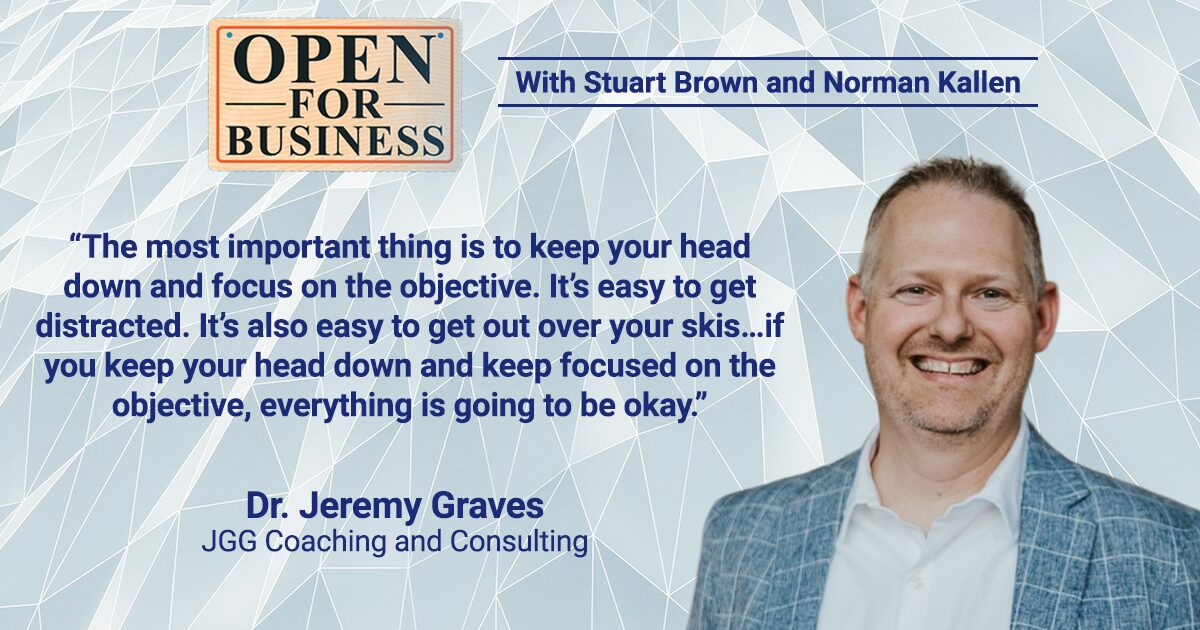
One of the biggest challenges business leaders face in this modern era is managing multi-generational teams. Bridging the generational gaps is easier said than done, since the Baby Boomers, Generation X, Millennials, and Generation Alpha have their own passions, interests, and needs. Norman Kallen and Stuart Brown explore how to make this work with Dr. Jeremy Graves, a renowned expert in intergenerational collaboration. He discusses how to shape a multi-generational workforce with a competitive advantage by finding unity in diversity. Dr. Jeremy also explains how such a team should collaborate in the most effective way, as well as how leaders should provide them with a culture where they can thrive despite their long list of differences.
—
Leading Across Generations with Dr. Jeremy Graves
Welcome back to the show. I’m Norman Kallen. I’m here with my co-host, as always, Stuart Brown. Hello, Stuart, welcome.
Hello, Norman. I’m very glad to be here as usual.
Nice to have you. This episode is another great one. We will be joined by Dr. Jeremy Graves, who will share a unique and timely perspective on bridging generational gaps in the workplace. If you’ve been wondering or even struggling about how to lead your organization, which is comprised of a mix of Baby Boomers, Gen X-ers, Millennials, and Gen Z-ers, you certainly don’t want to miss this conversation.
Norman, don’t forget we also have to include Traditionalists in this mix, those people who were born before 1945. Some of those people are still working.
Dr. Jeremy Graves will explain what all this means. I’d like to welcome our guest, Dr. Jeremy Graves. Stuart, do you want to give us a little brief background on Jeremy?
By way of brief background, Dr. Graves is a distinguished generational strategist, professor, author, speaker, and leadership coach dedicated to unlocking the potential of multi-generational teams within organizations. If you think that I pulled that off the top of my head, you’re mistaken. He serves as the Director of Professional and Continuing Education at Boise State University, where he champions innovative programs designed to equip leaders with the tools necessary for effective intergenerational collaboration.
Dr. Graves has also written several influential books on leadership and generational dynamics. He lives in Boise, Idaho, and enjoys supporting the Boise State Broncos, attending Idaho Steelheads hockey games. He also enjoys spending quality time with his family. We’re going to ask him about that in a little while. Jeremy, here’s a lead question. This is probably going to be the most difficult question that we have for you. Why is the turf blue?
I was ready. I knew that was going to be the lead question. I had it in the back of my mind.
That’s an East Coast question.
Competitive advantage, that’s what it comes down to. Somebody sat in their office one day. At this point, we were part of the Western Athletic Conference, the WAC. Someone decided, “How can we get some competitive advantage? Let’s turn the field blue.” The Smurf turf has its claim to fame.
It’s the true camo when you wear the blue uniforms. I was watching that on television one time. I said, “That’s an enormous advantage.” Sometimes, you can’t pick up who’s going to wear it.
When we moved into the Mountain West, they started telling us that we couldn’t wear all blue. Certain conference games would not allow us to wear all blue.
Introducing Dr. Jeremy Graves
You’re talking about intergenerational matters. Stu and I are business lawyers, and our clients are business owners and businesses. One of the things that we deal with and they struggle with day in and day out is how to deal with multigenerational employees. How do you lead? How do you motivate? How do you even understand what they want, and what it all does? That’s interesting. That’s what got us to look after you and find who you are, and particularly your book, Leading Across Generations, hits that right on the money.
That was my doctoral dissertation. I made the book readable because no one would want to read a dissertation.
That’s interesting because we were going to ask you how in the world you get interested in this, and what motivated you to write the book. Now, we know.
The motivation came from having a dissertation that no one was ever going to read. I took all the academic speak out of it and decided to write something that I knew could be helpful to folks. I got into it as a leader who was leading a team of college-age students who were the front line of the organization. I had a board made up of men and women who were either retired or nearing retirement. I could not get the two groups of people to communicate with each other.
My dissertation was in a complete desperation as a leader to figure out how we get people to communicate and talk to one another. I was sharing that with the dissertation supervisor. He said, “I think that’s what you should write about.” Part of my research and writing was how do we build intergenerational teams and leverage the strengths that each of the generations brings to the organization, rather than saying, “If those folks were more like me, we’d be okay.”
We always talk about products, but the reality is that this is the expression, “Necessity is the mother of invention.” This was your case as well.
I wish I could say it was an aspirational leadership, but I was pretty desperate. I call myself a desperate leader, trying to figure out how to get people to communicate with one another.
Identifying the Different Generations
Before we get into the details, can you describe the different generations for us, so we understand?
The hardest part of the research was getting to the generations because our friend Google has a way of messing with the numbers. When I was doing research, they kept coming back to me. My dissertation supervisor kept saying, “What dates are you going to use?” They were all over the place. The dates that I ended up landing on are dates from the Bureau of Labor Statistics. However, I’ve tweaked those even for the book. Traditionalists are from 1929 to 1945. Boomers are from 1946 to 1964. Generation X is from 1965 to 1981. Millennials are from 1982 to 1994.
If you read my dissertation and the book, I used to have it going until 1999 because the idea of Millennials was those turning of age around the millennium. That’s where the term came from. I started to read some new research after I’d completed my dissertation by a researcher by the name of Jean Twenge. She’s from the University of San Diego, and she wrote a book called iGen. I started looking at her research. I reached out to her and I said, “I need to have a conversation because your research is messing up my research. I need to know who is right.” In the process, she convinced me. She believes that Gen Z or iGeneration should start in 1995 and go to 2010. If you look at Gen Alpha, you may see 2010 to 2024.
You said a moment ago, when you were talking about Generation Z, the iGeneration. Why did you make that reference? I’m curious.
Do you know why 1995 is such an important year for a generational divide?
I have no clue.
1995 is the year that we have a generation that doesn’t remember a time before the internet. That’s why iGeneration stands for internet generation, the first generation to grow up not knowing a time before the internet. Do you remember downloading pictures? Do you remember how long it took to download a picture? That’s where the i comes from in iGeneration. It’s the internet generation. That was the work that Jean Twenge unpacked in her book iGen. I finally reluctantly said, “I think you’re probably right. That is a great demarcation between the two.” We would say Millennial Group A and Millennial Group B because there was such a large gap between them.
1995 is the year when a generation that does not remember a time before the internet emerged.
Did you have to study each of these generations in order to understand how they would interact?
I did qualitative research specific to focus groups. I did focus groups in two different ways, in three different places. I did qualitative research of people who were of the same age bracket or generation. I did multi-generational qualitative research where I would have focus groups of multi-generations. I started my research when I lived in Atlanta, Georgia, in a metropolitan area and urban center. I finished my research in Boise, Idaho, which is very different.
A lot of the rural communities around Boise are where I did some of my research. I had both an urban and a rural perspective that, for me, became important. Having grown up in a North Idaho town with a population of 2,000, moving to Atlanta, Georgia, living in a city of 4 million at the time, and then moving back to Idaho, all of that played a role in the focus groups and the qualitative research that I was doing at the time.
When you’re requested by a leader to give them advice and insight, it’s got to be to a leader, forgetting all the groups, but you need to understand how all these people think and view business, culture, and all the rest of it. As a leader, it’s got to be, “Timeout. I can’t do this. I can’t sit, take the time, and figure out what everybody wants. I’ve got to run this business. Maybe they need to adapt to me.”
I have an approach that I take to that. You have a choice every day when you show up in the business world and at your place of work. You can either be a Swiss Army knife or a scalpel. The scalpel says, “If everyone would adjust to me, we’d be okay.” For a long time in the business world, that’s how we did things. 2017 became an interesting point because it was a tipping point where the younger generation outnumbered the older generation in the workplace.
In that space, people needed to start to adjust to a Swiss Army knife approach, which is, “How can I leverage the strengths that each of these generations brings? What does that look like?” For me, if I can give you a couple of tools to be able to work with this generation or that generation, then that’s all you need. To truly start the conversation and be successful is to know a little bit. I challenge people to think like a Swiss Army knife. What piece do you need at this time to successfully lead this team?
Do the rules change if the leader is a Traditionalist versus a Gen Z-er?
Absolutely. You have to keep in mind what a Traditionalist view of business would have been. Their background would have been probably very hierarchical because that’s what they saw. When they think about business, they think that those at the top think, those at the bottom do, you work your way up, and you earn the right to be heard. You have a Gen Z leader who would be much more collaborative from the beginning, maybe because they have grown up more collaborative, they’ve seen business as a partnership versus a hierarchy, and sometimes they feel inadequate. They want to get a sense of what other people think to help them decide if what they think is the right way to go in that moment. What is it that a Gen Z leader is missing or a Millennial leader is missing? It’s the experience.
Getting Better in Multi-Generational Communication
As you speak to leaders who have a good mix of employees, what are some of the biggest mistakes they make, other than not taking the time to understand their employees based on your book and your philosophy?
One of the big ones is when it comes to communication, we assume that people want to communicate the way that we want to communicate. I’ve seen a lot of the struggles that we often blame on intergenerational issues come down to communication. I challenge leaders to think about how they communicate. I also challenge them to think about methods of communication, like emails, text messages, phone calls, and in-person. How do you ensure that the people who are a part of your team, your organization, and your business, take in communication? How do you help them grow in that space so that they don’t just always rely on the text?
There’s a generation that, even at the university, I have to help them learn how to answer the phone. It’s a new way of thinking. We have phones at the university. Many of them, as a student worker, have not been trained to pick up the phone and say, “Hello, Boise State University. How may I help you?” Leaders have a responsibility to think about communication, as well as our generational differences, our worldviews, and how that shapes us.
It has to be exceptionally frustrating, though.
It’s extremely frustrating. I worked with the CEO of a large company here in Boise, who called me in utter frustration. He said, “I can’t take it anymore. I look at these resumes. I throw them straight in the trash because they have sixteen months here, they have four months here, or they have two weeks here.” I said, “You’ve probably thrown your replacement away ten times.” He looked at me and said, “What do you mean?” I said, “This younger generation, it’s not that they’re afraid to work. We like to blame it on them not having a work ethic. That’s not true. They’re looking for something meaningful for them to do. If you can help connect that dot, you can alleviate a lot of your frustration in the space because what they’re looking for is meaning.”
It is not true that the younger generation does not have work ethic. They are actually looking to work on something meaningful for them.
My generation, Gen X, and generations above me didn’t think about meaning when we went to work. We thought about a paycheck. We thought about taking care of our family and paying the mortgage. That was how we thought about things. I challenged that leader. He brought me into his entire company. He flew me to Chicago to work with his leadership team. He said, “I want to introduce you to the person who told me I’ve probably thrown away my replacement ten times.” That’s how he introduced me.
We had a great conversation and did some great work with their industry because their industry was suffering at the time. It was an industry that was hit hard during the recession of 2008 and 2009. They had to lay off a lot of their middle management. I was working with them as their older folks were getting ready to retire, and they had no one to replace them.
Jeremy, can you give us an example of a success story and also an example of a failure?
Let’s start with a failure. Remember, I told you that I was a desperational leader. I failed to implement what I was researching because it was still so new to me. We eventually ended up closing the organization that I was running as the executive director because I could not solve the problem of communication between the generations. Part of it was that the research was so fresh that I was trying anything, throwing it at the wall and seeing what would stick. That was not helpful.
It also confused people and didn’t give them a clear path on how to work together. I became not only the desperational leader trying to figure this thing out that ended up writing a dissertation on it, but I also took my failures. When I started working with organizations, I started to hone in on what works when we get people in the same space, trying to figure out how to work together, and what was wasting people’s time. You all know that this is about, “We have a business to run. We have things to do. I don’t have time to sit around and play kumbaya for hours.” The success stories that I have had with major organizations have all been around coming in quickly and identifying where the conversations need to be had, doing some work with smaller groups, and then bringing the whole team together.
Jeremy, the word you used earlier in a conversation is the word everybody struggles with, and it goes to the core of all of this. It is communication. I don’t think we’ve had a guest on that communication wasn’t the key element of what they were talking about. I think it was a Clint Eastwood movie where there was a failure to communicate. That’s what it is. People make assumptions, and you get burned by assumptions.
I tell people all the time, you can’t inspect what you don’t expect. If you don’t set an expectation, you can’t hold someone accountable to that, so set the expectation.
Multi-Generational Teams in Big and Small Businesses
When you’re working with a very large organization, like a Fortune 500 company, you’re going to have multiple layers of management. I don’t want to generalize, but usually in that scenario, your senior management is going to be older, and then your middle management is going to be a little younger and younger until you get to the workforce. If you can contrast the way you work with that type of organization versus a small business, 100 employees, you have the owner, you have a couple of managers, and then you have your employees.
I’ve worked with one large organization for quite a while now, and it started with HR, believe it or not. HR brought me in, which was a cross-section in a good way of the full organization, because we had multiple generations in the room. Stuart, to your point, this is one of the problems that began to occur in the workforce, and it was around 2017. Up until that point, how we raised people up was that we got near retirement, and we looked to the generation behind us. We said, “I’ve got to start raising somebody up because I’m going to retire,” and that’s how people progressed in the workplace.
It was around 2017 because you have Boomers that were this large generation, then you have Generation X, which is a squished generation. The divorce rate skyrocketed during the late ’70s and early ’80s, and so families started having fewer kids. Generation X is a smaller generation and a squished generation, squished between a large Boomer and a large Millennial generation. What happened around 2017 is that senior leaders of organizations started to look back and say, “I’m getting ready to retire,” and pure panic, because there was not enough of the Gen X generation to fill the leadership pipeline. What happened is they started to freak out because the next people behind them were Millennials. They’re like, “We’re bringing Millennials into leadership in an organization.”
When I work with a large organization, I start with the HR team, but then I work with senior leaders. For senior leaders, it’s about communication, what kind of succession planning are you doing for your organization, and how you are raising up and empowering leaders. I then move down to the mid-level managers. I call them the bridge builders. They’re building bridges between where the frontline employees and the senior leadership differences might be. Middle managers play this important role because not only do they have to take the vision of the senior leadership team and cascade it down, but they’re also the mouthpiece back and forth between how the frontline employees, who are often younger, are feeling about the organization.
Leading a business is all about communication. You must know how to raise and empower your team.
They are cascading that up to the leadership, taking that information back down, and trying to cast vision from a meeting that they may have never been in, where the vision was established for what they were going to do. They live in this nebulous place. The final thing that I do is I work with that frontline team. At that point, it’s about leading up and managing up. It’s also about clear expectations. Sometimes, I’ll work with teams on roles and responsibilities. What are your roles so that you can continue to develop a cohesive structure within your organization?
Succession Planning in a Multi-Generational Team
You mentioned succession planning. On this show, Open for Business, we talk about succession planning quite a bit. One of the other areas that I thought would be interesting for you to comment on would be a family-owned business, where you have multiple generations within a family. Mom, who’s been running the business for the past 40 years, is getting ready to call it a day and move on to her second act. Her kids may or may not be on the same wavelength as her.
How impactful are culture and ethnic differences within a family type of family? Depending on who your background is as a family, where you’re from impacts that answer as well.
When you look at the families that make decisions based on the way their culture has made decisions, which is that the family comes together, we talk about it, fight it out, argue it out, and then come to a consensus and move forward. If you have that culture that you’re also leading a family-owned business in, you have two areas that you have to work on. You have the business side of things, but then you also have the family cultural side of things.
I see that a lot with Indian families when I work in India. It’s very familial in how they connect and communicate with one another. You can ask one of them, “I need you to make a decision on this,” and they’ll look right at you and say, “I need to go talk to my family.” They will go home, and that can be frustrating if I need you to make a decision quickly. They need to go home and talk to their family because the family input becomes important.
The Importance of Proper Collaboration
I want to cut over to your book, Leading Across Generations, for a minute and ask you to touch on the subject of CORE. Do you teach it? Do you discuss it? I know what the letters stand for. I got to believe with some leaders, as opposed to ‘celebrate,‘ they might view this as ‘capitulate.‘ I’d like you to comment on that a little bit.
It would depend on the day. For me, CORE came from looking at my son’s science homework one day, when he was in fourth or fifth grade. He had a picture of an atom, with the molecules, the electrons, and the neutrons. We were writing all of those down, and I began to think about leadership through the lens of whether you attract people or repel people. That’s how it first started for me. What kind of leader are you? Are you attracting people or repelling folks?
I started to unpack it. Succession planning was where I started with this conversation. How do you help people think about that? When we talk about the C, it has to do with how collaborative you are as an organization. When you are collaborating, how are you teaching collaboration? Sometimes, we assume people know how to collaborate. The O is objectives, and specifically, how do you have clear objectives? When you are building a team, you have collaborative folks who have clear objectives, and then when you have clear objectives, you can work on raising up and empowering them. R is raising up, and E is empowering.
The idea is, “How do I create a collaborative organization with clear objectives that has a focus on actually building people up in the organization and moving them up in the organization?” You probably know this as well as I do. It costs your company every time someone leaves. It’s expensive. I wanted to look at this from, “How do you build talent from within your organization?” When you think about our generational differences, how do we learn to collaborate?
The gentleman or the lady who’s in the C-suite, who is thinking of retirement in the next few years, has a lot that they can give to the generations below them to empower them, raise them up, and those things. Sometimes, they feel like, “The younger generation doesn’t care. They want to do their own thing.” Sometimes, we haven’t clearly given them a pathway to understanding culture of our organization, and more importantly, why we do what we do, why our organization does what it does, and here’s all the industry understanding of how we landed where we are now, so that someone new to the organization can go, “That makes sense to me now why we do what we do.”
Avoiding People Who Think Exactly Like You
With all this information out there and all this discussion about leadership, sensitivity, and the different generations, you would think in this age that people would have gotten it, but they don’t seem to get it. That’s a very frustrating feeling. It seems what you’re telling is so obvious to understand, and you think that a leader would get it, as opposed to saying, “Just do the job.” Why is this still an issue?
We have a tendency to want to silo and find people who think like us. If I can find a bunch of people who think like me, then I don’t have to have any of the hard conversations. I don’t have to acknowledge that maybe someone does something better than I do, or maybe someone’s approach to problem-solving is different than mine. I saw this when I first started researching. The biggest struggle that I saw when organizations would get together to work through some of this was that we had too much groupthink.
Business leaders tend to depend on a silo and find people who think like them.
We hired people who thought like us. In that process, we created businesses that were very egocentric. We were focused on how we think instead of building and hiring people who think differently from us. Generationally, the younger generations have forced this conversation because they’ve grown up being a little bit more sensitive than my generation and generations before to things like diversity and how diversity plays out in their schools.
Managing Multi-Generations in a Hybrid Workplace
How does all this discussion play into running a business and then dealing with the issue of working in person or remotely?
Let’s start with in-person. We have certain skills that I don’t even call soft skills. That was the term that people started using. I call them essential skills. We have some skills that are essential to a successful business. They are things like being able to have conversations when there is emotion attached to it or when there’s conflict attached to it, and not just running from conflict, but stepping into conflict and feeling the uneasiness of it.
Jeremy, when you refer to conversations, are you talking about oral conversations?
It is us legitimately having conversations in the workplace to get things done, not simply a Teams chat with the person at the desk next to me. It is having legitimate conversations. In the space of working together, when we talk about generations and running a business, it is not just communication and being in the same space, but it’s leveraging the strengths. Each generation brings something to the workplace based on a whole bunch of experiences that they had that led them to where they stand or sit. We have a responsibility to leverage that to the success of our business, which I think you can when you know a little bit about how they show up. These are things like grit and resiliency from certain generations, using technology from other generations, and how you bridge the gap between those.
When you talk about this conversation in a hybrid workspace, it gets very different. It’s a difficult conversation to continue to build a business when you have workers who are in the office and some who aren’t. Google went remote long before COVID, but they were one of the first to bring people back into the office because they said what they were losing by the hybrid space was creativity. They felt like the creativity was suffering in the workspace because, as much as you have your brainstorming sessions via Zoom, it’s not the same as being in the same space with a whiteboard.
Out of curiosity, do you know whether or not those executives were senior people or Millennials?
They were senior folks. They did get some pushback, but not as much as some might have expected from a younger generation. In the hybrid workplace, when you’re talking about building a business, I always tell leaders, if you are leading a team and you have remote employees, you can expect 35% to 40% more time connecting and making sure that they have what they need to do their job. It is simply because they’re not in the same space as you.
This is a little bit of the field of what we’re talking about. My daughter works at a very large accounting firm. We were sitting around with some of her friends, having a beverage or two. They were discussing working remotely. I was sitting there listening. I finally chimed in and said, “I have to be honest with you. I do not believe that you get the same training remotely that you do when you’re in person, because you read body language, you see how people communicate with each other, and so on.” I was shot down. They’re all in their early 30s.
I would respectfully disagree with them.
I did, too, but I didn’t do it respectfully.
Jeremy, I learned a long time ago that I made the mistake with email, that you can’t read emotion in emails and texts. That is an enormous factor. That’s good and bad. Sometimes, you want people to read emotion because maybe it’s sarcasm, and it’s not intentional. I learned the hard way. I’ve never done that again. When I have to talk to someone and there’s an issue, I walk in.
Stuart, the reason I would say that I would disagree with them in some space, especially when it comes to onboarding, is that long before COVID, I wrote that to give your employees that are hybrid or remote eligibility when it is earned. What I meant by that wasn’t like, “You have to jump through a bunch of hoops to earn it.” It is to ensure that they are successful at doing their job when you’re not in the same space as them, which means the onboarding needs to be done in person. You need to know what’s working and what’s not working.
This is why you see all these stories that emerged from the pandemic, and even since then, of people who are working two or three jobs. They call them side hustles, but they’re skimming money from one company because they’re not giving 40 hours to that company. They’re a salaried employee there, and they’re a salaried employee here. Neither company is getting the best of them, but they’re saying, “I can do two full-time jobs. We’re not in the same space. As long as I can work my calendar to make sure I’m in the right meetings, you might think I’m getting a lot of things done.”
Dr. Jeremy’s Book Recommendations
Jeremy, I want to give you an opportunity. You’ve got a great list of books. I love the Leading Across Generations and your other ones. How do people find them? How do people learn more about you? How do they learn more here from you, because the subject is fascinating?
It’s been super fun. My books are on Amazon. You can find me there on Amazon. I have three books. Leading Across Generations came out in 2018. That was my doctoral dissertation that I wrote in 2012, dusted it off, and took all the technical words out of it, so we could read it. In 2023, I wrote a book called The Leader Paradox, which is on servant leadership, how you develop a culture within your organization of leading and serving, and what that looks like.
In November of 2024, I finished a book, and probably the one I’m most proud of in the sense that it’s the shortest book I’ve ever written, called Change Leadership. It’s a crazy title, isn’t it? This is how it all started. In 2018 or 2019, I started working with teams around generational conversations, which led me to think about how we can best lead a generational team, and that’s where servant leadership came from.
People with several side hustles fail to give one company their very best.
Since the pandemic, we have experienced change at such a rapid pace that I kept hearing companies talk about it. I had the privilege of working with a large company on a change initiative. I took that entire experience and wrote a book on it. The reason I like the Change Leadership book so much is that it’s the shortest book I’ve written. It’s 25 chapters. Each chapter is two pages, but at the end of each chapter is a tool that you can use if your team is experiencing change.
If your team is experiencing change this way, you can do this. If your team is experiencing change this way, you can do that. The publishers didn’t like it. They said, “You’re giving away all your secrets.” I said, “Here’s the thing. I can only be in one place at one time. Let’s acknowledge that this is good content that people can get their hands on. If they don’t want me to come work with them, but it still moves the needle with their team, that’s fantastic.”
I’ve seen that in other books. It’s fabulous because you can’t be all things to all people.
You can find me at DrJeremyGraves.com.
Appreciating Your Team and Their Strengths
Jeremy, usually on Open For Business, we ask our guests to give us one piece of advice at the end.
This is a tough one, so don’t rush into your answer.
I would challenge people to see the value of their team and the strengths that they bring to their organization through the lens of appreciative inquiry. It is seeking to see the best versus what frustrates them. We’re so trained to see what frustrates us that sometimes, we miss what someone brings to our organization. If we can flip that script, it doesn’t mean we shouldn’t challenge people to grow, but we really should also look to see how we can help this person be successful by leveraging the strengths that they bring to the team.
It’s like the glass is half full philosophy. One last question before you go, which is always important to us because we track this as well. Bourbon or scotch?
100% bourbon.
Why and which brand?
Several. I fell in love with bourbon during the pandemic. It wasn’t until that point.
Where else? You got to drink at home?
It was at that point that I discovered Old Fashioned.
I love Old Fashioned. By the way, did you buy a smoker?
My boys got me one for Father’s Day.
Thank you so much for being on Open For Business with us. This has been enlightening and enjoyable. Give me some of your brands that you like.
I’m a big Angel’s Envy fan.
Excellent.
Important Links
- Dr. Jeremy Graves’ Website
- Leading Across Generations
- iGen
- The Leader Paradox
- Change Leadership
- Dr. Jeremy Graves on LinkedIn
About Dr. Jeremy Graves

Dr. Jeremy Graves ignites minds and empowers organizations to unlock the hidden potential of their multi-generational teams. As Dean of the College of Business and Innovation and Director of the Center for Executive Leadership at Ohio Christian University, he leads innovative, high-impact programs that equip today’s leaders with tools to thrive in the evolving workplace. A sought-after keynote speaker and author, Jeremy has written three acclaimed books: Leading Across Generations (2018), The Leader Paradox (2023), and Change Leadership (2024), which provide practical frameworks for navigating intergenerational dynamics, advancing servant leadership, and leading through transformation.
Jeremy’s passion lies in creating learning environments where diverse perspectives can fuel innovation and where leaders are equipped not only to manage change but to lead it with integrity and purpose. His training and consulting work spans industries and continents, helping organizations from startups to Fortune 500 companies build stronger cultures through intergenerational collaboration, servant leadership, and strategic adaptability.
Beyond his professional pursuits, Jeremy and his wife now reside in Columbus, Ohio. Jeremy is a proud season ticket holder for the Columbus Blue Jackets, and they both enjoy all the city has to offer. Their older son, Jordan, is a fifth-grade teacher in Boise, Idaho, and their younger son, Taylor, is a motorcycle fabricator in Boston, Massachusetts.