
Maximizing Value in the Middle Market: M&A Lessons from Alan Scharfstein
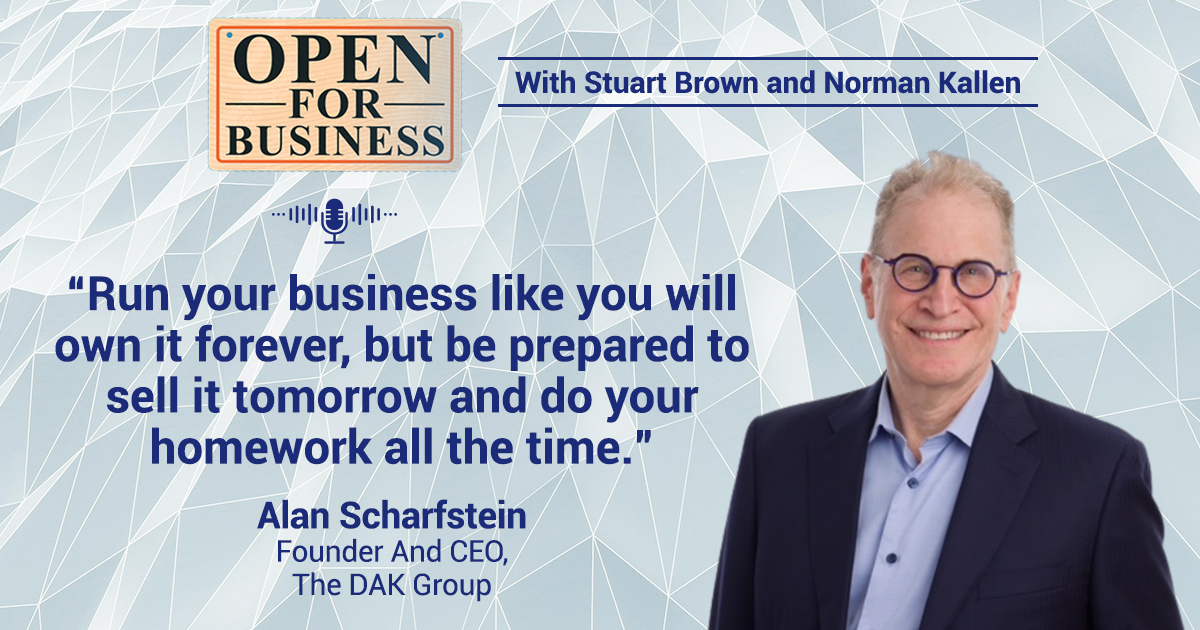
On this episode of Open for Business, Stuart and Norman welcome Alan Scharfstein, Founder and CEO of The DAK Group, one of the nation’s most trusted advisors to middle-market business owners navigating high-stakes M&A decisions.
With more than 750 transactions completed across industries and borders, Alan shares what founders most need to know before they sell: why an unsolicited offer isn’t the same as a true market process, how the right advisor can locate buyers you’d never expect, and why buyers don’t “buy your past” — they buy a company’s future story and the roadmap to growth.
You’ll also hear Alan’s candid take on:
- When it makes sense to not sell — and how the best bankers talk owners off the ledge
- What sellers obsess over that doesn’t matter to buyers (and what buyers care about most)
- The most common ways founders unintentionally leave money on the table
- Why “due diligence” can feel like a “colonoscopy without anesthesia,” and how to manage it without losing momentum in the business
- How to evaluate value beyond price: employees, legacy, life-after-sale, and the emotional reality of closing day
- Red flags in buyers, deal “retrades,” and how to protect yourself from terms that shift risk back onto the seller
- A lightning round of hard-won lessons on handshakes, negotiation mistakes, and what owners should never say at the table
Alan also weighs in on what’s ahead for the deal market — private equity dry powder, increased international interest in U.S. businesses, and why strategic acquirers continue to rely on M&A for growth — plus how AI is reshaping diligence and deal execution without replacing the human judgment that closes great transactions.
Whether you may be years from an exit or are getting approached right now, this conversation is a practical masterclass in preparing, positioning, and protecting what you’ve built — so you can maximize value and walk away feeling great about the outcome.
—
Maximizing Value in the Middle Market: M&A Lessons from Alan Scharfstein
Welcome back to Open for Business, the show where we explore the people, the ideas, and the innovations shaping today’s business landscape. I’m Norman Kallen. I’m here as always with my partner, Stuart Brown. Hello, Stuart.
Hi, Norm. How are you doing?
I am good. How about you?
Just fine. Thanks.
Stuart, our guest is Alan Scharfstein. He’s the founder and CEO of the DAK Group and one of the most respected advisors to middle-market business owners in the country. Alan has spent his career advising founders, families, and private equity groups on some of the most important decisions that they will ever make, when to sell, how to prepare for, and how to maximize value and outcomes. Alan is a highly skilled M&A strategist and negotiator. He has personally been involved in more than 750 transactions across a wide range of industries, both here in the United States and abroad. He maintains a singular focus on helping business owners realize maximum value for what they’ve built.
It is incredible to think about 750 transactions or more. Whether you’re building, buying, or eventually selling a business, I guarantee you, this episode is packed with real-world insight from someone who has been in the room when it matters most. You should also know that prior to founding DAK, Alan held senior executive roles at PepsiCo and Universal Folding Box, giving him a rare blend of large corporate, operational, and entrepreneurial experience.
He is also a frequent lecturer on valuation, negotiation, and the sale of privately held businesses. He has been quoted in The Wall Street Journal, Businessweek, the Financial Times, TIME Magazine, and now here on Open for Business. When he is not advising clients, Alan is an avid cyclist. He believes the steeper the climb, the more enjoyable the ride. He holds a Bachelor of Science degree in Economics and an MBA from the Wharton School at the University of Pennsylvania. Join me in welcoming Alan to Open for Business.
Hi, Alan. Thank you so much for joining us here. Looking forward to our conversation.
—
What Drew Alan to Investment Banking and M&A
Hi, Alan. Welcome to Open for Business. It’s good to have you. Let’s jump right in with a couple of questions here, since we already provided some background for you. First of all, what drew you to investment banking and M&A? Certainly, that wasn’t in your background.
It was absolutely not my intention. I actually started my career as a corporate person working for Pepsi, first in finance, then in manufacturing. I left Pepsi to run a family-owned business, not my family, but a family-owned business in a manufacturing space that I ran for seven years. After that, I decided it was time for me to live out my entrepreneurial dream and buy a business.
My process of trying to find a business to buy was so incredibly frustrating that at the end of the day, I made the determination that maybe if no one else was doing a great job of acting as intermediaries in mid-size business deals, maybe there was a market there. I started as a one-person operation in the basement of my house, and lo and behold, I found there was a market.
Good for you. The DAK Group is very well-known in the middle market. What differentiates your approach from other investment banks?
We look at what is in the owner’s best interest. What that means is sometimes, it’s part of our job to talk the owners out of selling a business because, usually, it’s not appropriate. It’s not the right thing for them to do. We’re brutally honest with clients and potential clients about what their options are. Sometimes, that means talking people out of doing a deal, but very often, it means educating them as to what patience they need and what they need to do before they go to market.
The business is very well prepared for that process. We have a group within our company that does nothing but work with businesses that think they may want to sell and think they may want to go to market, but aren’t quite ready, and help them fine-tune their businesses so that they get the maximum value when they go to market.
The Importance of Using an Investment Banker
Let me jump in and ask you why people use investment bankers. We hear a lot from business owners that, “I know the industry. I know the players. I got an unsolicited offer, so I already got a dollar value.” Why should they use an investment banker at that point in time to help them in the process?
Not every case requires an investment banker, but many do. The reason you use an investment banker is that you want to run a process where you know you’re getting the highest price, where you know you’ve brought in all the right buyers into that process. At the end of the day, you know you got the right value for your business. Norm, one of the interesting statistics that we track is when we are engaged by a new client, we typically ask them to write down on a piece of paper the three most likely buyers for their business.
Those are people they know. They’re in their industry. They think they may buy. They’d be willing to buy and pay a premium price. Interestingly enough, in over 80% of the cases, the ultimate buyer turns out not to be one of those three. It is important that a business owner feels comfortable that they have got the highest price. That’s part one. Part two, the biggest mistake that business owners make, as they think about this process, is that the process of selling a business is very time-consuming.
As a result of that, some of them take their eye off the ball. What’s the ballgame here? To continue to run your business as profitably as possible. Those who take their eye off the ball end up sub-optimizing their value. To make it easy for business owners, we take the burden off their shoulders. We help them through this whole process and let them focus on what they do well.
What Business Buyers Really Care About
I’m making a note. Don’t buy that red Ferrari until the deal closes. I got it now, Alan. Here’s an interesting one. From your seat in the middle of these deals, what’s the biggest thing sellers think buyers care about that buyers actually don’t care about?
Sellers think buyers care about the assets that they have in the business, their equipment, inventory, and other things that they may think are of value. They care about two things. They care about earnings. What are your earnings? What is your EBITDA? More so than that, they care about the future. A good part of our challenge when we represent the business is making sure that we paint the roadmap for the future because that’s what buyers buy. They don’t buy your past. They don’t buy your income from last year. They buy what they expect is going to happen in the future.
You might’ve said it at one of your seminars at one point in time. They look at the business based on past earnings. That’s where the purchase price is based, but they buy it based on what’s going to happen in the future. It is exactly to your point.
One of the interesting things business owners should be thinking about is that we all tend to think about the earnings of the business in the last year as being the key metric there. Every buyer is doing a different calculation. Every buyer is doing a calculation as to what they’re going to make running this business. What they make running the business may be very different from what you make as an owner currently or as a seller of this business.
They may be able to leverage your client base. They may be able to cross-sell products. They may be able to use your technology over a broader geography. All of these things are things we have to think about because if we can put ourselves in the shoes of the buyer and understand what their economics are, we stand a much better chance of getting the highest value for the business.
If business sellers can put themselves in the shoes of the buyer and understand their economics, they stand a much better chance of getting the highest value for their business.
How To Manage a Deal That Is Not Going Well
It is an excellent point. Thank you. Take us inside a deal where you knew in the beginning, it wasn’t going to go well. You knew there were either the wrong parties at the table or it wasn’t the right situation, but everybody kept pushing forward anyway.
If we think a deal isn’t going to go well, we’re not getting engaged, or we’re not pushing it forward. That’s part of our job as deal clients when they’re dealing with the wrong buyer or when there are issues. One of the things that investment bankers know well is that they understand the DNA of the buyer. Let’s take private equity, for example. There are some private equity groups that I can take a look at and say, “These guys are like Boy Scouts.” They tell you the truth. They’ll deliver on what they promise. If we have a handshake on a deal, I’m pretty sure that deal is going to close.
There are other groups that I look at, and I know that they are setting up the seller for a retrade later on the deal. As a matter of fact, one of the largest private equity groups in the country has a reputation that if you have 100 items on your closing checklist and item 100 is to wire the money, item 99 is to retrade or renegotiate the deal. That’s what they do all the time. Part of our job is to know that and to be able to educate our clients as to what’s going to happen if we engage with that particular party. Most business owners sell a business once in a lifetime. You’ve got to make sure you do it right. It’s a real learning experience.
How do you walk them off the cliff if they see dollar signs and you say, “It’s the wrong buyer?”
Business owners are smart. They will listen if you can rationalize your position with them. Part of our job is not just rationalizing the position when we have a buyer who we have to walk off the cliff. Sometimes, one of our greatest challenges is that business owners may think they know what their business is worth, and they may not. They may think their business is worth a fortune.
If their expectation is totally unrealistic, part of the job of an investment banker, even before we engage together, is to educate them as to what the likely market value of their business is. Why should they waste the time and the money on a failed process? That’s not fair. On the other hand, we have had numerous occasions where business owners told us what they expect the value of their business to be when we go to market. They’re drastically underestimating what we think the market will pay. Part of our job is education.
That’s interesting. What are the telltale signs of a seller who comes to you and says, “My business is worth X,” and you know that he or she is undervaluing their business?
A seller may think it’s worth X because they understand what their income was on a federal income tax return for the last year. Very few privately held businesses run their businesses to maximize their tax payment. Most run businesses to minimize that number. We have to think about all the things that will go into a business when a new owner takes it over. For example, if the owner is paying themselves excess salary, if they’re paying excess rent, or if you have family members who aren’t contributing or working in a business, let’s figure that out. If you have a plane or a big boat, that may not be essential for running your business. We start to look at all of these things and understand where they are.
The other thing we’re going to take a look at is who the buyers may be. For example, if you’re selling to a buyer who has another factory and may not need your manufacturing facility or may want to relocate their manufacturing to your facility, there may be significant overhead dollars that you can save in running the business. Those are the types of things that we have to think about with business owners. When you run those numbers, there can be some pretty compelling increases in value in a business.
Three Aspects of Selling a Business
We’re talking about price for the most part. How should founders think about the value that they’re getting beyond the top-line number?
The bottom line for most business owners is, is it the right time to be selling the business? It has three aspects to it. One, is it the right time in terms of the business performance? Two, is it the right time in the marketplace? Are deals happening? Are people paying the right price? The third, and maybe the most important factor, is whether it is the right time personally for the owners or owners of that business. Most entrepreneurs are not good retirees. Not only might they not be happy if they retire too early, but their spouse might also be even less happy if they retire too early.
One of the things we have to think about with business owners is what happens the day after. What are they going to do? Is the buyer going to engage them to continue to run their business, or are they superfluous and unnecessary? What’s their employment going to look like? How are they going to be treated? Also, what’s going to happen to key employees? Are they going to be employed or not? We did a deal out in Arizona. We had two extraordinary offers for this business. One was significantly higher than the other, but both were good offers.
We were meeting with the owners late at night, trying to figure out which direction to go. The owners turned to me. He said, “Alan, I think we want to go with the lower of the two offers.” “That’s okay with me, but tell me why.” His explanation was, “The buyer who had the highest price, even though he has promised to keep my plant open and keep everybody employed, has a very similar factory in Los Angeles, not that far away. I’m concerned that a few years from now, I’m going to be shopping in a grocery store and someone is going to tap me on the shoulder and say, ‘You took care of yourself. We got screwed by this deal.’”
He said, “I could not live with myself. The difference in price is not worth that pain for me.” His decision was to do what was right for his employees and not necessarily what was optimizing his results. That’s probably one of the great things about working with entrepreneurs and privately held business owners. Their decisions are not just dollar-and-cents decisions. Their decisions are based upon a much bigger universe that they’re looking at.
What You Should Do After Selling Your Business
Alan, when you’ve had a business owner, you’ve talked to them about, “What’s your next act? What are you going to do once you sell it?” Have you had situations where, when you ask that question and have that discussion, business owners have realized, “I’m not ready to sell my business. I can’t do it, not for the value proposition, and I won’t even say for my own ego, but for my life. I don’t mean lifestyle per se, but my life?”
Yes, absolutely. That’s why we asked that question early on in the process. One of the first things we do with every client or potential client is talk to them about if they sold this business, what would they do afterwards? Also, if they sell this business, what do they want to do with the buyer? For example, in some cases, clients will tell us, “What I would like to do is to stay in the business and continue to work here. I’d like to find a buyer who will let me run this business. Maybe you can find me a private equity firm that will allow me to stay here.” In other cases, clients will say to us, “I’m not going to be a good employee. Let me blow it up into the sunset after this deal is done.”
I’ll give you a quick story, Norman, because this is interesting. One of the things that we find is that the whole process of selling a business is an education for entrepreneurs. Again, people do it once in a lifetime. You want to do it right. We sold the business a few years ago. It was a significant transaction. We had known this owner for many years. We helped him grow his business. He was in his 40s when we first met him. He was in his 50s when we finally said to him, “You’ve gotten to the point that we think you should take a look at selling this business.”
The whole process of selling a business is an education for entrepreneurs. People do it once in a lifetime, and they want to do it right.
He said, “I’m willing to do that, but under one condition. You have to find me a highly strategic buyer who is going to pay me a lot of cash and get me out of this business fast.” When we asked him why, he said, “Because I think I’m a good entrepreneur, but I’m going to be a bad employee. Let’s do it that way.” Our response to him was, “Do us a favor. Let us run the process the best way we know how. Let us create options for you. Let’s show you what the market looks like in terms of strategic, private equity, and foreign buyers. At the end of the day, we’ll make a judgment as to what is best to do.” We ran the process, and we found him exactly what he wanted.
We found him a highly strategic buyer willing to pay him a lot of money and get him out of business quickly. He said, “No.” Why not? He said, “One of those private equity firms you introduced me to, I liked them. We can have a lot of fun together. What I want to do is I want to sell them part of my business. I’d like to stay in here with a significant ownership position.” The private equity firm wanted to buy 80% of his business. He only wanted to sell them 60%, and he did. The private equity firm in his case was brilliant because what they did was they said to him, “Tell us all the things you dislike about running your business.” He was a great engineer and a good salesman, but he hated HR. He hated finance. He hated legal.
They said, “Don’t worry. We’ll take all that off your table. You just run the business now.” In the five years since we’ve sold that business, its sales have quintupled. The private equity firm is going to sell that business. His second bite at the apple is going to be a lot more than his first. He is the happiest guy on the face of the earth. It’s a great deal. I’ll give you the epilogue to this whole thing. There was one person who was not happy with this deal. Who was that? That was his spouse because she kept saying, “I thought you told me I would see him more after the deal was done. He’s actually working harder, traveling the world, doing all these other things. I see him less today.” You can’t make everybody happy, but it still turned out to be a great deal.
Don’t Treat Due Diligence as a One-Way Street
That is a great story. Out of curiosity, because you’ve done so many of these deals, when sellers want to stay on, how often do you see situations where the seller says, “I want to stay on. I want to be employed, or be a consultant,” and the buyer says, “Okay,” and then a few months later, they separate because of different philosophies and what have you?
The cases where that happens are few. That’s because part of our job and part of the process is to educate the client as to what they should expect. What does that mean? It means that one of the other mistakes that sellers make when they sell a business, and what we can talk about due diligence at some point, which is a whole painful part of the process for sellers, is that sellers often think that diligence is a one-way street. The buyers can do all the diligence they want on you, and you do none on them.
That’s not the way it should work. As a result of that, we urge our clients, and we do as much diligence on the buyer as the buyer does on the seller. What does that mean? It means that if you’re selling to a strategic that has done multiple acquisitions, we want to talk to the last three or four people they acquired and allow them to talk directly to the owners of the business as to what their experience was like and what it’s like to live with these people after a deal is done.
The same thing with private equity. There’s nothing wrong with asking a private equity firm. “Show us all the deals you’ve done over the last five years. Let us pick the owners we want to talk to.” Let’s find out what they say about living with these people, because again, it’s going back to the fact that everybody who does these deals has their own DNA. What you generally find is that people who make sellers happy are consistent in terms of making them happy. Those who don’t are consistent in that. If you do your homework right, you’re not going to have a lot of surprises.
In those situations when you’ve spoken to people who have worked with a private equity group and were sellers, have you found a sense of honesty? You got real answers that you thought were not just, “I got to talk nicely because I’m still working with them.” Did you get honest answers?
If you speak to entrepreneurs who have sold their businesses, they’re not political. They tell you what they did. It’s great. One of the things that we typically do is that the way we cut through a lot of the bull that goes with some of this is if it’s the owner of the business who’s making this call, not us, they get far more honest answers than any intermediary, any lawyer, any accountant, and any financial advisor.
Emotional Challenges of a Business Sale Process
It’s interesting. Let’s change the subject a little bit. What type of emotional challenges do founders underestimate when they go through a sale process?
They do not know what it’s going to be like the night before. One of the things that we do with business owners is we explain to them that if you’re selling your business and you’re closing on Tuesday morning, I bet your Monday night is going to be a sleepless night for you. You’re going to question whether you made the right decision. You’re going to question whether it’s the right thing for your employees. You’re going to question whether it’s the right thing for your family. The thing you have to realize is that today, when you’re thinking about this logically, you are making this decision. When you wake up at 3:00 in the morning, this could be a highly emotional state. You’re going to be in a state of panic.
You have to remember at that point in time that you’ve made this decision, weighing all the consequences and all the pros and cons, and that you made the right decision with all that’s considered. I can’t tell you how many times I’ve gone to a closing and the seller has said to me, “Alan, I’m so glad you told me that because I woke up at 3:00 in the morning. I had a panic attack. I said Alan told me this is totally normal. I can go back to sleep now.” A part of it is that this is all education of the business owner.
I was going to ask you. Have you received those calls at 3:00 in the morning? Do you shut your phone off the night before?
I got to walk them off the cliff.
I’ll give you the ultimate story. Not only did I get them at 3:00 in the morning. We were doing a transaction. It was about 10:30 at night. I did get a call at home from the owner of the business. I could tell he was in a panic mode. He was a very emotional type of person. He was explaining to me all the reservations he was having and all the concerns he had. I said, “I understand you’re having a tough time with this right now. Should we get together in the morning?” He said, “I don’t know about the morning. I’m not sure how I’m going to sleep tonight.”
I said, “Do you want to get together tonight?” He said, “Would you come over to my house?” It wasn’t that far away. It was a half-hour drive from my house. I said, “Sure, I’ll come over there. I’ll be there around 11:30.” He said, “Can you do me a favor, Alan? My wife is having a panic attack, too. Can you bring your wife?” I had to give my wife a little elbow and tell her. “We had to make a house call.” We did. The deal closed, and all was good after that. That was an unusual event. I will say that.
You have entrepreneurs who have a great deal of, not all the time, admiration for themselves and what they built. Have you been in negotiations where you’ve seen that ego get in the way of the economic transaction itself? If you have, how do you deal with that?
We absolutely have. Part of the challenge of our transactions is to make sure that when you’re negotiating a deal, you do not have the decision maker as the point person in the process. That’s bad form for negotiation. We’re out front of this process. We’re running interference for the owner of the business. Do we have owners who sometimes go off the reservation and do what they want to do? Yes, absolutely.
When negotiating a business sale, do not make the decision maker as the point person in the process.
Has it blown deals? Yes, it has. Part of our job is to educate those owners as to how they should play it and when they should become involved. There are times when we want the owner there. Sometimes, the buyer will only believe that they’ve gotten to the end of the line when they hear it directly from the owner. Part of our job as we orchestrate this process is to think about this whole process of selling a business. There are lots of actors in this play. We have to make sure everybody understands their role, what role we’re going to play, what role the attorneys are going to play when there’s a negotiation, who’s wearing the white hat, and who’s wearing the black hat.
One of the things that is important for us to do is to keep owners out of the nitty-gritty of the process. If you think of what role we want an owner to play in this process, we want the owner to be painting the picture of the future, talking about opportunities, talking about growth, and talking about together what the vision of this business would look like. If we can get the owner to focus on that, that is tremendous. In terms of all the other things that go on in the negotiations, the representations, the warranties, the escrow, and all those other things, that’s not where we want an owner in that process.
Let me ask toward that end. You mentioned due diligence before. Two questions for our audience. First of all, what is due diligence from your perspective? Secondly, what role does the owner play in the due diligence process, following up on your last comment?
Due diligence is when the buyer gets to verify everything that we’ve told them about the business. They’re looking at everything related to the business. They’re looking at your sales history, your HR process, your manufacturing process, your bill of materials, anything that you can think of in the business, and your strategic plan. All of that is part of the due diligence process. There is very little that a buyer will not want to see about a business because they do not want any surprises after they close this deal. As a business owner, you know this business well.
Very often, they don’t know it nearly as well as you do. As a result of that, they want to see everything. I will call it a very painful process for most business owners because gathering the information and coming out with all of this data is difficult at best. Part of our job is to help people through this process. The term that is most commonly used in the industry when people describe what due diligence is is a colonoscopy without anesthesia.
We do get through that process, and we do make it as easy as possible for the owner. We don’t want the owner to be in the middle of the process. Part of our job as investment bankers is to make sure the information is gathered, that we organize it, and that we put it together in a data room of some type that buyers want to see. We do it in a way that makes it easy for the buyers to understand it, but also in a way that protects information that may be very sensitive about the business.
For example, if you were dealing with a competitor, there may be things that you do not want him to see about your customers, what you’re charging for your product, some of your manufacturing costs, or some of your raw material costs. There may be things that are very sensitive that we don’t mind conglomerating those things into a big financial statement, but we don’t want to give them all the gory details. That’s something that we help owners walk through and understand what is appropriate for them to provide and what may be an inappropriate ask on the part of the buyer. Do you have a second part of that question?
I wanted to follow up. At what point do you involve or would you suggest involving the owner? Owners, as you said, have egos. They know their business best. I would imagine that you see a lot of puffery, for lack of a better term, when people start talking about due diligence. I’m assuming you have to pull that back as you go through the process.
We want the business owner to understand the way a buyer is going to look at the information that we provide to them. Part of our job is to make sure that we position the business, the information, in a way that is easy for buyers to digest and is what they want to see. Yes, some business owners want there to be puffery involved in some of this. Business owners are involved throughout the process. They see everything we do.
We’re totally transparent. They approve everything that leaves our shop. There is nothing that we will provide to a buyer that they have not seen and approved for a couple of reasons. One is that we want to make sure we did not make any mistakes in interpreting the data. Two is that the business owner understands that better than anybody else. He can help us make sure that we have framed everything properly. Some of this is the question of how you control the narrative. As an example, we may have a client who has an environmental problem of some type.
What you don’t want, the last thing in the world you want, is for a buyer to discover that on their own, and you have not told them that. We control the information when they hear it, explain it to them, and let them understand what the implications of that are. For example, if you have an environmental problem, maybe something that can be very well controlled, and you may be able to monitor it, and as a result that I have a solution that’s acceptable to both the state and the buyer. You want to come to the table with the solution. If you’re coming to the table with the problem only, that’s a problem.
Achieve Success by Being Brutally Honest
You want to control, as you say, the narrative. Stuart and I have always been big believers that those types of issues get out in front of them because then they don’t become the issues you’re worried about to kill the deal. Let me go back. When you first started as an investment banker, you had no experience. I’d love to know what a deal lesson you learned the hard way that you’ve carried through your entire career?
I would say that the key to success here is being brutally honest at all times. You have to kiss a lot of frogs to find a prince. You have to talk to lots of businesses to find the ones that are good businesses, and when the timing is right for them. The mistake that more people make in our field of investment banking is that there is no deal that they see that they don’t like. That’s a problem. You need to be able to look at a deal and figure out if it’s the right deal for you and if it’s the right deal for the seller. You also have to be able to be honest with sellers about whether it’s the right time for them. We talk about what the right time is in their lives.
One of the biggest mistakes people make in investment banking is not seeing a deal they do not like.
The one asset that we have in investment banking is our time. We cannot afford to spend that time on situations that are not going to materialize. How do you avoid those situations? It’s very simple. Be honest with business owners, what the likely results of this are, what you recommend in terms of what they do, what valuation you expect them to receive, and whether it’s the right time for them to be selling a business. By the way, when you tell people, “It’s not the right time. Let’s take a step back from selling this business,” you earn their respect and loyalty. As a result of that, those transactions usually turn out to be far more profitable and far better in the future than they would have been in the past.
We’re not going to talk about the nitty-gritty of the granular aspects of a deal. In your opinion and in your experience, when you’re speaking to potential sellers, what do you tell them in terms of the duration of a deal, the highs, and the lows that they’re going to expect throughout the process?
The one thing I tell them is expect you’re going to ride a roller coaster with us. Together, we’re going to have some big ups and some big downs. There are going to be times when you think you’ve wasted a bunch of time and money, but at the end of the day, you’re going to end up in the right spot. We want them to understand what the realities of the situation are. If they understand that, then we’re going to have a good ride together.
An Example of a Pretty Messy Business Sale
Going back to the ego issue for a moment, the ego is a big part of being an entrepreneur. On either side of the table, can you give us an example of some mess-up that was very expensive from either the buyers’ or the sellers’ perspective? You must have a thousand of them.
Can I add to that? That’s a great question. I would love to hear situations where you found the buyer to be a bully in the deal, and you had a need to step in as well, because that’s part of the ego question as well.
We did a deal a few years ago, where we had a buyer who was at the table and made an offer to the seller. This was a very substantial strategic buyer owned by a private equity firm. Late in the game, he decided that the offer that they had made originally was too high, and they wanted to negotiate it down. The seller had to invest a bunch of time and effort into this process. It was frustrating. He came to us with the question of “Should we accept this retrade or not?” We had gone to market with this business. We knew who some of the other buyers were. We understood how they valued the business. We did not think that a retrade was warranted.
We thought that we could withstand this retrade. We ended up advising the client. He had a tough time with this, but we suggested that we walk away from this transaction. “Let’s take a breather. Let’s take three months off. The company is performing at a higher level than it was. Let us go back to the market with new numbers and go back to some of the players who were highly competitive in the last process.” The seller finally agreed with us. We went to the market. He ended up getting 20% more for the business than his original offer. He loves the buyer with whom he has ended up. They think that they are a great fit together.
They’re working tremendously well. They’re growing this business. He is very thankful that he made the decision that he did. As a matter of fact, he’s invited me to go to lunch with him and buyer number one, whom he walked away from, because he does want to go to lunch and thank him for having screwed up that first deal. By the way, this is a real entrepreneur. This is someone who wants to go and have this lunch with this buyer so he can tell him how well the business is doing under someone else’s ownership.
How Far in Advance Should You Think About Business Exit
On a more basic question for business owners, when do you start thinking about selling your business from a preparation stage? I know there’s always the argument when you’re running a business. Always be prepared to sell it. How far in advance should you take the steps necessary to do that?
Norm, I do think the right advice is to run your business like you’re going to own it forever, but be prepared to sell it tomorrow. Do the homework all the time because in today’s world, with private equity and other buyers, business owners are being approached all the time by buyers. You don’t want to be in a position where the right buyer approaches you to say, “I’d love to talk to you, but can you give me six months to clean my business up? Let’s talk at that point in time.”
You want to think about those issues today. It’s not that expensive to run it that way because the things we’re going to advise you to do to maximize your business at a sale are the very same things that you should be doing to maximize your business if you can continue to own it now and into the future. You want to do those same things. As a result of that, it will make you a better business owner. As an interesting point here, I’m at the age where I have kids whose classmates and others are starting their own businesses.
Those young people in their 20s, 30s, and 40s come to see me all the time to ask me for my advice because they think I know something about the subject. The second question out of most of their mouths when they start their business is, “What’s my exit strategy?” They’re all thinking about, “When I enter the business, what’s my exit strategy? What do I have to do?”
If you think about your business in those terms, you’re going to be far more successful in running your business, generating profits, and doing the right things. It’s not that much harder. You just have to focus on it. One of the things that we are good at is helping businesses understand the way a buyer is going to look at their business. What are they going to look at? What are they going to see value in? What are you doing that provides them with no value? How do you focus your attention on things that are going to matter in terms of maximizing value?
Answering Lightning Round Questions
That’s great advice. Thank you. I loved it. Alan, we’re at the stage where we want to do a little bit of a lightning round with you. Stuart, are we okay with jumping into that now, or do you have another question?
No, absolutely. Let’s do the lightning round.
We’re going to ask you a series of questions for a quick answer on those. Stuart and I will alternate so we can hear from either side. Stuart, you want to start?
Sure. Take a deep breath, Alan. Are you ready?
I’m ready for you.
Buyer or seller, who usually causes more chaos at the finish line?
Seller.
Why?
It’s because the emotion of the deal comes home to roost, and they need to think through all those issues that we hope they have thought through prior to the closing.
Most overrated deal terms owners obsess over.
Despite the rise of automation and AI, there will always be a vital role for the middle market bankers and business owners in figuring out how to maximize value in a business sale.
Price. The reason I say that is that price is one component of the total deal. Those who are only interested in the headline price, who don’t care about the tax effect, don’t care about their employees, and don’t care about the other family members, those are the players who miss the mark. Price is just one component of the process.
What I always tell people is that the price is nice, but the method of payment is also quite important as we go through a deal.
You want to be paid. Cash is important. You’ve got to think about whether you’re rolling over, you’re getting stock in the entity, and how that stock is being valued. You have to think about the tax effects, which are significant. Planning for that in advance can save owners millions of dollars on a transaction.
Next one. Handshake deal. Myth or mistake?
It’s a mistake. It’s okay to start with a handshake deal. Before you get far down the road, you’d better make sure that you pin down lots of aspects of that transaction, because all you’re going to do is you’re going to find out that later on in the deal, your attorneys and the other side’s attorneys are going to get very different interpretations of what the deal is. You will spend a lot of time, money, and effort. You’re going to find out that your handshake was only one part of the total picture.
Red flag that screams, “This buyer is not real.”
They love everything about the business. When I sold my first house, we had a buyer who walked through the house. A couple loved it. They loved the paint. They loved the decoration. They loved the house. My friend was with me. He said, “Throw them out. They’re not real. The real buyer is the buyer who is going to come in there and say, ‘Is that a paint? Is that a water stain in your ceiling?’ They’re starting a negotiation.” People who love it aren’t going to buy it.
The biggest mistake first-time sellers make. Price, timing, or control?
Terms. The biggest mistake they make ae these terms. They will accept terms that put them at risk. One of the concerns that you have to have is, for example, if you have an earn-out or you have other things, you don’t want there to be any room for a buyer to manipulate those proceeds from a transaction.
Next. Deal you’re proudest of, not because it was big, but because it was right.
We closed the transaction for a couple who owned a fantastic business. It turned out to be the perfect deal for them, meaning that the husband got to stay in the business and run it. His spouse, who wanted to take a step back, got to take a step back. They both got to spend more time with their grandchildren. The proceeds of the deal were exceptional. Put that all together. They got the lifestyle, and they got the funds that they wanted to get from this transaction.
Next one. One thing every owner should stop saying in negotiations.
Everything they say, they probably should not say. Let us go in front. The seller is going to ask you, as an owner of a business, “What price do you want? What’s going to make you happy?” You don’t even want to get involved in those discussions. All you want to do is to say to them, “Talk to our investment banker. They’ll help us get through this deal.”
Final question. Finish this sentence. If your banker says, “Don’t worry about that,” you should.
You should absolutely worry about it. There’s almost nothing that you should not worry about when you’re in a deal. You have to worry about everything. Your banker should be worrying about everything. If the banker worries about everything, that’s a good thing. If the banker tells you something doesn’t matter, it’s a problem. The one thing I’ll go back to Norm is the thing that we said before. If you can control the narrative on almost any subject, you can come to the right resolution.
We have done deals where we’ve had environmental problems. We have HR problems. We’ve had all sorts of issues with the business. We’ve had federal regulatory problems. If we get out in front of the issue, explain it, control it, and talk about what the solution is, we will get that deal closed. If a buyer discovers any of that stuff in due diligence, the deal is at risk.
Alan, given all of your experience over the years, generally speaking, how do you see the market now versus potentially in the future? What significant changes do you anticipate happening?
We see a strong market as we look towards the future. We see that many of the issues that we had that were slowing the market down in the past, which included some of the bedlam in Washington, some of the tariff issues, and other things of that type, those things that we thought would be disruptive to the deal environment have turned out to be what people are used to. They’re used to the distraction. As a result of that, buyers, both strategic and financial, are moving forward with transactions at a fast pace.
The other important thing to recognize is that if we look at the buyer environment that’s out there, there are three things driving our environment right now. One is that private equity has trillions of dollars of cash sitting on the sidelines that they have to use. They are using it, and they are buying businesses. The second is that non-US buyers, people who aren’t in the United States now, want to be here. They have to be here. We’re the world’s largest economy. With some of the barriers we’re throwing up, it makes their investment in the United States even more important. We’re seeing probably 1/3 of our transactions now being driven by non-US buyers who want to be in the United States.
The third thing is the strategics, the public companies, and others who are finding that it is difficult to grow a business organically. The only way that they can fulfill their promise to shareholders to grow their business is by acquisition. If you put those three things together, it paints an extraordinarily bright picture of what we see happening in the relatively near future.
Alan, that’s fantastic. Thank you for that. Let me ask you a little different question here, then, away from the actual subject matter here. You’re an avid cyclist. We’ve had guests on before who found a correlation between athletic performance and business performance. What has cycling taught you about success or endurance? Give us a little story or a lesson that you can share with us.
People who are driven to perform and driven to succeed do it in every aspect of their lives. They do it in their business lives. They do it in their private life. They do it as they exercise and do things. I have found cycling to be a great outlet for me. It clears my head before I go to work. It keeps me in pretty good shape. I like to be competitive with our buyers of deals. It’s important to me that I can outlast them in the negotiations.
That’s always a nice thing. I do think it also attracts a great group of friends, a cohort of people who you like and build relationships with, or outside of work. Those three things have helped me in terms of making sure that I keep everything in balance. Hopefully, you keep your business life, your personal life, and your family life all in balance. If that all happens, you’re in good shape.
Last question for you. How do you see AI playing a role both in your business and affecting your deals?
We are actively looking at every potential use of AI in our deals. We think it’s going to help us. It’s going to help our deals move to market faster. It’s going to mean diligence is going to be more automated and hopefully faster. It’s going to mean that the quality of earnings and other types of things that go into business information are going to be more efficient and faster. All of those things are going to move our transactions much more effectively. The other thing that people forget is that when you take a look at entrepreneurial businesses, they are owned by entrepreneurs. There is always going to be a personal touch to that business.
When we think about our deals and what makes our deals happen, so much of it is the relationship between the buyer and the seller, the comfort level that they have with each other. Our feeling is that no matter what else we do in the use of automation, AI, and the like, there’s still going to be a vital role for the middle market banker and the middle market business owner to play an important role in figuring out how they maximize value and who’s going to be the right partner as they look into the future.
Episode Wrap-Up and Closing Words
Alan, this has been a great discussion. Thank you. We appreciate your time. We are glad you joined us. Maybe we’ll have you back. This was great. I think people want to hear more from you. Thank you.
Thank you so much for the invitation. I appreciate it, even though there were five last questions I was asked.
One last question, Alan. No, I’m kidding.
Your questions were great. I appreciate it. Thank you.
Thank you, Alan.
Important Links
About Alan Scharfstein

Alan Scharfstein is the Founder and CEO of DAK. A trusted advisor to thousands of middle market business owners for over 40 years, he guides clients as they navigate strategic options for growth and expansion, as well as to pursue successful exit strategies (full or partial sale of their business).
Alan founded DAK in 1984 to address the need by middle market business owners to have a high level of investment banking expertise, comparable to what large corporations receive on Wall Street, yet able to meet their very different needs.
Alan built DAK on catering to the nuances of the middle market. A skilled M&A strategist, strong negotiator and expert at transaction execution, he is passionate about ensuring his clients realize the maximum value for their business with each transaction. Alan has personally been involved in negotiating over 750 transactions in a wide range of industries throughout the US and abroad.
Mr. Scharfstein brings to middle-market M&A a unique combination of financial sophistication, large corporate transactional and operating experience and the skills necessary to succeed in an entrepreneurial environment. Prior to founding DAK, he served in several executive financial and manufacturing positions with PepsiCo, he was also a senior executive with Universal Folding Box, a privately-held packaging manufacturer.
Mr. Scharfstein is a frequent lecturer on the sale of privately held businesses, valuation and negotiation strategies. He has been quoted and written about in such publications as the Wall Street Journal, Business Week, Financial Times and Time.
Alan is an avid cyclist and believes that the steeper the climb, the more enjoyable the ride!


On this episode of Open for Business, Stuart and Norman welcome Alan Scharfstein, Founder and CEO of The DAK Group, one of the nation’s most trusted advisors to middle-market business owners navigating high-stakes M&A decisions.
With more than 750 transactions completed across industries and borders, Alan shares what founders most need to know before they sell: why an unsolicited offer isn’t the same as a true market process, how the right advisor can locate buyers you’d never expect, and why buyers don’t “buy your past” — they buy a company’s future story and the roadmap to growth.
You’ll also hear Alan’s candid take on:
- When it makes sense to not sell — and how the best bankers talk owners off the ledge
- What sellers obsess over that doesn’t matter to buyers (and what buyers care about most)
- The most common ways founders unintentionally leave money on the table
- Why “due diligence” can feel like a “colonoscopy without anesthesia,” and how to manage it without losing momentum in the business
- How to evaluate value beyond price: employees, legacy, life-after-sale, and the emotional reality of closing day
- Red flags in buyers, deal “retrades,” and how to protect yourself from terms that shift risk back onto the seller
- A lightning round of hard-won lessons on handshakes, negotiation mistakes, and what owners should never say at the table
Alan also weighs in on what’s ahead for the deal market — private equity dry powder, increased international interest in U.S. businesses, and why strategic acquirers continue to rely on M&A for growth — plus how AI is reshaping diligence and deal execution without replacing the human judgment that closes great transactions.
Whether you may be years from an exit or are getting approached right now, this conversation is a practical masterclass in preparing, positioning, and protecting what you’ve built — so you can maximize value and walk away feeling great about the outcome.
—
Maximizing Value in the Middle Market: M&A Lessons from Alan Scharfstein
Welcome back to Open for Business, the show where we explore the people, the ideas, and the innovations shaping today’s business landscape. I’m Norman Kallen. I’m here as always with my partner, Stuart Brown. Hello, Stuart.
Hi, Norm. How are you doing?
I am good. How about you?
Just fine. Thanks.
Stuart, our guest is Alan Scharfstein. He’s the founder and CEO of the DAK Group and one of the most respected advisors to middle-market business owners in the country. Alan has spent his career advising founders, families, and private equity groups on some of the most important decisions that they will ever make, when to sell, how to prepare for, and how to maximize value and outcomes. Alan is a highly skilled M&A strategist and negotiator. He has personally been involved in more than 750 transactions across a wide range of industries, both here in the United States and abroad. He maintains a singular focus on helping business owners realize maximum value for what they’ve built.
It is incredible to think about 750 transactions or more. Whether you’re building, buying, or eventually selling a business, I guarantee you, this episode is packed with real-world insight from someone who has been in the room when it matters most. You should also know that prior to founding DAK, Alan held senior executive roles at PepsiCo and Universal Folding Box, giving him a rare blend of large corporate, operational, and entrepreneurial experience.
He is also a frequent lecturer on valuation, negotiation, and the sale of privately held businesses. He has been quoted in The Wall Street Journal, Businessweek, the Financial Times, TIME Magazine, and now here on Open for Business. When he is not advising clients, Alan is an avid cyclist. He believes the steeper the climb, the more enjoyable the ride. He holds a Bachelor of Science degree in Economics and an MBA from the Wharton School at the University of Pennsylvania. Join me in welcoming Alan to Open for Business.
Hi, Alan. Thank you so much for joining us here. Looking forward to our conversation.
—
What Drew Alan to Investment Banking and M&A
Hi, Alan. Welcome to Open for Business. It’s good to have you. Let’s jump right in with a couple of questions here, since we already provided some background for you. First of all, what drew you to investment banking and M&A? Certainly, that wasn’t in your background.
It was absolutely not my intention. I actually started my career as a corporate person working for Pepsi, first in finance, then in manufacturing. I left Pepsi to run a family-owned business, not my family, but a family-owned business in a manufacturing space that I ran for seven years. After that, I decided it was time for me to live out my entrepreneurial dream and buy a business.
My process of trying to find a business to buy was so incredibly frustrating that at the end of the day, I made the determination that maybe if no one else was doing a great job of acting as intermediaries in mid-size business deals, maybe there was a market there. I started as a one-person operation in the basement of my house, and lo and behold, I found there was a market.
Good for you. The DAK Group is very well-known in the middle market. What differentiates your approach from other investment banks?
We look at what is in the owner’s best interest. What that means is sometimes, it’s part of our job to talk the owners out of selling a business because, usually, it’s not appropriate. It’s not the right thing for them to do. We’re brutally honest with clients and potential clients about what their options are. Sometimes, that means talking people out of doing a deal, but very often, it means educating them as to what patience they need and what they need to do before they go to market.
The business is very well prepared for that process. We have a group within our company that does nothing but work with businesses that think they may want to sell and think they may want to go to market, but aren’t quite ready, and help them fine-tune their businesses so that they get the maximum value when they go to market.
The Importance of Using an Investment Banker
Let me jump in and ask you why people use investment bankers. We hear a lot from business owners that, “I know the industry. I know the players. I got an unsolicited offer, so I already got a dollar value.” Why should they use an investment banker at that point in time to help them in the process?
Not every case requires an investment banker, but many do. The reason you use an investment banker is that you want to run a process where you know you’re getting the highest price, where you know you’ve brought in all the right buyers into that process. At the end of the day, you know you got the right value for your business. Norm, one of the interesting statistics that we track is when we are engaged by a new client, we typically ask them to write down on a piece of paper the three most likely buyers for their business.
Those are people they know. They’re in their industry. They think they may buy. They’d be willing to buy and pay a premium price. Interestingly enough, in over 80% of the cases, the ultimate buyer turns out not to be one of those three. It is important that a business owner feels comfortable that they have got the highest price. That’s part one. Part two, the biggest mistake that business owners make, as they think about this process, is that the process of selling a business is very time-consuming.
As a result of that, some of them take their eye off the ball. What’s the ballgame here? To continue to run your business as profitably as possible. Those who take their eye off the ball end up sub-optimizing their value. To make it easy for business owners, we take the burden off their shoulders. We help them through this whole process and let them focus on what they do well.
What Business Buyers Really Care About
I’m making a note. Don’t buy that red Ferrari until the deal closes. I got it now, Alan. Here’s an interesting one. From your seat in the middle of these deals, what’s the biggest thing sellers think buyers care about that buyers actually don’t care about?
Sellers think buyers care about the assets that they have in the business, their equipment, inventory, and other things that they may think are of value. They care about two things. They care about earnings. What are your earnings? What is your EBITDA? More so than that, they care about the future. A good part of our challenge when we represent the business is making sure that we paint the roadmap for the future because that’s what buyers buy. They don’t buy your past. They don’t buy your income from last year. They buy what they expect is going to happen in the future.
You might’ve said it at one of your seminars at one point in time. They look at the business based on past earnings. That’s where the purchase price is based, but they buy it based on what’s going to happen in the future. It is exactly to your point.
One of the interesting things business owners should be thinking about is that we all tend to think about the earnings of the business in the last year as being the key metric there. Every buyer is doing a different calculation. Every buyer is doing a calculation as to what they’re going to make running this business. What they make running the business may be very different from what you make as an owner currently or as a seller of this business.
They may be able to leverage your client base. They may be able to cross-sell products. They may be able to use your technology over a broader geography. All of these things are things we have to think about because if we can put ourselves in the shoes of the buyer and understand what their economics are, we stand a much better chance of getting the highest value for the business.
If business sellers can put themselves in the shoes of the buyer and understand their economics, they stand a much better chance of getting the highest value for their business.
How To Manage a Deal That Is Not Going Well
It is an excellent point. Thank you. Take us inside a deal where you knew in the beginning, it wasn’t going to go well. You knew there were either the wrong parties at the table or it wasn’t the right situation, but everybody kept pushing forward anyway.
If we think a deal isn’t going to go well, we’re not getting engaged, or we’re not pushing it forward. That’s part of our job as deal clients when they’re dealing with the wrong buyer or when there are issues. One of the things that investment bankers know well is that they understand the DNA of the buyer. Let’s take private equity, for example. There are some private equity groups that I can take a look at and say, “These guys are like Boy Scouts.” They tell you the truth. They’ll deliver on what they promise. If we have a handshake on a deal, I’m pretty sure that deal is going to close.
There are other groups that I look at, and I know that they are setting up the seller for a retrade later on the deal. As a matter of fact, one of the largest private equity groups in the country has a reputation that if you have 100 items on your closing checklist and item 100 is to wire the money, item 99 is to retrade or renegotiate the deal. That’s what they do all the time. Part of our job is to know that and to be able to educate our clients as to what’s going to happen if we engage with that particular party. Most business owners sell a business once in a lifetime. You’ve got to make sure you do it right. It’s a real learning experience.
How do you walk them off the cliff if they see dollar signs and you say, “It’s the wrong buyer?”
Business owners are smart. They will listen if you can rationalize your position with them. Part of our job is not just rationalizing the position when we have a buyer who we have to walk off the cliff. Sometimes, one of our greatest challenges is that business owners may think they know what their business is worth, and they may not. They may think their business is worth a fortune.
If their expectation is totally unrealistic, part of the job of an investment banker, even before we engage together, is to educate them as to what the likely market value of their business is. Why should they waste the time and the money on a failed process? That’s not fair. On the other hand, we have had numerous occasions where business owners told us what they expect the value of their business to be when we go to market. They’re drastically underestimating what we think the market will pay. Part of our job is education.
That’s interesting. What are the telltale signs of a seller who comes to you and says, “My business is worth X,” and you know that he or she is undervaluing their business?
A seller may think it’s worth X because they understand what their income was on a federal income tax return for the last year. Very few privately held businesses run their businesses to maximize their tax payment. Most run businesses to minimize that number. We have to think about all the things that will go into a business when a new owner takes it over. For example, if the owner is paying themselves excess salary, if they’re paying excess rent, or if you have family members who aren’t contributing or working in a business, let’s figure that out. If you have a plane or a big boat, that may not be essential for running your business. We start to look at all of these things and understand where they are.
The other thing we’re going to take a look at is who the buyers may be. For example, if you’re selling to a buyer who has another factory and may not need your manufacturing facility or may want to relocate their manufacturing to your facility, there may be significant overhead dollars that you can save in running the business. Those are the types of things that we have to think about with business owners. When you run those numbers, there can be some pretty compelling increases in value in a business.
Three Aspects of Selling a Business
We’re talking about price for the most part. How should founders think about the value that they’re getting beyond the top-line number?
The bottom line for most business owners is, is it the right time to be selling the business? It has three aspects to it. One, is it the right time in terms of the business performance? Two, is it the right time in the marketplace? Are deals happening? Are people paying the right price? The third, and maybe the most important factor, is whether it is the right time personally for the owners or owners of that business. Most entrepreneurs are not good retirees. Not only might they not be happy if they retire too early, but their spouse might also be even less happy if they retire too early.
One of the things we have to think about with business owners is what happens the day after. What are they going to do? Is the buyer going to engage them to continue to run their business, or are they superfluous and unnecessary? What’s their employment going to look like? How are they going to be treated? Also, what’s going to happen to key employees? Are they going to be employed or not? We did a deal out in Arizona. We had two extraordinary offers for this business. One was significantly higher than the other, but both were good offers.
We were meeting with the owners late at night, trying to figure out which direction to go. The owners turned to me. He said, “Alan, I think we want to go with the lower of the two offers.” “That’s okay with me, but tell me why.” His explanation was, “The buyer who had the highest price, even though he has promised to keep my plant open and keep everybody employed, has a very similar factory in Los Angeles, not that far away. I’m concerned that a few years from now, I’m going to be shopping in a grocery store and someone is going to tap me on the shoulder and say, ‘You took care of yourself. We got screwed by this deal.’”
He said, “I could not live with myself. The difference in price is not worth that pain for me.” His decision was to do what was right for his employees and not necessarily what was optimizing his results. That’s probably one of the great things about working with entrepreneurs and privately held business owners. Their decisions are not just dollar-and-cents decisions. Their decisions are based upon a much bigger universe that they’re looking at.
What You Should Do After Selling Your Business
Alan, when you’ve had a business owner, you’ve talked to them about, “What’s your next act? What are you going to do once you sell it?” Have you had situations where, when you ask that question and have that discussion, business owners have realized, “I’m not ready to sell my business. I can’t do it, not for the value proposition, and I won’t even say for my own ego, but for my life. I don’t mean lifestyle per se, but my life?”
Yes, absolutely. That’s why we asked that question early on in the process. One of the first things we do with every client or potential client is talk to them about if they sold this business, what would they do afterwards? Also, if they sell this business, what do they want to do with the buyer? For example, in some cases, clients will tell us, “What I would like to do is to stay in the business and continue to work here. I’d like to find a buyer who will let me run this business. Maybe you can find me a private equity firm that will allow me to stay here.” In other cases, clients will say to us, “I’m not going to be a good employee. Let me blow it up into the sunset after this deal is done.”
I’ll give you a quick story, Norman, because this is interesting. One of the things that we find is that the whole process of selling a business is an education for entrepreneurs. Again, people do it once in a lifetime. You want to do it right. We sold the business a few years ago. It was a significant transaction. We had known this owner for many years. We helped him grow his business. He was in his 40s when we first met him. He was in his 50s when we finally said to him, “You’ve gotten to the point that we think you should take a look at selling this business.”
The whole process of selling a business is an education for entrepreneurs. People do it once in a lifetime, and they want to do it right.
He said, “I’m willing to do that, but under one condition. You have to find me a highly strategic buyer who is going to pay me a lot of cash and get me out of this business fast.” When we asked him why, he said, “Because I think I’m a good entrepreneur, but I’m going to be a bad employee. Let’s do it that way.” Our response to him was, “Do us a favor. Let us run the process the best way we know how. Let us create options for you. Let’s show you what the market looks like in terms of strategic, private equity, and foreign buyers. At the end of the day, we’ll make a judgment as to what is best to do.” We ran the process, and we found him exactly what he wanted.
We found him a highly strategic buyer willing to pay him a lot of money and get him out of business quickly. He said, “No.” Why not? He said, “One of those private equity firms you introduced me to, I liked them. We can have a lot of fun together. What I want to do is I want to sell them part of my business. I’d like to stay in here with a significant ownership position.” The private equity firm wanted to buy 80% of his business. He only wanted to sell them 60%, and he did. The private equity firm in his case was brilliant because what they did was they said to him, “Tell us all the things you dislike about running your business.” He was a great engineer and a good salesman, but he hated HR. He hated finance. He hated legal.
They said, “Don’t worry. We’ll take all that off your table. You just run the business now.” In the five years since we’ve sold that business, its sales have quintupled. The private equity firm is going to sell that business. His second bite at the apple is going to be a lot more than his first. He is the happiest guy on the face of the earth. It’s a great deal. I’ll give you the epilogue to this whole thing. There was one person who was not happy with this deal. Who was that? That was his spouse because she kept saying, “I thought you told me I would see him more after the deal was done. He’s actually working harder, traveling the world, doing all these other things. I see him less today.” You can’t make everybody happy, but it still turned out to be a great deal.
Don’t Treat Due Diligence as a One-Way Street
That is a great story. Out of curiosity, because you’ve done so many of these deals, when sellers want to stay on, how often do you see situations where the seller says, “I want to stay on. I want to be employed, or be a consultant,” and the buyer says, “Okay,” and then a few months later, they separate because of different philosophies and what have you?
The cases where that happens are few. That’s because part of our job and part of the process is to educate the client as to what they should expect. What does that mean? It means that one of the other mistakes that sellers make when they sell a business, and what we can talk about due diligence at some point, which is a whole painful part of the process for sellers, is that sellers often think that diligence is a one-way street. The buyers can do all the diligence they want on you, and you do none on them.
That’s not the way it should work. As a result of that, we urge our clients, and we do as much diligence on the buyer as the buyer does on the seller. What does that mean? It means that if you’re selling to a strategic that has done multiple acquisitions, we want to talk to the last three or four people they acquired and allow them to talk directly to the owners of the business as to what their experience was like and what it’s like to live with these people after a deal is done.
The same thing with private equity. There’s nothing wrong with asking a private equity firm. “Show us all the deals you’ve done over the last five years. Let us pick the owners we want to talk to.” Let’s find out what they say about living with these people, because again, it’s going back to the fact that everybody who does these deals has their own DNA. What you generally find is that people who make sellers happy are consistent in terms of making them happy. Those who don’t are consistent in that. If you do your homework right, you’re not going to have a lot of surprises.
In those situations when you’ve spoken to people who have worked with a private equity group and were sellers, have you found a sense of honesty? You got real answers that you thought were not just, “I got to talk nicely because I’m still working with them.” Did you get honest answers?
If you speak to entrepreneurs who have sold their businesses, they’re not political. They tell you what they did. It’s great. One of the things that we typically do is that the way we cut through a lot of the bull that goes with some of this is if it’s the owner of the business who’s making this call, not us, they get far more honest answers than any intermediary, any lawyer, any accountant, and any financial advisor.
Emotional Challenges of a Business Sale Process
It’s interesting. Let’s change the subject a little bit. What type of emotional challenges do founders underestimate when they go through a sale process?
They do not know what it’s going to be like the night before. One of the things that we do with business owners is we explain to them that if you’re selling your business and you’re closing on Tuesday morning, I bet your Monday night is going to be a sleepless night for you. You’re going to question whether you made the right decision. You’re going to question whether it’s the right thing for your employees. You’re going to question whether it’s the right thing for your family. The thing you have to realize is that today, when you’re thinking about this logically, you are making this decision. When you wake up at 3:00 in the morning, this could be a highly emotional state. You’re going to be in a state of panic.
You have to remember at that point in time that you’ve made this decision, weighing all the consequences and all the pros and cons, and that you made the right decision with all that’s considered. I can’t tell you how many times I’ve gone to a closing and the seller has said to me, “Alan, I’m so glad you told me that because I woke up at 3:00 in the morning. I had a panic attack. I said Alan told me this is totally normal. I can go back to sleep now.” A part of it is that this is all education of the business owner.
I was going to ask you. Have you received those calls at 3:00 in the morning? Do you shut your phone off the night before?
I got to walk them off the cliff.
I’ll give you the ultimate story. Not only did I get them at 3:00 in the morning. We were doing a transaction. It was about 10:30 at night. I did get a call at home from the owner of the business. I could tell he was in a panic mode. He was a very emotional type of person. He was explaining to me all the reservations he was having and all the concerns he had. I said, “I understand you’re having a tough time with this right now. Should we get together in the morning?” He said, “I don’t know about the morning. I’m not sure how I’m going to sleep tonight.”
I said, “Do you want to get together tonight?” He said, “Would you come over to my house?” It wasn’t that far away. It was a half-hour drive from my house. I said, “Sure, I’ll come over there. I’ll be there around 11:30.” He said, “Can you do me a favor, Alan? My wife is having a panic attack, too. Can you bring your wife?” I had to give my wife a little elbow and tell her. “We had to make a house call.” We did. The deal closed, and all was good after that. That was an unusual event. I will say that.
You have entrepreneurs who have a great deal of, not all the time, admiration for themselves and what they built. Have you been in negotiations where you’ve seen that ego get in the way of the economic transaction itself? If you have, how do you deal with that?
We absolutely have. Part of the challenge of our transactions is to make sure that when you’re negotiating a deal, you do not have the decision maker as the point person in the process. That’s bad form for negotiation. We’re out front of this process. We’re running interference for the owner of the business. Do we have owners who sometimes go off the reservation and do what they want to do? Yes, absolutely.
When negotiating a business sale, do not make the decision maker as the point person in the process.
Has it blown deals? Yes, it has. Part of our job is to educate those owners as to how they should play it and when they should become involved. There are times when we want the owner there. Sometimes, the buyer will only believe that they’ve gotten to the end of the line when they hear it directly from the owner. Part of our job as we orchestrate this process is to think about this whole process of selling a business. There are lots of actors in this play. We have to make sure everybody understands their role, what role we’re going to play, what role the attorneys are going to play when there’s a negotiation, who’s wearing the white hat, and who’s wearing the black hat.
One of the things that is important for us to do is to keep owners out of the nitty-gritty of the process. If you think of what role we want an owner to play in this process, we want the owner to be painting the picture of the future, talking about opportunities, talking about growth, and talking about together what the vision of this business would look like. If we can get the owner to focus on that, that is tremendous. In terms of all the other things that go on in the negotiations, the representations, the warranties, the escrow, and all those other things, that’s not where we want an owner in that process.
Let me ask toward that end. You mentioned due diligence before. Two questions for our audience. First of all, what is due diligence from your perspective? Secondly, what role does the owner play in the due diligence process, following up on your last comment?
Due diligence is when the buyer gets to verify everything that we’ve told them about the business. They’re looking at everything related to the business. They’re looking at your sales history, your HR process, your manufacturing process, your bill of materials, anything that you can think of in the business, and your strategic plan. All of that is part of the due diligence process. There is very little that a buyer will not want to see about a business because they do not want any surprises after they close this deal. As a business owner, you know this business well.
Very often, they don’t know it nearly as well as you do. As a result of that, they want to see everything. I will call it a very painful process for most business owners because gathering the information and coming out with all of this data is difficult at best. Part of our job is to help people through this process. The term that is most commonly used in the industry when people describe what due diligence is is a colonoscopy without anesthesia.
We do get through that process, and we do make it as easy as possible for the owner. We don’t want the owner to be in the middle of the process. Part of our job as investment bankers is to make sure the information is gathered, that we organize it, and that we put it together in a data room of some type that buyers want to see. We do it in a way that makes it easy for the buyers to understand it, but also in a way that protects information that may be very sensitive about the business.
For example, if you were dealing with a competitor, there may be things that you do not want him to see about your customers, what you’re charging for your product, some of your manufacturing costs, or some of your raw material costs. There may be things that are very sensitive that we don’t mind conglomerating those things into a big financial statement, but we don’t want to give them all the gory details. That’s something that we help owners walk through and understand what is appropriate for them to provide and what may be an inappropriate ask on the part of the buyer. Do you have a second part of that question?
I wanted to follow up. At what point do you involve or would you suggest involving the owner? Owners, as you said, have egos. They know their business best. I would imagine that you see a lot of puffery, for lack of a better term, when people start talking about due diligence. I’m assuming you have to pull that back as you go through the process.
We want the business owner to understand the way a buyer is going to look at the information that we provide to them. Part of our job is to make sure that we position the business, the information, in a way that is easy for buyers to digest and is what they want to see. Yes, some business owners want there to be puffery involved in some of this. Business owners are involved throughout the process. They see everything we do.
We’re totally transparent. They approve everything that leaves our shop. There is nothing that we will provide to a buyer that they have not seen and approved for a couple of reasons. One is that we want to make sure we did not make any mistakes in interpreting the data. Two is that the business owner understands that better than anybody else. He can help us make sure that we have framed everything properly. Some of this is the question of how you control the narrative. As an example, we may have a client who has an environmental problem of some type.
What you don’t want, the last thing in the world you want, is for a buyer to discover that on their own, and you have not told them that. We control the information when they hear it, explain it to them, and let them understand what the implications of that are. For example, if you have an environmental problem, maybe something that can be very well controlled, and you may be able to monitor it, and as a result that I have a solution that’s acceptable to both the state and the buyer. You want to come to the table with the solution. If you’re coming to the table with the problem only, that’s a problem.
Achieve Success by Being Brutally Honest
You want to control, as you say, the narrative. Stuart and I have always been big believers that those types of issues get out in front of them because then they don’t become the issues you’re worried about to kill the deal. Let me go back. When you first started as an investment banker, you had no experience. I’d love to know what a deal lesson you learned the hard way that you’ve carried through your entire career?
I would say that the key to success here is being brutally honest at all times. You have to kiss a lot of frogs to find a prince. You have to talk to lots of businesses to find the ones that are good businesses, and when the timing is right for them. The mistake that more people make in our field of investment banking is that there is no deal that they see that they don’t like. That’s a problem. You need to be able to look at a deal and figure out if it’s the right deal for you and if it’s the right deal for the seller. You also have to be able to be honest with sellers about whether it’s the right time for them. We talk about what the right time is in their lives.
One of the biggest mistakes people make in investment banking is not seeing a deal they do not like.
The one asset that we have in investment banking is our time. We cannot afford to spend that time on situations that are not going to materialize. How do you avoid those situations? It’s very simple. Be honest with business owners, what the likely results of this are, what you recommend in terms of what they do, what valuation you expect them to receive, and whether it’s the right time for them to be selling a business. By the way, when you tell people, “It’s not the right time. Let’s take a step back from selling this business,” you earn their respect and loyalty. As a result of that, those transactions usually turn out to be far more profitable and far better in the future than they would have been in the past.
We’re not going to talk about the nitty-gritty of the granular aspects of a deal. In your opinion and in your experience, when you’re speaking to potential sellers, what do you tell them in terms of the duration of a deal, the highs, and the lows that they’re going to expect throughout the process?
The one thing I tell them is expect you’re going to ride a roller coaster with us. Together, we’re going to have some big ups and some big downs. There are going to be times when you think you’ve wasted a bunch of time and money, but at the end of the day, you’re going to end up in the right spot. We want them to understand what the realities of the situation are. If they understand that, then we’re going to have a good ride together.
An Example of a Pretty Messy Business Sale
Going back to the ego issue for a moment, the ego is a big part of being an entrepreneur. On either side of the table, can you give us an example of some mess-up that was very expensive from either the buyers’ or the sellers’ perspective? You must have a thousand of them.
Can I add to that? That’s a great question. I would love to hear situations where you found the buyer to be a bully in the deal, and you had a need to step in as well, because that’s part of the ego question as well.
We did a deal a few years ago, where we had a buyer who was at the table and made an offer to the seller. This was a very substantial strategic buyer owned by a private equity firm. Late in the game, he decided that the offer that they had made originally was too high, and they wanted to negotiate it down. The seller had to invest a bunch of time and effort into this process. It was frustrating. He came to us with the question of “Should we accept this retrade or not?” We had gone to market with this business. We knew who some of the other buyers were. We understood how they valued the business. We did not think that a retrade was warranted.
We thought that we could withstand this retrade. We ended up advising the client. He had a tough time with this, but we suggested that we walk away from this transaction. “Let’s take a breather. Let’s take three months off. The company is performing at a higher level than it was. Let us go back to the market with new numbers and go back to some of the players who were highly competitive in the last process.” The seller finally agreed with us. We went to the market. He ended up getting 20% more for the business than his original offer. He loves the buyer with whom he has ended up. They think that they are a great fit together.
They’re working tremendously well. They’re growing this business. He is very thankful that he made the decision that he did. As a matter of fact, he’s invited me to go to lunch with him and buyer number one, whom he walked away from, because he does want to go to lunch and thank him for having screwed up that first deal. By the way, this is a real entrepreneur. This is someone who wants to go and have this lunch with this buyer so he can tell him how well the business is doing under someone else’s ownership.
How Far in Advance Should You Think About Business Exit
On a more basic question for business owners, when do you start thinking about selling your business from a preparation stage? I know there’s always the argument when you’re running a business. Always be prepared to sell it. How far in advance should you take the steps necessary to do that?
Norm, I do think the right advice is to run your business like you’re going to own it forever, but be prepared to sell it tomorrow. Do the homework all the time because in today’s world, with private equity and other buyers, business owners are being approached all the time by buyers. You don’t want to be in a position where the right buyer approaches you to say, “I’d love to talk to you, but can you give me six months to clean my business up? Let’s talk at that point in time.”
You want to think about those issues today. It’s not that expensive to run it that way because the things we’re going to advise you to do to maximize your business at a sale are the very same things that you should be doing to maximize your business if you can continue to own it now and into the future. You want to do those same things. As a result of that, it will make you a better business owner. As an interesting point here, I’m at the age where I have kids whose classmates and others are starting their own businesses.
Those young people in their 20s, 30s, and 40s come to see me all the time to ask me for my advice because they think I know something about the subject. The second question out of most of their mouths when they start their business is, “What’s my exit strategy?” They’re all thinking about, “When I enter the business, what’s my exit strategy? What do I have to do?”
If you think about your business in those terms, you’re going to be far more successful in running your business, generating profits, and doing the right things. It’s not that much harder. You just have to focus on it. One of the things that we are good at is helping businesses understand the way a buyer is going to look at their business. What are they going to look at? What are they going to see value in? What are you doing that provides them with no value? How do you focus your attention on things that are going to matter in terms of maximizing value?
Answering Lightning Round Questions
That’s great advice. Thank you. I loved it. Alan, we’re at the stage where we want to do a little bit of a lightning round with you. Stuart, are we okay with jumping into that now, or do you have another question?
No, absolutely. Let’s do the lightning round.
We’re going to ask you a series of questions for a quick answer on those. Stuart and I will alternate so we can hear from either side. Stuart, you want to start?
Sure. Take a deep breath, Alan. Are you ready?
I’m ready for you.
Buyer or seller, who usually causes more chaos at the finish line?
Seller.
Why?
It’s because the emotion of the deal comes home to roost, and they need to think through all those issues that we hope they have thought through prior to the closing.
Most overrated deal terms owners obsess over.
Despite the rise of automation and AI, there will always be a vital role for the middle market bankers and business owners in figuring out how to maximize value in a business sale.
Price. The reason I say that is that price is one component of the total deal. Those who are only interested in the headline price, who don’t care about the tax effect, don’t care about their employees, and don’t care about the other family members, those are the players who miss the mark. Price is just one component of the process.
What I always tell people is that the price is nice, but the method of payment is also quite important as we go through a deal.
You want to be paid. Cash is important. You’ve got to think about whether you’re rolling over, you’re getting stock in the entity, and how that stock is being valued. You have to think about the tax effects, which are significant. Planning for that in advance can save owners millions of dollars on a transaction.
Next one. Handshake deal. Myth or mistake?
It’s a mistake. It’s okay to start with a handshake deal. Before you get far down the road, you’d better make sure that you pin down lots of aspects of that transaction, because all you’re going to do is you’re going to find out that later on in the deal, your attorneys and the other side’s attorneys are going to get very different interpretations of what the deal is. You will spend a lot of time, money, and effort. You’re going to find out that your handshake was only one part of the total picture.
Red flag that screams, “This buyer is not real.”
They love everything about the business. When I sold my first house, we had a buyer who walked through the house. A couple loved it. They loved the paint. They loved the decoration. They loved the house. My friend was with me. He said, “Throw them out. They’re not real. The real buyer is the buyer who is going to come in there and say, ‘Is that a paint? Is that a water stain in your ceiling?’ They’re starting a negotiation.” People who love it aren’t going to buy it.
The biggest mistake first-time sellers make. Price, timing, or control?
Terms. The biggest mistake they make ae these terms. They will accept terms that put them at risk. One of the concerns that you have to have is, for example, if you have an earn-out or you have other things, you don’t want there to be any room for a buyer to manipulate those proceeds from a transaction.
Next. Deal you’re proudest of, not because it was big, but because it was right.
We closed the transaction for a couple who owned a fantastic business. It turned out to be the perfect deal for them, meaning that the husband got to stay in the business and run it. His spouse, who wanted to take a step back, got to take a step back. They both got to spend more time with their grandchildren. The proceeds of the deal were exceptional. Put that all together. They got the lifestyle, and they got the funds that they wanted to get from this transaction.
Next one. One thing every owner should stop saying in negotiations.
Everything they say, they probably should not say. Let us go in front. The seller is going to ask you, as an owner of a business, “What price do you want? What’s going to make you happy?” You don’t even want to get involved in those discussions. All you want to do is to say to them, “Talk to our investment banker. They’ll help us get through this deal.”
Final question. Finish this sentence. If your banker says, “Don’t worry about that,” you should.
You should absolutely worry about it. There’s almost nothing that you should not worry about when you’re in a deal. You have to worry about everything. Your banker should be worrying about everything. If the banker worries about everything, that’s a good thing. If the banker tells you something doesn’t matter, it’s a problem. The one thing I’ll go back to Norm is the thing that we said before. If you can control the narrative on almost any subject, you can come to the right resolution.
We have done deals where we’ve had environmental problems. We have HR problems. We’ve had all sorts of issues with the business. We’ve had federal regulatory problems. If we get out in front of the issue, explain it, control it, and talk about what the solution is, we will get that deal closed. If a buyer discovers any of that stuff in due diligence, the deal is at risk.
Alan, given all of your experience over the years, generally speaking, how do you see the market now versus potentially in the future? What significant changes do you anticipate happening?
We see a strong market as we look towards the future. We see that many of the issues that we had that were slowing the market down in the past, which included some of the bedlam in Washington, some of the tariff issues, and other things of that type, those things that we thought would be disruptive to the deal environment have turned out to be what people are used to. They’re used to the distraction. As a result of that, buyers, both strategic and financial, are moving forward with transactions at a fast pace.
The other important thing to recognize is that if we look at the buyer environment that’s out there, there are three things driving our environment right now. One is that private equity has trillions of dollars of cash sitting on the sidelines that they have to use. They are using it, and they are buying businesses. The second is that non-US buyers, people who aren’t in the United States now, want to be here. They have to be here. We’re the world’s largest economy. With some of the barriers we’re throwing up, it makes their investment in the United States even more important. We’re seeing probably 1/3 of our transactions now being driven by non-US buyers who want to be in the United States.
The third thing is the strategics, the public companies, and others who are finding that it is difficult to grow a business organically. The only way that they can fulfill their promise to shareholders to grow their business is by acquisition. If you put those three things together, it paints an extraordinarily bright picture of what we see happening in the relatively near future.
Alan, that’s fantastic. Thank you for that. Let me ask you a little different question here, then, away from the actual subject matter here. You’re an avid cyclist. We’ve had guests on before who found a correlation between athletic performance and business performance. What has cycling taught you about success or endurance? Give us a little story or a lesson that you can share with us.
People who are driven to perform and driven to succeed do it in every aspect of their lives. They do it in their business lives. They do it in their private life. They do it as they exercise and do things. I have found cycling to be a great outlet for me. It clears my head before I go to work. It keeps me in pretty good shape. I like to be competitive with our buyers of deals. It’s important to me that I can outlast them in the negotiations.
That’s always a nice thing. I do think it also attracts a great group of friends, a cohort of people who you like and build relationships with, or outside of work. Those three things have helped me in terms of making sure that I keep everything in balance. Hopefully, you keep your business life, your personal life, and your family life all in balance. If that all happens, you’re in good shape.
Last question for you. How do you see AI playing a role both in your business and affecting your deals?
We are actively looking at every potential use of AI in our deals. We think it’s going to help us. It’s going to help our deals move to market faster. It’s going to mean diligence is going to be more automated and hopefully faster. It’s going to mean that the quality of earnings and other types of things that go into business information are going to be more efficient and faster. All of those things are going to move our transactions much more effectively. The other thing that people forget is that when you take a look at entrepreneurial businesses, they are owned by entrepreneurs. There is always going to be a personal touch to that business.
When we think about our deals and what makes our deals happen, so much of it is the relationship between the buyer and the seller, the comfort level that they have with each other. Our feeling is that no matter what else we do in the use of automation, AI, and the like, there’s still going to be a vital role for the middle market banker and the middle market business owner to play an important role in figuring out how they maximize value and who’s going to be the right partner as they look into the future.
Episode Wrap-Up and Closing Words
Alan, this has been a great discussion. Thank you. We appreciate your time. We are glad you joined us. Maybe we’ll have you back. This was great. I think people want to hear more from you. Thank you.
Thank you so much for the invitation. I appreciate it, even though there were five last questions I was asked.
One last question, Alan. No, I’m kidding.
Your questions were great. I appreciate it. Thank you.
Thank you, Alan.
Important Links
About Alan Scharfstein
Alan Scharfstein is the Founder and CEO of DAK. A trusted advisor to thousands of middle market business owners for over 40 years, he guides clients as they navigate strategic options for growth and expansion, as well as to pursue successful exit strategies (full or partial sale of their business).
Alan founded DAK in 1984 to address the need by middle market business owners to have a high level of investment banking expertise, comparable to what large corporations receive on Wall Street, yet able to meet their very different needs.
Alan built DAK on catering to the nuances of the middle market. A skilled M&A strategist, strong negotiator and expert at transaction execution, he is passionate about ensuring his clients realize the maximum value for their business with each transaction. Alan has personally been involved in negotiating over 750 transactions in a wide range of industries throughout the US and abroad.
Mr. Scharfstein brings to middle-market M&A a unique combination of financial sophistication, large corporate transactional and operating experience and the skills necessary to succeed in an entrepreneurial environment. Prior to founding DAK, he served in several executive financial and manufacturing positions with PepsiCo, he was also a senior executive with Universal Folding Box, a privately-held packaging manufacturer.
Mr. Scharfstein is a frequent lecturer on the sale of privately held businesses, valuation and negotiation strategies. He has been quoted and written about in such publications as the Wall Street Journal, Business Week, Financial Times and Time.
Alan is an avid cyclist and believes that the steeper the climb, the more enjoyable the ride!