Something To Wine About with Gary Fisch of Gary’s Wine & Marketplace
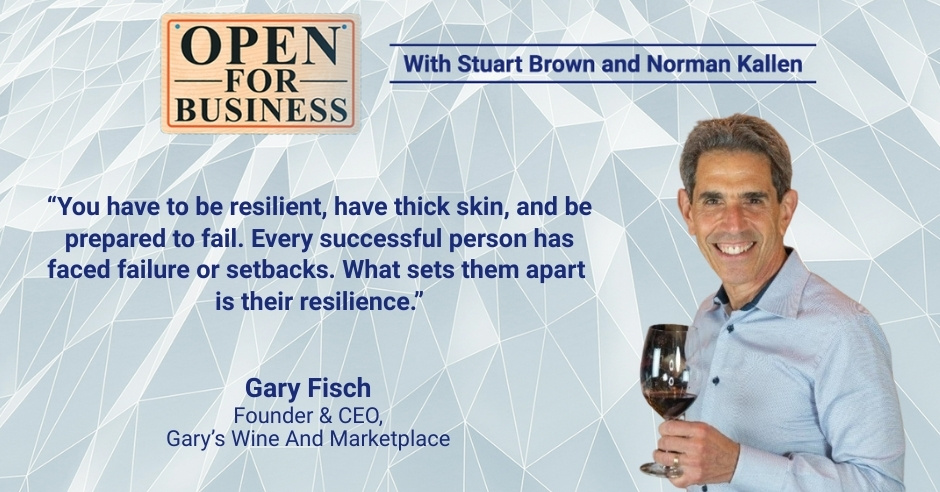
Ever wonder what it takes to turn a political science degree into a multi-million dollar wine empire? Today, we’re about to find out! The legendary Gary Fisch of Gary’s Wine & Marketplace joins hosts Norman Kallen and Stuart Brown to go behind the scenes of a retail revolution, from navigating unexpected pivots and the challenges of rapid growth, to the surprising impact of a global pandemic on a beloved wine business. If you’re an entrepreneur, a wine enthusiast, or just curious about the art of the pivot, this is an episode you won’t want to miss. Pull up a chair, and let’s pour into Gary’s incredible story.
—
Something To Wine About with Gary Fisch of Gary’s Wine & Marketplace
This episode’s focus is on SIP and strategy. We’re thrilled to welcome a true pioneer in the world of wine retail, Gary Fisch, Founder and CEO of Gary’s Wine & Marketplace. Norman, what can you tell us about Gary?
Stuart, thank you. From a small liquor store in Madison, New Jersey, to a premier multi-location wine and gourmet destination, Gary has redefined what it means to curate the retail wine experience. He’s been named Retailer of the Year multiple times, he’s appeared on national TV and even launched his own line of private label wines, which Stuart and I have and they’re excellent. In this episode, we’re going to dig into the journey behind the brand, the lessons he’s learned, and what the future holds for what I would consider to be a dynamic entrepreneur. Grab your glass and let’s get started.
Sounds good.
Gary, welcome to the show.
Stuart, Norman, it’s good to be here with you guys.
Gary, thank you so much for joining us. Let’s jump in.
Hopefully, you say that at the end of the conversation as well, Gary. I’m not sure, but we’ll take it for now.
It depends on if you send me a bill for legal services or not.
That depends on how much we talk. Hopefully, very little. Remember, we bill in minutes, by the way. I’m sure you’re familiar with that.
My son-in-law’s a lawyer.
Gary’s Pivot from Political Science to Wine Retail
There you go. Sorry to hear that. Anyway, we’ll jump right into this. Obviously, I’ve been to your locations. I love your stores, but let’s talk about Gary Fisch a little bit and how you got started, because that’s really the greatest interest of our readers here, who are hopefully business owners, people in business and will enjoy this conversation with you. Again, having heard you speak before you started, as a Political Science major in college, so did I. How did you pivot to the wine industry? How did you pivot to retail? Give us a little bit of background on Gary Fisch and how you got started in this.
I was a Political Science major because I thought that would be a great way to become president of the United States, through Political Science.
How’d that work out for you, by the way? You’re a president, just not of the United States.
I have a less stressful job, let’s say.
No new planes for you, though.
No, I don’t think there should be. The reality is we never know where life is going to take us. I went to Rider University outside of Trenton and Lawrenceville and I became president of university as a sophomore. I was president for two full years, sophomore and junior year. I loved politics. I loved the concept of politics, but that’s not a job.
Rider, then and now, but then in particular, was known for accounting. All my friends were getting accounting jobs and I was getting nothing. I didn’t even do job interviews. I was not prepared to graduate. I was just going out into the real world. I had an opportunity to become a liquor salesman. My father was a sales rep for what is now one of the largest wholesalers in New Jersey.
I figured four years of college drinking, being a Political Science major and president of the university, I could sell myself. I could sell liquor. It’s interesting. It’s not that easy to convert from a consumer to a salesperson. Back in the day, there was no training. I think they assumed, like many companies at the time, you hire people. If they have a personality, let them just go do their job. There wasn’t any formal training.
It was a very humbling experience. I called on people without real knowledge. They had no knowledge and I had zero knowledge. I’m in an industry of professional salespeople, and selling spirits was the business back then. Nobody talked about wine. The largest volume wine in our portfolio was Paul Mason. That gives you a background of what we sold.
To sell spirits against spirits salespeople as a 21-year-old kid was impossible. I was very fortunate the first summer of my job, it was a union. They closed for two weeks and I had to go on vacation. My fraternity brother was living in LA. He said, “Come to California, we’ll hang out like we did. We’ll do a bunch of stuff.” I said, “Great.” He said, “If you stop in any wineries, it becomes a tax deduction.” I said, “That’s perfect.” We met in San Francisco and drove up to Napa Valley.
He was an accountant, obviously, Gary.
Yeah. It was funny because I have a reunion coming up and I talked to a couple of my fraternity brothers. Virtually all of them are accountants, and it’s funny how it goes. Me and a couple of other guys were not. As an accountant, he said, “Visit a winery and they make wine so we could drink, so it’s perfect. You drink for free and you get a write-off.” We went and visited.
You can’t get better than that, by the way.
No, you can’t. We visited Louis Martini, which was the only Napa wine that we sold at that point. Just to give you a little historical perspective, a case of Dewars back then was about $120 and it was 5% commission. A case of Louis Martini Cabernet was about $22, $28 and 5% commission. The liquor guys were selling liquor, not mentioning wine at all.
I go into this winery early August of, I believe, 1979, 1980. I’m from New Jersey, and you may find it hard to believe, I may be a little aggressive, a little brash. I’m looking to meet the CEO of Louis Martini Winery. This farmer comes up and says, “I’m Louis.” Thank God, I didn’t say it out loud. I said, “You’re a farmer, you’re not a business guy.” I was fortunate for many reasons. One is it was harvest. He literally showed me around what happens during harvest. Norman, I know you’ve been to Napa many times. Back in those days, tractor-trailers would come up with grapes just dropped in the trailer, these eighteen-wheelers, as they call them.
Literally drive the trailer onto a scale. They would weigh it, dump the grapes, weigh it again and that’s how much they would pay, based upon the tonnage. He took me up on the trailer, and trust me, I needed help getting up there. He had me taste the grapes on top that were just sitting there. They were already down a few feet below and they tasted dramatically different because they’d already started to ferment. What he said was, “They’ll reject that truck or buy it as bulk where they would make jug wine.” It became a negotiating session for him and the grower of those grapes. After that, he took me to the vineyard because there are vineyards behind the winery.
He showed me what was going on. He took me to the cellar. We tasted through all their wines. At that point, they probably had 30 SKUs of different varietals, Riesling and dry Riesling and sweet Riesling and a grape they were playing with called Merlot. A lot of interesting things. I came back in love with Louis Martini, enthralled with the concept that it’s made by a person. It’s not a manufactured product.
We think of manufactured products. Everything we do, we look at it as manufactured. It’s a car, it’s a bottle, it’s something. A glass of wine is an agricultural product made by a person. It’s cool. I got back and I was like, “How do I learn more?” I started tasting wine, which is fun. I took Kevin Zraly’s Windows of the World class.
I took, I think, three of them every Monday night or whatever for a very long period. I started traveling to wine country, whether it was back to Napa every year, Italy, or France. I started going around and I learned a lot about wine. All by act. This was a short-term play. I was going to do this for a few years until I figured out what I wanted to do when I grew up. Either I still haven’t grown up or I still haven’t figured out what I want to do. Fast forward, I’m still doing it.
A few years into my selling, one of my accounts, a liquor store, had to sell. I was 28. He brought me into his office and he said, “Kid, I’ll have you know, the store in Madison, I need to sell it and I think it’d be good for you.” “Why would it be good for me?” He said, “It’s my wine store. All the other stores I have are old-time liquor stores. This one has wine. You’re the only one I know who knows anything about wine.”
The Purchase and Initial Growth of the Madison Store
You were 28 at the time?
Yes. He said, “Would you be interested in buying it? Keep in mind, it’s doing very little business in a very small footprint. It was 1,200 square feet. Would you be interested?” I said, “Sure.” I called my wife. I got home that night. I said, “Liz, what do you think?” She said, “Why not? We can’t quit our jobs because it’s not enough volume. We didn’t have any money.” We reached around, we talked to people and no money became available. I called my brother who said he would put up whatever amount of money we put up. I’m not an accountant, but I know if he’s putting up what I’m putting up and I have no money, we still have no money.
We went back to the person selling it and he came up with a number that we could fund. My brother and I each put up the same amount. I found the original checks and it was not very much cash. He did a payout over a longer period of time with very low interest because his deal with the government, he couldn’t take the business back. If we failed, he would lose everything. He wouldn’t get anything. By structuring a deal where he thought it would do enough business, so we couldn’t fail allowed us to pay for it. As a 28-year-old with no money, but a pretty hard work ethic. We opened the first door in August of 1987.
How did you buy inventory if you had no money?
We had 30 days’ credit and I still had a job. I would taste the wine. I would like the wine. We would buy three cases. I would spend the whole weekend selling those 3 cases and then would buy 3 more cases.
While you had your regular job, you worked there on the weekends or whenever you could.
I worked on my regular job, I would get up really early, go see my furthest accounts. I had accounts in Atlantic City and Cherry Hill. I’d get up really early, go to Atlantic City, see those accounts, Somers Point, and then shoot up. What I was doing was I would start the farthest away and then I would end up in Madison usually by 3:00 or 4:00 every day. I would work until 10:00, 11:00 every night in the store. We lived in Marlborough. I was driving like 70,000 miles a year for those three years. Secondly, I was literally out of my house for 18, 19 hours a day.
Let me ask you for a quick second. Other than your passion, because you fell in love with wine at Martini’s, what made you believe you can make it work?
The lack of thought. I don’t know.
The innocence?
I talk about it because everybody’s like, “You must have analyzed it, this and that.” I’m like, “No, it seemed like a good idea.”
What kind of analysis? You were a Poli Sci major. You didn’t do analysis.
That’s the point. The offer came to me because he liked me. He liked my energy and he knew I knew wine and he thought there was an opportunity. I only know hard work. I was never a natural at anything, so by working hard, things happen and I just put my head down and I literally worked every day as hard as humanly possible.
What influence did your father have on you, considering he was a liquor salesman?
That’s probably a harder question than you thought it would be. My father was a very tough human being and I did not enjoy spending a lot of time with him, and he was much older. When I started working with the wholesaler, he was in his late 60s, so he was already leaning towards retirement. I didn’t necessarily like spending time with him and learning but he was a very hard worker.
I think what I got from him, more than anything, was this work ethic. You think about the opportunity came, I already had a work ethic. My father had gotten a door open for me as a wholesaler because they knew him. Back in those days, like probably still is in many industries, if you know somebody, you get a shot and it was 100% commission. They were not taking a big risk on me.
You had this store in Madison. Take us from that point in time because it’s certainly healthy for our readers to know how you started to build that up. At what point in time did you know you could be successful and then say, “I have a vision.” Where’d that vision come from to take it to the next level?
You’re giving me much more credit than I deserve. I had a vision. If I could work, if I could sell more, I could buy more. If I could buy more, I could sell more. I could pay my bills and everything is good. That was my vision. A couple of things happened. One is in 1990, our daughter was born. Norman, you have kids around the same age. At that point, my wife and I both said, “This is crazy. I can’t keep at this pace and I would never see our daughter.”
I had a vision: If I could work harder and sell more, I could buy more. If I could buy more, I could sell more. I could pay my bills, and everything would be good. That was my vision.
We moved up to Morristown. I was now driving very far to my accounts as a sales rep, but the store was five minutes from my house. We decided that I quit my job. In 1990, I quit my job in July, our daughter was born in June, my wife didn’t go back to work. We went from two incomes, not including a store because we weren’t making any money, to no income. I’m sure you guys know this, even though you’re not accountants, but the advantage of no income is you don’t pay any federal income tax.
That’s such a good advantage. Congratulations.
If there was ever a reason not to make money, that’s it.
When we did that, I literally became full-time and we outgrew the space. By 1989, there was a Chinese restaurant next door to us. They had a back room, which was where their employees slept. They bought a house, so they didn’t need that space. That became our warehouse. A year later, we outgrew that, so we bought out the Chinese restaurant. We moved from 1,200 feet literally next door to, I think it was about 3,800 square feet. A year after that, the car dealership in Madison went out of business. I saw the sign went up and I’m like, “That would be picture perfect.”
The Chevy dealership.
It’s a great location. It’s big. It’s way too big, but we could work it. We started calling and they never returned our call. We had a good client, a lawyer who’s now a retired lawyer. He was coming in every other Saturday. I would talk about what wines that case did that week, he would take home an assorted case, come back the week or two later, I would tell him the new ones. He said in passing, like, “If you ever have an opportunity to grow, give me a call. I could help you.” He was in one day. I said, “There’s a store for sale. They won’t return my call.” He says, “I know the leasing company,” or whatever. Two days later, we had a lease. Instead of going to a bank to borrow, he invested in our company. He’s a retired attorney.
The small store you had that was teetering always on the edge, it seemed like, with the prior owner, how’d you grow that business to make it, again, at least mildly successful, that allowed you to grow and purchase a new property?
First, I’m going to take no credit and say that I was very fortunate that in that period of ‘90, ‘91, the wine business was starting to boom in the country and in New Jersey. We happened to be at the right place at the right time. The take credit is because I knew a lot about wine and I was tasting virtually every new wine that came in. Everybody who came into that store, I could talk to them specifically about that wine. Nobody was doing that.
Rarely do you find a store in New Jersey that does that now or around the country that the person you’re talking to really knows the product. Predominantly wine, but I could talk about the spirits at that point. I could talk about the beer, although now, there are way too many beers. I could never talk to that. You would come in on a Friday or Saturday and you would go out knowing that the person who sold you the wine appreciated the quality of the wine and gave you something that you would like. I was not transactional. I was relationship.
The Evolution to “Gary’s Wine & Marketplace” and the Focus on Personalized Experience
It was really a personalized experience for your customers.
To that, the name of the store was Shoppers Discount Liquor and Wine Warehouse. Fast forward, when we opened in the car dealership, we went from small to very big. It’s very big. I didn’t want to look like or feel like a warehouse. I said I want to be small. When I was small, I wanted to be big. I wanted to appear big. When we became bigger, I wanted to appear smaller. I didn’t want to lose that family, that personal touch.
You haven’t, by the way. Obviously, we love to go there.
I appreciate that. That’s what we brought in food. I said you go into a big liquor store in New Jersey, especially back then, it was a big liquor store. You had piles of Dewars, you had piles of Budweiser. What I wanted to do is I wanted to have beautiful rows and caps displays and fresh-cut cheese and meat. We put it the cheese department in, which meant we needed fresh bread. We found bakers to get us bread.
We went into chocolates and desserts and British foods. All of a sudden, we became that marketplace, but we were still Shoppers Discount Liquor. We hired a coach facilitator and we brought in a bunch of clients on a Saturday morning. I think a dozen customers who brought bagels and coffee and a whiteboard. I joke, I think I paid a guy $2,500 and he brings in this big whiteboard and a dozen customers sitting around a table. We were advertising in the Star Ledger every Wednesday with the shoppers’ group.
For those who don’t know what the Star Ledger was, it was the newspaper in New Jersey at the time.
By doing that, we were spending a lot of money on advertising, which nobody was doing. None of the local smaller stores. He asked everybody around the room what was the name of the store they went to and everybody called it something else. Madison Discount Liquor, World Liquor, Warehouse Liquor. He said, “If nobody knows the name of the store, what do you tell people you’re doing on Saturday?” “I’m going to go have Gary pick out wine for me.” He wrote Gary on the board and that was that. It became Gary’s. They wanted me to change my name to Pierre or Jacques because they thought Pierre’s Wine & Marketplace sounded better, but I’m not changing my name. Anyway, that’s literally how we became Gary’s Wine & Marketplace.
How would you describe the experience at Gary’s Wine & Marketplace now?
The same as it was then, except for it’s not just me. What I’ve worked very hard at doing is finding people that like people and like wine or beverages, because that’s secondary. If you can talk to a consumer, talk to a person, “Hi, how are you, how’s your day going,” you could sell wine. We could teach people how to sell wine. We’ve been very fortunate over the years to find people, whether it’s a musician that hasn’t made a living at music, or for a while, we had some actors that weren’t making a living acting.
Maybe an accountant who no longer wants to practice accounting.
We find people who have either a second career or just a shift. We teach them wine. I’m still walking the floors. I’m not climbing the ladder as much as I did ten years ago, but I’m still involved in the business and I’m coming in every day. Now, instead of it being, “Gary tasted it and Gary’s selling it,” it’s “We tasted it and we’re selling it.”
I have a wine team. We have an Italian buyer, a French buyer. I’m the domestic buyer. We have a wine director. She also does all of Spain, Portugal, and the Southern hemisphere. We pick the wines and we taste them with our teams in the stores. They’re tasting a lot. I have two people going to Bordeaux for a week. We took a group to Spain for a week. I got back from Oregon from the Willamette Valley. We’re traveling and we’re bringing back new wines and also our passion for wine. That’s something I don’t think you see at a traditional store.
I will say this much because obviously I’ve been to Napa quite a few times and I love coming to your stores, because I think people, whether it’s in the wine industry or in the liquor industry, the enjoyable part is the passion they bring to their business. I get the concept. I tell people you’re selling it too. I get it. You love the passion because they enjoy what they do. I think you build a certain leadership concept at your place and you see that with the people. You make sure you got to have people, people and you obviously interview for that skillset.
Yeah, but it’s the hardest thing we got. People is the hardest. We can’t trade our people for AI. We need consumer-facing people. That’s hard. I think that would be one of our biggest challenges.
Are you suggesting that AI is not going to infiltrate your industry?
Yes. We’re working with AI now to help us. I believe it will infiltrate. At the end of the day, at this moment in time, we need cashiers because we can’t do self-checkouts with alcohol. Even when we do, you still need cashiers. We need stock people. AI can’t put a bottle on the shelf. Traditional brick-and-mortar retail has a different perspective. Somebody has to get the product in the back door. Somebody has to get the product on the shelf. Somebody has to take it off the shelf and put it in your hand.
That’s an in-store experience. What happens if you’re shopping online?
Shopping online, which we have a huge network of followers online, there, we can enhance that experience with AI and that’s exactly what we’re working on doing.
Let’s switch gears to, you had your one store in Madison. When did it occur to you that one you wanted to get bigger and build out new stores and then what were the challenges? We have business people reading this in similar circumstances. I certainly would love to hear your experience and your thoughts.
When we opened Madison, we then got an opportunity and we bought and sold stores. Somebody said to me a long time ago, “You can fall in love with your wife and you should or your spouse and keep that person. A store is real estate, it’s a transaction. We bought and sold. Don’t fall in love with it.” We bought and sold a half a dozen stores. Shortly after we opened Madison, the bigger version, an opportunity came up in Livingston.
I remember when you were there.
We opened up in Livingston and that reached a point, partially because the mall was tough. It was supposed to be Kings and then it became, I think, Grand Union. They went out of business and then it became Pathmark and they went out of business. The volume of that store became limited and so we sold that. The landlord in Bernardsville in Madison, truth be told, I think he was going to invite Becky for dinner. He stopped in our store to pick up a bottle of wine. He’s like, “I need this in my plaza in Bernardsville.”
He started chasing us, seeking us to come to his store. He had a little liquor store in his plaza. He went out and he bought a liquor license. When their lease was up, literally two months before the lease expired, he called us and said, “Would you come?” We went there. By creating more of a touchy-feely gourmet marketplace, I think that’s what defined us and made us different. It made us physically different and also appear different to our landlord.
Having multiple locations, were you concerned about losing the personal touch with your clients/customers?
I was, but if you work seven days a week, open to close, which I did back then, when it was two stores, I literally would start one store, go to next door, then go back and forth from store to store.
Going back to your comment earlier about your employees, is it one of your core values in running your business that you convey to your people, “We need to have that small company touch?” It’s the experience for the customer. You’re the customer-facing employee. You have to make sure that happens.
Absolutely. We talk about that a lot. That’s hard. It’s hard to train for. It’s the biggest challenge. It’s also, in my mind, the way we do business. I never saw us as a ten-store chain. I need to be too touchy-feely to be that big. Although we tried. We opened a store in Napa. That had huge advantages for us. It made us a national chain. If you’re going to Napa because you like wine, come to the store, sign up for email, you get emails from our New Jersey store. It had huge potential advantages. It was also a great exit strategy. I could leave New Jersey, have my son run it. I could bounce back and forth, being in semi-retirement. The problem with that is if you have two fires, COVID and can’t get employees.
Timing in life is everything.
It became not worth the aggravation, so we closed up.
How long was that store open?
It was open for four years. Normally, I don’t remember dates that well, but we opened October 4th of ‘19. They turned off our power on October 7th of ‘19 for fear of fire. They turned our power back on the ninth. There was a fire on the 17th and we lost power for a week. Within 3 weeks of being open, we were out of business for 2 of those weeks. Our best week ever in that store was March 1st through March 7th, 2020.
How did, I should say, COVID affect your business, if at all?
In California, it just set us back so far, we can never recover. In New Jersey, it was mindboggling.
Challenges and Innovation During COVID-19
Talk to us about how you not just survived, but you thrived during COVID.
COVID was interesting for a couple of reasons. Personally, our daughter, who lives in Chicago, had a baby and came to New Jersey because she needed childcare and Liz was going to be the childcare. Our daughter moved back home with her husband and six-month-old son and dog. Our son was going to Wharton for his MBA and he moved back home to finish his MBA from the house because Wharton was closed, the campus was closed. All of a sudden, the house of two became a house of constant movement.
I was in Napa on the 14th or 13th of March. Liz said, “We’re out. We’re going back to New Jersey.” I said, “We have a cute little house. The weather’s perfect. We can weather a couple of months in Napa.” She said, “It’s going to be longer, we’re going back.” We got back and literally, within a couple of weeks, everybody showed up. On the Saturday, I want to say the 21st of March, the governor said he was going to announce what closes and what opens. I don’t know if you remember what he said.
In our stores, I have cameras. I was looking online. It was worse than Christmas or better than Christmas. Depends on your perspective. People were fighting over shopping carts. They were grabbing the last bottle. On that Friday night, as a family, we decided that we couldn’t put our employees in harm’s way. We closed our retail stores, even though we believed, and it was true, that the governor would not close alcohol stores.
We closed when much of our competition stayed open and we said we’re too big. If it was just me, I would’ve stayed open. Each store has 50 employees. I can’t put them in the way. We had a mobile app, which had a couple of thousand users. Now we have 40,000. In order to buy from Gary’s Wine, even if you wanted, we had a pickup, delivery or ship.
You would go on your mobile app, GarysWine.com, you would click if you wanted a case of X, you wanted to pick it up and we would have it ready for you. Changing from retail to online, from retail to warehouse. Completely different mindset. Literally, my son, was problem-solving the technology. I’m problem-solving purchasing and logistics. Every time a problem came up, I would go to him and we would figure out a solution.
Problem number one, we couldn’t get product out quickly enough. We’re talking to general managers every day. They’re like, “We don’t have enough people.” I’m like, “Stop. We’re not retail. It’s not 9:00 to 5:00. Have a crew come in at 6:00 in the morning, have a crew leave at 2:00 in the morning,” because it’s packing. It’s not retail.
They said, “We can’t get the product on the shelf fast enough.” I said, “Don’t put it on the shelf. Take the top 50 items, just cut the cases and put it on the floor in order of sales.” At that point, Josh was one of our top items. Have the Josh all in one spot so when you pull an order, it’s easier. We didn’t have enough boxes, so we found a company to get us packing boxes.
This is interesting because our phone system was not geared up for 50 calls an hour or 100 calls an hour. We couldn’t accommodate the calls. That’s where our complaints were coming in. “I can’t get an order in.” “I’m calling and nobody’s answering the phone.” My son reached out to the Wharton World and somebody said, “I know a woman from the Marriott Reward program who was furloughed.”
He got in touch with her and within ten minutes of the problem, we had 5 or 7 Marriott Rewards people answering our phones. He found a company that could convert our phone system from what it was to have unlimited numbers.
Instead of nobody answering the phone, we had professional service people who knew how to talk to people. He put in technology that he would just contact the store and say, “I’m on the phone with Mrs. Smith. Can you tell me where her order is?” The store would say, “Mrs. Smith is routed. She’s the fourth order.” We put in routing technology. We didn’t have enough trucks. Hertz was going out of business. I found somebody that worked for Hertz and we rented a dozen Hertz trucks for virtually no money because they were sitting there, not doing anything. What we did was we ebbed and flowed. Wherever a problem occurred, we solved it through being innovative and creative.
Advice for Young Entrepreneurs and the Future of the Wine Industry
Let’s broaden the conversation. Gary, you’ve been doing this for a long time. What advice would you give to a young entrepreneur who’s reading? Whether they want to start in the wine business or, for that matter, any other business.
First off, you have to be resilient. You have to have tough skin. You have to be prepared to fail. Every book I read about some successful person, unless they’re totally full of something, there’s a good chance they failed at something along the way or something didn’t work and they were resilient. This concept didn’t work, so they shifted. You can’t be so married to what you’re doing that if it’s not working, you still push it forward. At some point, you’ve got to know when to say when.
The phrase that people use is, “You’ve got to pivot.”
That is a great example. Successful people, they’re always pivoting. I love wine. If the wine’s not working, you move on. You see it all the time. Great companies change as needed. I guess the first thing is not being so married to your concept that it buries you. Being prepared for hardship. Taking advice, but don’t use the advice as gospel. I’ve seen some people, they don’t make their own decisions anymore. It’s like, “This person said I should do this,” so they start doing it. They keep pivoting to the point where they’re dizzy. You still have to have a plan and go forward with that.
Successful people are always pivoting. If something isn’t working, you move on. Great companies adapt as needed.
What about in the wine industry now? What changes have you seen in the past umpteen years since you’ve been there and where do you think it’s going?
Nothing is the same, which is probably easier than saying what has changed. When we started, like I said, it was jug wine, it was Bud, Coors, Miller. You’ve got to be available to change. It went from X number of SKUs to thousands. The amount of wine brands we carry now is off the charts. The amount of beer brands we carry is more than the amount of wine and beer brands we used to carry.
The industry’s changing. To say like predict the future, you can’t, first off, because it’s no longer just beer, wine and spirits. It’s THC beverages. There’s a cannabis industry growing outside of traditional alcohol retail, which we are not involved in. Our licenses don’t allow that. Right now, they’re allowing us to sell THC. That didn’t exist five years ago.
Single serve. RTDs, they’re called. That was not a category ten years ago. From our business, we are pivoting more, but also, we’re adjusting the lane. We’re looking at shelf management and do we need that much space for Chardonnay? Can we shrink that down so we can add more THC? Spirits would be down if it weren’t for spirit-based RTDs. Do we shrink the spirit section and add space? It’s a constantly moving chart.
Are you finding, to some degree, that it’s generational too? I read Wine Spectator every month and they were talking about the fact that people under the age of 40 and the age of 35 are not drinking the wines anymore. The interest isn’t there. They’re moving to the spirits to some of the other things you just mentioned. Is that what’s causing the change in the industry?
It’s one of the changes. Think back, when we started, we weren’t drinking $100 bottles of wine. I was an exception because once I got into wine, that became my beverage of choice. When you graduate college, you’re drinking beer or you’re drinking cocktails. If you’re drinking wine, you’re learning about wine, you’re introing into wine.
Now first off, wine has become more expensive, especially Napa, to that point where when we were starting, Caymus Napa Cab was $22. Now, Caymus Napa Cab is $80. It changes the perspective, but more importantly, I believe that the younger generation will start drinking more wine because it’s better with food. Food and wine pairing. It’s truly better. I believe, though, younger people are clearly not as enamored with drinking as our generation, so they drink less overall.
The younger generation will drink more wine because it pairs better with food. Food and wine pairing truly enhances the experience.
When they shift to wine, it will not be the volume. They’re not collectors. I know people who collect cars, they collect clothing, they collect watches. The younger generation, they don’t want stuff. Wine is, in this case, stuff. They’re collecting less, they’re saving less, they’re drinking less. Cannabis and THC beverages give an alternative.
Weight loss drugs. I read a study that if you’re a diabetic, so the new wave of drugs, first off, the percentage of the population taking it is enormous. Two is that I think it cuts consumption by 75%. It’s 25% of your ability to consume. If you were drinking 4 glasses of wine, now you’re drinking 1. That dramatically reduces the consumption. People that use cannabis, it’s also significantly less alcohol. If you add all these things, it’s a shrinking world.
Gary, as we get close to the end of our conversation, what do you believe success looks like for you now, both personally and professionally?
Success looks like the opportunity to spend more time with my grandchildren while continuing to grow the business. Success is being happier that my team are making the decisions than me making the decisions. Success is seeing the smile on the face of an employee who made a great sale.
Those are all terrific answers, I have to say.
I hadn’t had that question and I’m just making it up on the fly at this point. It’s funny because I’m glad you asked that because success for me used to be, when Norman would come in, making sure I sold them that extra case of wine. Now, success is very different.
You know what, everybody matures over time. Things change.
Let me follow up that up with, if you had the opportunity to share a bottle of wine or share a glass of wine with one living or dead person, who would you like to do that with? Obviously, you’re going to be drinking all the wine, but who would you like to sit at the table with over a nice meal if you could, and have a glass of wine?
You’ve added a meal.
Robert Mondavi. I was fortunate enough to have dinner with him and his passion for the industry and it was special. I don’t think that’s who I would pick.
Not that it’s not a wonderful person. That’s just you have one choice here.
I’d go with somebody like Golda Meir. She was the first female leader of a relatively new country at the time. She was born in America and she broke an enormous amount of boundaries. Forget whether it’s the bottle of wine. Dinner with that person would be amazingly fascinating. Throw in wine because wine, I call the great equalizer. Doctors and politicians love talking about wine. Everybody I talk to, lawyers, everybody would rather talk about wine than what they do for a living. That would be my answer.
If someone comes to you first time, wine buyer, has drank wine, obviously, what would your advice be to that type of person as to what wine to pick? What should they try? What should be their natural instincts when it comes to picking a wine for somebody?
I don’t believe there’s a natural instinct. I think it goes deeper. You have to ask some questions. Is the goal to have wine with meals? If it’s to collect wine, we’re doing high-end Bordeaux and Burgundy first. If it’s to drink wine with meals, then we’ve got to figure out what you like. If you like Thai food, it’s going to be dramatically different than if you eat steak and potatoes all the time. I had a couple come in who just moved to Chatham and the house has a wine cellar. They don’t know anything about wine, but they feel like they should fill the cellar. I feel a moral obligation to help them fill that.
A decent person that you are. Absolutely, yes.
He’s like, “Okay, what should I take?” I’m like, “Let’s not.” Now I became an antithesis of a good retailer. I didn’t want to sell them any wine yet because it’s not just filling the cellar, it’s deciding what you want to do with it. What I said is, “First, think about what you’d like to do with your wine. Is it food, not food, friends, price range that you like to be in now? Weeknight wine versus weekend wine? Do you have birth year? Do you have kids? Do you have anniversaries?”
Buy wines in anniversary years or birth years so that you have those special occasion wines. It’s about more of a holistic approach, like an investment portfolio, I say. You can’t have just stock. It used to be Apple, it used to be IBM. You want to have wines you could drink, younger wines that go with spicy food, and wines that go with heavier foods.
Stuart, any further questions? I think I’m out of questions. Gary, thank you.
No, Gary, thank you very much. This was fascinating at the very least and we really enjoyed it.
Thanks for having me on, guys.
Gary, we absolutely appreciate your time and thank you. This was great. I’ll see you, obviously, at your store and around town.
Alright, take care. Good seeing you.
Be well. Thank you.
—
Stuart, that’s a wrap on this episode. I want to give a huge thank you to Gary Fisch for sharing his wisdom, his stories and passion with us. Whether you’re an inspiring entrepreneur, a wine lover, or just someone who appreciates the great retail experience, Gary’s journey is full of inspiration.
I agree with you, Norman. If you enjoyed this episode, and hopefully you did, be sure to subscribe, leave us a review and share it with your fellow wine lovers and fellow business colleagues. Be sure to visit Gary’s wine stores in Madison, Bernardsville, Closter, and Wayne. Those are all in New Jersey, for those of you not in the state. Until next time. Cheers to the hustle, the heritage, and, of course, the pour. Stay curious and stay sipping.
Important Links
- Gary’s Wine & Marketplace
- Gary Fisch on Instagram
- Gary Fisch on LinkedIn
- Gary’s Wine & Marketplace on LinkedIn
About Gary Fisch

Gary Fisch is the Founder and CEO of Gary’s Wine & Marketplace, which he established in Madison, NJ in 1987. With decades of experience, he has been named “Retailer of the Year” multiple times by Beverage Dynamics and Market Watch magazines. Gary is known for his innovative approach, including early adoption of online wine sales and pairing wine with gourmet foods. He is also a dedicated community leader, serving on the boards of the NJBIA and the Community Foundation of New Jersey. His passion for wine and giving back continues to shape his work and has a lasting impact.