The Life of a Multi-Business Owner with Bobby Mascia
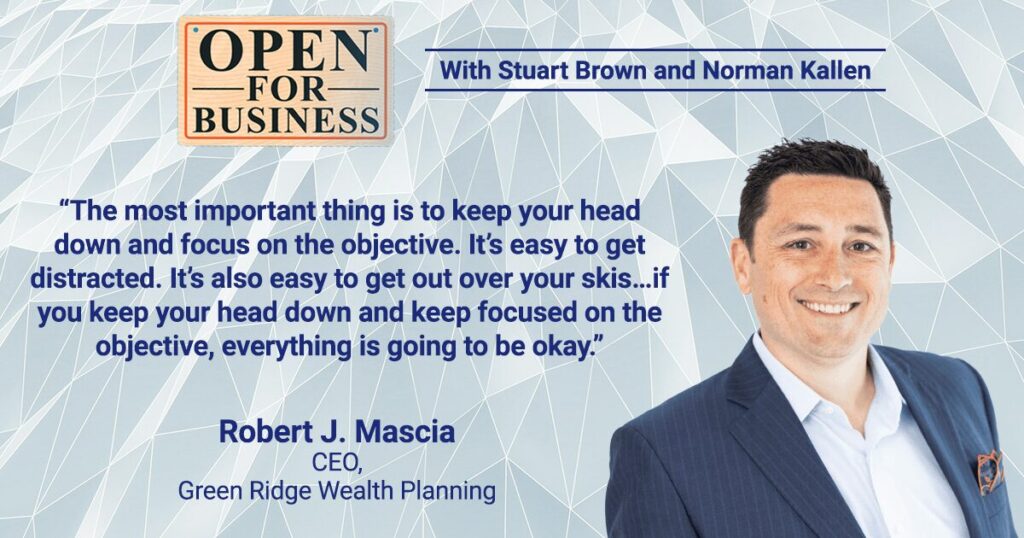
Managing a business is challenging in itself, but did you ever wonder what running several businesses at the same time looks like? Norman Kallen and Stuart Brown learn exactly that with multi-business owner Bobby Mascia. In this insightful conversation, he shares his experiences and takeaways as the CEO of Green Ridge Wealth Planning (GRWP) and Mascia Capital Group. Bobby shares his strategies for building a reliable network, sticking to your core values, nurturing a healthy culture, and managing time well. Bobby also opens up on the challenges he faced when he worked in their family business, as well as its valuable lessons that shaped his entrepreneurship success today.
The Life Of A Multi-Business Owner With Bobby Mascia
I’m here as always with my partner Norman Kallen. Norman, say hello and give us a few jovial words so that we can continue the conversation.
Before we get started on a guess, I have to bring up an interesting story.
We’ll be the judge of that but go ahead.
Fair enough. Our car lease is up, meaning my wife’s car lease is coming up, so we’ve been looking at renewing the lease or getting a new car. I got a call from somebody from the same dealership saying, “We understand your car lease is up. Would you be interested in leasing a car and coming down to have a conversation?” It sounds reasonable except for one thing.
As I said to the young lady on the phone, “By the way, the new car is at our house. My wife just called me to say, she’s there with the gentleman who’s explaining all the new features of the car. May I recommend that there’d be a little better communication in your office?” She goes, “I’m so sorry. We have to talk amongst one another a little bit more often to make sure this doesn’t happen.” I said, “Not a problem but thank you for the call.”
You should have said to her, “What rate can you give me for this lease?” If she did better than the car salesman that’s at your house, you got something negotiating power.
That would have been good. You’re right. I didn’t think about that. We’re so anxious to get the car lease straightened out before the tariffs hit.
I’m excited for this. Tell everyone who are guests is.
We have a great guest. It’s Bobby Mascia. Bobby is the Owner/Operator of several business ventures, which we’ll get into. He has his own show entitled Business Unchained. He has numerous other activities.
As you know, we were on Business Unchained and we happened to be excellent guests.
Yes, I thought we were. I don’t know whether Bobby agrees but that’s too bad.
We’re going to have to ask him that.
His opinion is not as important as ours. In addition to being a husband and a father with two teenage children, he’s going to share his take on time management. I like to know about that because I don’t know how we fits everything into a 24-hour day. Anyway, with that said, I like to welcome Bobby Mascia and let’s get started.
Bobby, it’s great to have you with us.
Thank you.
It’s our pleasure.
We talked about you in our introduction that you’re the owner of numerous businesses, numerous activities and numerous children.
You don’t own the kids, though. They are his kids but he doesn’t own them.
Until they’re eighteen, you own them, by the way, the last I checked at least in theory. Anyway, our biggest concern which we want to find out about is how do you manage your time? What do you do about it? You’re a successful entrepreneur and you have numerous activities. We talked about your show Business Unchained that we thought we did a fantastic job on it, by the way.
We were going to ask you later who your favorite guests of all time has been. You don’t have to answer that now but I need you to think about it.
Obviously, the two of you.
I was going to say there’s a box of bazooka bubble gum on the line for that.
All kidding aside, Norman’s, right, time management is critical for everybody and it seems like there’s less and less time every day. As the owner of a wealth management practice, as the person who is running a family office, a podcaster, an entrepreneur and as a father, it seems like you need at least 27-hours in each day and eight days a week.
No sleep included in that.
By the way, as a husband and family man, on top of it. The first question we have for you is, describe an average day and tell us how you get through it because a lot of people are curious to see how somebody with so many different aspects in their life makes it through an average day.
At such a young person as yourself.
I’m not going to lie. If I told you that every day was perfect, I’d be lying. I sometimes feel like I have a top hat and I’m in the center of a circus and I am the ringleader. For the most part, what I’ve learned over the two and a half decades or more than, I’ve been working in finance to some degree and owning businesses and working through the hustle. It’s not necessarily my job to do everything.
It is my job to find the right people to add to the team and make sure that there’s a system of accountability for everybody so that this way communication flows throughout the company. The trick for me has been to find the good people who are on my team that can help me execute and fire on the different initiatives that we have going on. While I have my hand and my imprint on a lot of what it is that we do and how we do it, it’s through collaboration with those people that we execute on it.
How does that impact with so much going on? All kidding aside because our kids a little bit older but we took the time. We know what it meant. We got out of the big farm that we were in to be able to allocate more time to our family and have more time to our business. How do you deal with the concept of quality of life? I never liked the expression when people say, “I want to spend quality time with my kids.” It’s just spending time with your kids. How do you manage all that?
It’s the ebbs and flows of life. My wife, when we first got married, I was a 24/7 workaholic. When we started having kids, that did not stop until my second child. I have three. My son was born and we had a hard conversation in terms of the direction of whether or not I was going to stay in the family business or get out. She had said to me, “Do whatever you have to do but you have to do what you want to do and need to do. We’ll figure it out if we have to sell the house, if we have to move into an apartment or to downsize in any way. We’ll do it until you get through the hard part but I have faith in you that we’re going to get through the hard parts.”
As I started to build this business that I founded, Green Ridge, I was still 24/7. I got to the point where my oldest son started to play baseball and I said, “I need to figure out a little bit more work-life balance.” Work-life balance is a relative term. To some people, it’s a split time. For me, it was taking the key moments when my kids needed me to be around so that this way they didn’t miss time with me as they started to grow up and forged some of those core memories. I also didn’t miss a lot of time with them and that was hard.
It was not an easy task. It was difficult. What I found was over time, I started to find these little pockets of time and I would grab them when I can. There were weeks where I work a lot of hours and then there are weeks where I can dial it back. It’s just a matter of communicating with my family and making sure that they know that, “Dad has a couple things going on and you’re going to see him a little bit less. On the flip side, I made sure that I kept a couple nights empty for you in the following week.”
That communication seems to clear things up with them because they’re not anticipating something. The worst thing for the kid is an unfulfilled promise. You say, I’m going to be there and then you don’t show up but if you say, “I’m not going to be able to make this one, but I’m going to make the next one. You can guarantee I’ll be there,” and you show up. That works.
You had mentioned this a moment ago. The fact that you look for good people and you hire good people and you’re collaborative. Is it easy for you to delegate?
It’s a muscle that needs to be exercised and developed. It was in the throes of trying to develop my career and my business. I fell into the same traps for every other entrepreneur. I needed to be all things to all people. It was only me. There was that moment where I said enough and I knew that if I wanted to continue down the current path that I was on, I could keep doing the same thing or I could do something different.
The first plight that most founders or business owners have to come to terms with is, can I forward it financially? It’s a financial out of pocket decision versus the bigger financial picture. What held me back a little at first was, how do I do this? How do I finance this? How do I spend it when I need to put the money in my own pocket for my own lifestyle, my own kids and myself?” That’s a conscious decision that I needed to make the realize that if I started to spend that money, what is the opportunity cost that I’m leaving on the table because there has to be a higher value activity that I can do more of if I am able to pass some of the lower value activities off to somebody else.
That’s where I started. I started a little. I had my assistant and she came on board. I went through a couple. I started from low level assistance of getting a few hours here and a few hours there. I got a couple of assistance that did a decent enough job then I was like, “If I’m going to go next level, I need to go next level.” I found a real assistant, Anastacia, whom you know.
For a quick second. You said you found a lot of good people to work for you who assist you. What’s your secret to finding those people because a lot of people struggle?
Honestly, my secret is my network. I believe wholeheartedly that 90% of who you are as a person is what’s going to matter in the sense of the roles that you fulfill in a business. Everything else can be taught. You can’t be taught to be a good person. You can’t be taught to have work ethic or to give a crap. You can’t be taught to grind through the personality that you have with clients or other co-workers. All of those soft skills and hard skills, everything else could be taught. That’s how I approached a lot of things.
That comes with its own issues because you’re not going to find every person who is great from all of those aspects that can also be good at the specific role in which you need them in the organization. That has been a little bit of the evolution of find the right person, get them on the bus, figure out where they’re seed is and then slowly start to identify where the gaps are and start to find the right person that might have stronger skill sets in those spaces. I can’t say that it’s all been, everybody who walked through the door. There was no way that’s been perfect.
That’s growth. That’s what growth is all about as an entrepreneur.
I drive some people crazy because of all the change that transpires. You want to go to the next phase and I bring somebody else in. Everybody knows who the person is because I make sure that they get into graded before I make the decision higher. When they come on board, it’s figuring out where they fit. For the most part, we just have fun with it. Our culture is to have fun with it. Our culture is a drama-free culture. It doesn’t mean that no drama seeps in, but we know that when the drama comes or once drama starts to fester a little bit. We got to stamp it out and we’re very honest and forthcoming with people when it comes to that.
I don’t think you can talk to anyone who doesn’t appreciate the concept of culture and hiring for culture because without it, it’s destructive.
Many people talk about their culture or they say, “We don’t have a real culture.” The reality is, you do. If you’re not the one who’s spearheading it as the leader, there’s a default culture that’s created and then even when you have a culture. You have these little subcultures that get created as more and more people start to join the firm. It’s just a matter of making sure that you’re finding the right champions that are going to hold true to the thing that you find most important that drives the culture so that this way, it becomes a situation where when something is not going in the way it should from a culture personality standpoint. Those people are there to say, “That’s not how we do things here,” and holding true to that.
Very interesting. You have a number of different business ventures, obviously and you have if not partners per se and you do have a partner, but if you don’t have a partner, you have family members who you’re accountable to or answerable to or at least have to have conversations with. How do they generally accept your multitasking in all your different businesses because you have to spend time in each of them?
I’m going to go back to the not, what is it that I have to do? It’s, who do I have to have that’s going to get that done for me? The communication and the transparency in what it is I’m doing and how I’m doing it, who I’m bringing in and what they’re going to be doing is all part of them being the inner circle. Them being part of the leadership team. The more I communicate with them, the clearer and more transparent I am with them, the less friction we have.
If there are moments of time that go by where things get in the way because as you said you, when you’re going 100 miles an hour, sometimes you just go and go. You don’t realize that the cop was sitting there until he’s behind you with flashing lights. That’s happened. Life happens. You’re right, I have to be held accountable to a lot of different people. My wife and my kids included, just being able to be present forthright.
Communication is key in other words.
I don’t think we’d be up the creek without a paddle.
Is there a discussion you can have without communication being the key issue? Whether it’s the good, the better, or the ugly. It’s always the issue as it’s on the table, which either helps an organization or hurts an organization. Always.
Most of the friction that comes is from lack of transparency or lack of communication. Its expectations that are derived from self or from not the two people that are in conflict but maybe self and somebody that’s not associated. These assumptions start to then get formed longer that it goes without it being communicated. They start to be forged into like steel and then when the conversation comes, the belief systems on both sides and the expectations on both sides, if they’re so far apart becoming difficult to come back together at that point because they’re so etched in there in what they are expected.
Let me switch gears for a second. You have your business brands, I should say. You have your personal brand and your show. You’re out there. You’re all over the place. What is Bobby Mascia trying to sell? You have your businesses and your personal stuff. What are you trying to do out there?
There are three things. Number one is, this road is a hard very road. Being a business owner is not easy. It’s not for the faint of heart and I’ve learned a lot of things along the way from reading, talking to other people, working with clients, centers of influence and people that are in businesses adjacent to mine. I’ve done a lot of the hard work. I failed a lot. I’ve had my successes. I have the scars to prove it. If I can help people who might be stuck along this journey or may have a lack of clarity in terms of how they need to approach certain things, I want to be able to give back.
I want to be able to help people get through some of the hardship that I had to get through without having to burn the candle at both ends like I’ve done. If I can do that for people, that’s number one. Number two is we have built a team at Green Ridge that specializes with the chaotic nature of business owners and how to help them manage their financial world by identifying some of the things that can go wrong or go right. By either helping them get through that or bringing in the right professional to work alongside all of us to guide as a team.
If I can bring more people into the frame, I’m helping them but I’m also bringing more good clients into the business so that we can all help one another. The other thing is I’m a professional investor. I love to find opportunities where I can grow my own personal need for being strategic in business by ownership and other places. I own a number of companies, whether it be a Dunkin’ Donuts that I own or the shares of Apple and NVIDIA. I like looking at companies with the investment side. It’s fun to identify, but in the actual physical tangible broken mortar that I can walk into and say, I own it and not I own a share of it. Making the difference and making the imprint is exciting and fun for me as well.
Let’s talk about that. I always say that entrepreneurs have something I call the e-Gene or the entrepreneurial gene. You’re either born with it or you’re not. I firmly believe that. At what point did you realize that you were an entrepreneur, that you have that e-Gene swimming around in your body somewhere?
I would say my father, my mother, and my family, let’s just say their influences weight on me. The father that I call my father is my stepfather. He and my mother got married when I was young. For all intents and purposes, he’s my dad. My mother before they got married was a hustler. She had a hot dog truck and a jewelry business. She always had something going on.
She did what she had to do knowing that she needed the flexibility because she was a single mother with a kid. She needed flexibility and income. My dad was the Dunkin’ guy. The fun thing that we did when I was a kid, my dad was always looking for a place to make a buck and he’d say, “It’s Easter. Do you want to sell flowers in front of the store?” We’d go and we would get a big box truck load of flowers. I would sit in front of the store, set up a stand, and I would sell it Easter weekend. We were there. When the Giants won the Super Bowl, when the Mets and Yankees were in the subway series, I was out there selling merchandise.
When I was home and I needed money because I say I was the poorest rich kid. We never knew we had money. My dad was always five minutes from being broke as far as we were concerned. Whenever I needed money, if I wanted to go hang out with friends, and we just want to go to the Pizzeria and play video games. I buy soda and candy or I take soda for my mom’s garage or my buddy’s garage. I pick up my buddy and I’d say, “Let’s go. We’re going to go over to the golf course.” We’d go for the golf course, and collect golf balls, then we would sell candy and soda and golf balls to the golfers at the eighth hole before the turn so that this way we caught them and we would make extra money.
I did that. I always find the golf balls in the woods and clean them off and sell them on the holes. It was great. It pushes you.
It had so much fun. I went to college and I double majored in finance and marketing. I was like, “I’m going to be an investment banker.” I was going to start my MBA and I was getting my CFA or my charter financial analyst designation. Here I am, I’m working a 9:00 to 5:00 and I’m grinding for the man. I’m super excited because I’m going to be an investment banker. Little did I know that life circumstances were going to take me into the family business but I never belonged in that organizational chart since I am the terrible employee. While I had a lot of that happened while I was a kid, I became attuned to it that’s what my future looked like until I was in my mid to late twenties.
That’s interesting. You were in grad school and you had this life experience of being an entrepreneur or coming from an entrepreneurial family at the very least. Yet you still felt as though, at least initially, you wanted to be an investment banker working for the man as you say.
I thought that was the coolest place to be. I wanted to be part of the big deals.
When did you come to have that epiphany that, “I’m a lousy employee. I need to be my own employee?”
My mother and my father within eighteen months of one another, they went in for open heart surgery. My mom because she has congenital heart disease. It was her second since she was nine years old and my father had an emergency quintuple bypass. In that period of time and a few months prior, my dad had been nudging me like, “Come work for the family business.” This was post 9/11. I was all stressed out. I was in the city. My mom didn’t want me in the city because of what happened.
They were both like, “Come on.” After my dad got sick, I’m a big family guy and I said, “I’ll come to the family business. Let’s do this.” This terms that my father and I had set at that point were very appealing for me. It didn’t come to fruition in that way. As I was working with him, that’s when my wife and I were having hard discussions.
It took about two years, but the reality of it is, I needed to do my own thing. I could not take direction from dad. That always be dad’s business. It will never be my business and I had big dreams. My dad, at that point, was in his mid-50s or late 50s. He’s like, “Whatever you want to do dial it back. We’re not doing that.” It was at that moment where I was like, I need to go do my own thing.
On the issue of family businesses, I’m curious to know because we deal with a lot of family businesses. You’ve run through this. Is it a blessing or nightmare?
I just wrote a book on this and it’s going to go live in months. I give my little teaser here. It is a blessing but it comes with a whole different mindset than a majority of family members that get into business have when they get into business most the time. Let’s just use brother and sister or brother and brother. We can use mother and father or whatever way you want to slice and dice it.
There is a history that goes back to pre-professionalism and that history tends to carry through as who you are as an adult in a business from what you did as a kid at home. The evolution of identifying like, let’s just mine for instance, which is these are things that I learned after I left my family business. “Dad, are we talking as you’re my dad and I’m your son? Are we talking as you’re the majority owner and I’m the minority owner? Are we talking as you’re the CEO and Kingpin, and I’m just the regional manager? What’s the conversation? Who’s talking? Who’s having the conversation?
What’s the context?
Most people go in and they go in with all three hats on that becomes unproductive.
It’s a fair point. How did that end? What was the ultimate resolution there that drove you to start your wealth planning business?
Being candid. My dad and I were just at opposite ends of our career and I was young. I look back and I probably didn’t have the best ender in how I did things. I’m a type A personality and I was driving the new. Here’s the only kid who went the college and was so smart he went to Lee High, a finance guy, coming off the Wall Street and trying to bring everything ahead to where we were at that time in the early 2000s.
That was not something that they meeting my dad and his brothers and sisters were ready to accept. I was of the mindset of we have to keep moving. I wasn’t quite abundance and they were scarcity, but they were scarcity and I was not scarcity. Everything for them was like, “We’ve got to cut back here. No, less is more.” What ended up happening was less being more meant we all worked a lot harder and a lot dumber doing stupid menial things around the clock because that was the culture that he had built.
Did he take the approach, if it it’s not broke, don’t fix it?
He took the approach that if it’s broke, try duct tape and bubble gum. Don’t fix it or spend any money until it’s completely out of commission and we have no other choice.
Bobby, isn’t a little bit? You find out with different generations. People talk about depression and mentality. It’s very common. It could be that he struggled getting his businesses going. The value of a penny for him or a dollar was enormous, and he never forgot that. Again, we see that in a lot of times in second and third generation families. Sometimes, they understand the value of a dollar and sometimes they don’t. That’s destructive for a family business as well.
It took me having to get out of the family business to appreciate that because when I was in the family business, it was lost time down revenue. We’re not able to function. We’ve got to come in in the middle of the night to fix it because it’s broken and it’s not going to be ready for the morning. Why are we spending this time, energy and effort? Let’s just fix it the right way, so that this way we don’t have a problem for another 5 years or 10 years. That, to me, drove me crazy in the moment. I didn’t look at it as that’s the psychology of it. I was like, “That’s my dad.”
We always conflated all of our roles. It was super frustrated, and it took us two years. I tried to work through the last years to get on the same page and tried to work to get the same page as me. I just decided that I had to go on my own because that’s when I decided that I was just going to be a terrible soldier. I had to do my own thing. Everything is perspective.
You live through the family business. Tell our readers, if you had to give them a couple of pieces of fair advice or good advice. What guardrails would you want to implement if you were going into business with your family, regardless of the business?
I would say treat it more like a business and less like a family. That’s the biggest thing. Treating it more like a business, you’re going to talk. If there’s ownership potential or some succession in the future, let’s talk about what the path is to get there. If there’s certain metrics that need to be hit to move up the ladder. What are those metrics? If there’s a certain pay scale for the position in which you’re hiring for, understand what the pay scale is and what it is to move up the chain.
Let’s stop there from all moment because I was just going to ask you that. In your opinion, how often does compensation derail these family businesses?
I thought I was a unicorn. I didn’t think I was as common as it was going on. I’m a good ventured servant. I had a peasant salary with a stick and a carrot that got dangled out as far as the eye could see. My dad was just like, “I paid for college. You are where you are because of me. Your family, you come in, and you do what you need to do at some point. You’re going to have a lot but that point is not until I dictate and I can dictate whatever the terms are depending on the weather, the wind direction and how I’m feeling.” That uncertainty is what becomes destructive and that’s what I’ve seen in a lot of the clients that come into our doors. We’re dealing with some financial and family planning around businesses that indentured servant.
Let me ask you, Bobby. To Stuart’s point. A lot of businesses, family business particularly, is a discussion 24/7 and that’s destructive. There’s got to be a separation when you get home. What are your thoughts on that? If you don’t separate the two, to your point earlier, it’s horrible for the family. If you’re always on edge, any discussion, any point in time when your home or you’re watching television, when you’re out for a family dinner, business is going to come up. It’s not a healthy environment.
I’m going to take the veto quarterly on rule book. We don’t talk business at the table and what I found is, in my life in the family business, as the son who was under his dad. Every opportunity that we all had as a family was an odd dynamic of sharing information in certain circles. When people broke off, it was all about the business and it was less about family. It was weird. We had a lot of separation. Remember the three hats. I’ve gone through a lot of different iterations of family businesses through clients. I’ve gone through a lot of training.
I have a lot of insight that we didn’t have at that time. Through that insight, three hat categories of ownership, where you are in the family and what your role is in the business needs to be separated through conversation. When the unfortunate passing of my dad happened and I had to take over the family business a couple of years ago.
At the time, I made sure that I bought out all of our other family and outside partners. One of the conversations that I had with my sisters and my brother-in-law and my mother was, “If we’re going to do it, we’re doing it my way. That was the deal I made with dad, but now the dad is no longer here, we’re still doing it my way. One of the things that I’m going to hold true is if we’re together, we are together as family if it’s not at the office or if it’s not a set schedule meeting.”
“I don’t want to talk about business on vacation. I don’t want to talk about business at Easter or Thanksgiving or Christmas. If it’s so important that we need to talk about it then we set some time afterward. This is sacred family time.” It’s amazing how the relief. I could see the relief come off their face when I had this conversation with him because they felt and I knew they did. I felt the same way that I did. It was just too much.
It’s the elephant in the room.
That gets back to time management. In effect, what you were doing is managing your time by compartmentalizing.
I’m so much closer with my family now that we don’t have those types of conversations, especially the family members that aren’t part of the business. The ones that aren’t part of the business or weren’t part of the business when I was in the family business, weren’t part of the conversation. They didn’t know what was going on with the business. We didn’t do a lot of conversing over those opportunities. When families are supposed to get tighter, we did not. Now, those conversations don’t happen. I’m able to spend more time with other family members because I’m not missing anything that’s relevant to the operations of the company.
Let me just switch gears from it. First of all, I just want to remind everybody, our guest is Bobby Mascia who is a multiple business owner. It’s a fascinating conversation about family businesses and his own business relationships. They got better over time which they needed to do. Otherwise, they weren’t going to survive.
Real quickly, in one of your Instagram you talked about you don’t love the idea of the concept what motivates people when they say, “I want to prove them wrong.” You indicated that’s not something that you think is a positive way to motivate somebody. Why? I know a lot of people who use it as an enormous motivating factor, whether it’s in business, in getting ahead, in sports, or in whatever it might be. Why don’t you like it?
I spent my whole life wanting to prove everybody wrong. It’s exhausting. That’s a driver. You’re right, 100%, “I’m going to prove them wrong,” but everybody who’s gained success by proving other people wrong, I believe and I don’t want to generalize everybody. Most of the people that I talk to who have that same affliction, have said, “I feel better now that I have purpose in what it is that I’m doing and why I’m doing it.” That isn’t proving somebody wrong. That is because it’s a passion of mine because I’m good at what I do because I enjoy doing it.
I don’t poo-poo it because I do think that you have a spark that’s going to ignite you and that drives you. Don’t lose the fact that your entire life can’t be about proving other people wrong. At some point, you’ve got to not care what other people think and you’ve got to be comfortable in your own skin. There’s a maturity that comes with that. You can’t expect people who haven’t quite hit that level of maturity and I’m not being insulting because it took me until my 30s or maybe my early 40s that I still wanted to prove people wrong. Even after my dad died, I took over the business. There are still elements that pop in. It’s a lot of hard energy to deal with.
At a certain point in time, somebody’s going to try to prove you wrong if all you do is try to prove somebody else wrong. Bob, you have a family and you have several business interests. Would you consider bringing your family, your children I mean, into your businesses or any of your businesses?
I look at what I do. I love what I do. My kids have shown interest in doing what it is that I do. I have a hard time with this multi-generational thing. “From riches to rice paddies,” is what they say in Japan. Here, it’s like my father walked to work. I drove a Camry or my son’s going to drive a Cadillac. My grandson’s going to drive a Ferrari and his son is going to be walking to work again.
Those adages that bring you back to a loss of work ethic when things are handed to you over each generation. I was fortunate that although my father had built a successful business, it ended up under my control. I had to forge my own way before that happened. I had the true plight of somebody. I didn’t have any money. My dad didn’t pay me any money.
You were good for nothing. The ultimate good for nothing.
I learned a lot. I truly believe that you learn more through failures and through struggle than you do from having it easy and success and that’s a pretty common belief system. I want my kids to feel something like that. I’m almost more inclined to build my businesses in the same way that I have my clients think about their businesses, what’s the exit strategy and then helping my kids to build their own thing whatever passion they have.
Being there as an advisor to guide them and letting them understand a little bit of the challenges, having the benefit of me at their side. I would like to see them build their own passion. Not all three of them are going to be entrepreneurs, I’m sure. I get nervous about the handoff, “Here you go. Come in. Here’s your entitlement. Where are we going to get from here?”
Part of it, we see this all the time in family business. It’s a matter of how you treat them and what you build for them as what your expectations are from them. If there’s a sense of entitlement, that’s destructive. I agree with you 1,000%. You need to earn it. You got to start on the bottom and work your way up if you’re going to come in because what do you do? What if you want to bring your children? What did they want to come in? What they said, “Dad, we love what you build.” Whether it’s the family business or your financial business. What if they want to come in? What do you do?
If this is what they want to do, I would entertain that and it would be a sense of bringing them in and making them earn their way, but I would give them the path. Let’s just say if they want to do it, I’d figure out a way for them to do it but if they didn’t want to do it and they thought this is what they needed to do. That’s what I want to avoid also. I don’t want them to feel like this is the easy path so let me just take it because then you come into that same situation that I was talking about before.
You’re not looking at your kids as a succession plan for you now?
My oldest is fifteen.
You got time.
They need to get beat up a little bit.
I was just going to say they need to get their butt kicked by somebody else.
I say this and my wife gets so mad at me but each one of my kids with the exception of my daughter. My two boys need to get punched in the face every once in a while. They need to feel like, “It hurts less than I thought it was going to hurt. I can still get up and move on, but I should probably not do the things that I did that had me punched in the face in the first place.”
We often ask our guests and this is a tough question, so get ready. Are you ready?
I guess.
I know it’s coming, so I can laugh.
Our readers do, too. There are two questions. The first question will determine whether or not we give you the second question. The first question is, Star Wars or Star Trek.
Star Wars.
There is a correct answer. Why?
I would say two things. Star Trek was more frequent and my dad watched it. It was like always on. Star Wars was a movie that I got to watch and get through. I didn’t have to think about it coming on TV 27 times in the future. I just gravitated to it more and that’s where it started.
Fair enough. Question two, scotch or bourbon. Why?
If it’s a less peaty scotch, I’ll enjoy it more so than a bourbon probably. Going to head, I got to go bourbon.
Tell us, Bobby, if you had to, what is your true passion in business?
For me, when I have a client that comes to the door and they have a good feeling of what they want to do and how they want to do it but they’re not too sure. That is strategizing, I love it. When I make it a little bit of the silver lining of it because losing my dad was not a good thing. The process that I went through rebuilding, re-energizing and reorganizing the business that I grew up around and watching it flourish from what it was, which my dad was an absentee owner for two years while he was sick. Coming in and fixing that and seeing how we progressed over that year or two, I have a deep amount of pride and a lot of pride because I know my dad would be super proud of me. I like that strategy to muddled through some of the hard parts.
The last question. This is one of my favorite things. What’s your favorite donut?
This is so lame, but I love sugar raised.
I know Norman said that was the last question, but I do have one more question for you. If you could provide some general advice for our younger readers. What would you say to them if they come to you and say, “Bobby, I want to start my own business doing X, Y, and Z. What should I do?”
Read my book. It’s an exciting time for somebody who has the passion to start their own business and there’s a couple preparation steps from your mindset that you need to go and be ready for. Number one is whatever you think it is, it’s ten times harder. Whenever you feel like you’re coming to a point where you want to give up and quit. Success is just around the corner. Don’t do it.
Whenever you feel like you just don’t have another ounce in the gas tank to go any further, take the time, disconnect, take a day, and recharge your battery because it will be there in the morning. You don’t have to grind through 24/7 every day. You do have to take a little time for yourself to make sure that you’re showing up in the best possible way that you can because if you’re constantly working around the clock and running yourself down to the empty line. You’re never going to bring the best version of you because you’re never going to get back to that best version of you.
That’s a great advice.
Thank you.
What’s the name of your book, Bob? How do people get a hold of you?
I don’t even know the name. We haven’t figured it out yet.
For our readers, as soon as we have the name and a way to get you that information, we’re going to get it to you because Bobby gave you great advice, honestly. We appreciate it. Thanks for coming on.
Important Links
- Bobby Mascia
- Bobby Mascia’s LinkTree
- Bobby Mascia on LinkedIn
- Bobby Mascia on Instagram
- Bobby Mascia on YouTube
- Business Unchained
- Green Ridge Wealth Planning
- Green Ridge Wealth Planning on LinkedIn
- Green Ridge Wealth Planning on Instagram
- Green Ridge Wealth Planning on YouTube
- Mascia Capital Group
- Mascia Capital Group on LinkedIn
About Robert J. Mascia

Robert J. Mascia, known as “Bobby” to loved ones and clients alike, is a seasoned entrepreneur with a background working both on Wall Street and as an owner of several successful businesses. As CEO of Green Ridge Wealth Planning (GRWP), Bobby ensures the firm offers individuals, families, and businesses tailored financial planning and investment management services. Unlike most financial planners, GRWP is not tied to any one financial institution, but is an independent firm of licensed fiduciaries who have only their client’s best interest in mind. In 2024 NJBiz named Bobby and his partner, Jordan Kaufman, as Leaders in Finance. In addition to his passion, a wealth management firm that specializes in helping entrepreneurs, Bobby is the owner of an 18-store Dunkin’ franchise, manufacturing business, family office, and de facto business coach. As CEO of Mascia Capital Group, he oversees the Dunkin’ franchises and a bustling manufacturing kitchen generating nearly $30 million in revenue, all located in New Jersey. Finally, Bobby has positioned himself as an entrepreneur eager to share his breadth of knowledge and experiences surrounding his successes as a guest speaker, podcast host, and author.
Recognitions:
• NJBIZ Leader in Finance 2024
• Inc. Magazine Best Workplaces 2024
• Forbes Finance Council 2022-2023